 뒤로
Chemical Reactions, Quantities, and Solutions: Study Notes for General Chemistry
스터디 가이드 - 스마트 노트
 자료에 맞춘 맞춤형 노트, 핵심 정의, 예시, 맥락을 확장해 제공합니다.
Chemical Reactions and Chemical Quantities
The Greenhouse Effect and Combustion Reactions
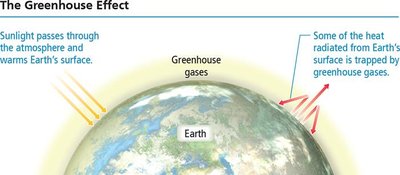
The greenhouse effect is a phenomenon where certain gases in Earth's atmosphere trap heat, affecting global temperature. Combustion reactions, especially of fossil fuels, are a major source of atmospheric CO2, contributing to climate change.
Greenhouse gases allow sunlight to enter the atmosphere and warm Earth's surface, but also prevent some heat from escaping.
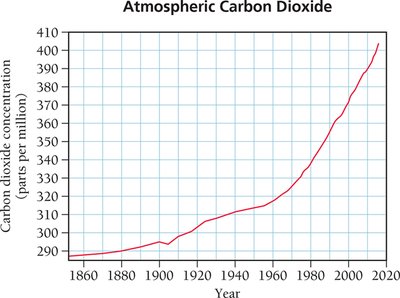
Combustion reactions of fossil fuels release CO2 into the atmosphere.
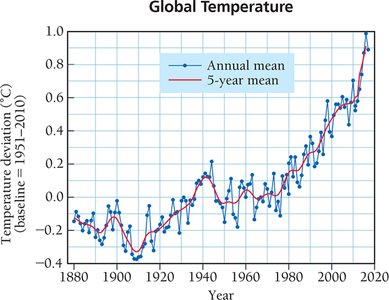
Atmospheric CO2 levels and global temperatures have risen significantly since 1860.
Writing and Balancing Chemical Equations
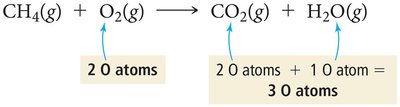
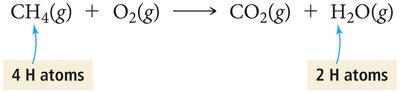
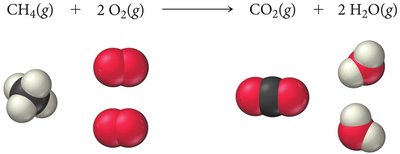
Chemical equations represent chemical reactions, showing reactants and products, their states, and the relative numbers of molecules involved. Balancing equations ensures the Law of Conservation of Mass is obeyed.
Reactants: Substances consumed in the reaction.
Products: Substances formed in the reaction.
States: (g) gas, (l) liquid, (s) solid, (aq) aqueous.
Balance equations by adjusting coefficients, not subscripts.
Stoichiometry: Mole-to-Mole and Mass-to-Mass Conversions
Stoichiometry is the study of quantitative relationships between reactants and products in a chemical reaction. Balanced equations provide the mole ratios needed for these calculations.
Mole-to-mole conversions use the coefficients in the balanced equation as conversion factors.
Mass-to-mass conversions require converting mass to moles using molar mass, applying stoichiometric ratios, then converting back to mass.

Limiting Reactant, Theoretical Yield, and Percent Yield
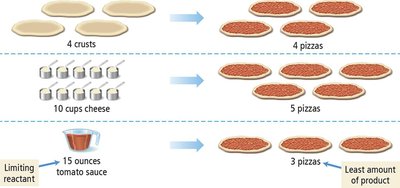
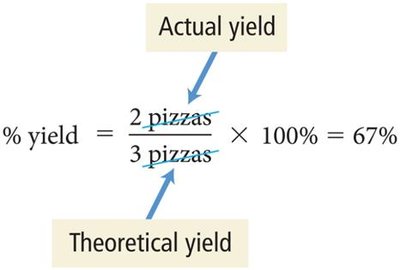
In reactions with multiple reactants, the limiting reactant is the one that is completely consumed first, thus limiting the amount of product formed. Theoretical yield is the maximum possible product, while actual yield is what is actually obtained. Percent yield measures efficiency.
Limiting reactant: Reactant that determines the maximum amount of product.
Theoretical yield: Calculated maximum product based on limiting reactant.
Actual yield: Amount of product actually obtained.
Percent yield:

Calculating Limiting Reactant and Yield from Masses
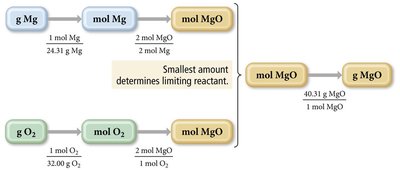
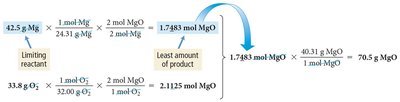
To determine the limiting reactant and theoretical yield from given masses, convert each reactant's mass to moles, use stoichiometric ratios, and identify which reactant produces the least product.
Convert mass to moles using molar mass.
Apply stoichiometric ratios from the balanced equation.
The reactant producing the least product is the limiting reactant.
Introduction to Solutions and Aqueous Reactions
Solutions and Solution Concentration
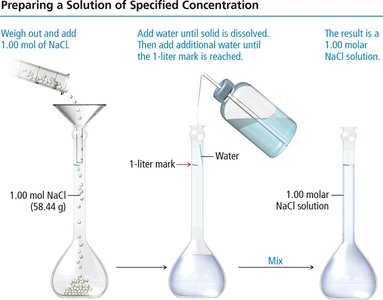
A solution is a homogeneous mixture of two or more substances. The solute is the component that changes state, while the solvent remains in its original state. Solution concentration is often expressed as molarity (M).
Molarity (M):
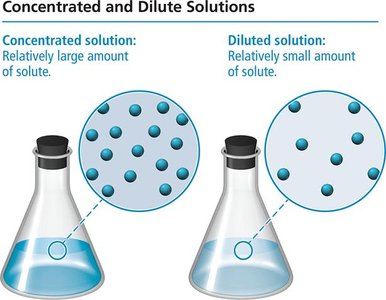
Concentrated solution: Large amount of solute relative to solvent.
Dilute solution: Small amount of solute relative to solvent.
Solution Dilution
To prepare a solution of lower concentration from a stock solution, add more solvent. The amount of solute remains constant, but the volume increases.
Dilution equation:
Used to calculate volumes and concentrations before and after dilution.
Solution Stoichiometry
In aqueous reactions, the volume and concentration of a reactant or product can be used to calculate its amount in moles, which is then used in stoichiometric calculations.
Convert volume to moles using molarity.
Use stoichiometric ratios to find moles of another reactant or product.
Convert moles back to volume or mass as needed.

Types of Aqueous Solutions and Solubility
Solubility describes how well a solute dissolves in a solvent. Ionic compounds may dissolve to form ions, while molecular compounds may dissolve as intact molecules.
Soluble: Compound dissolves in water.
Insoluble: Compound does not dissolve in water.
Solubility rules help predict whether a compound will dissolve.
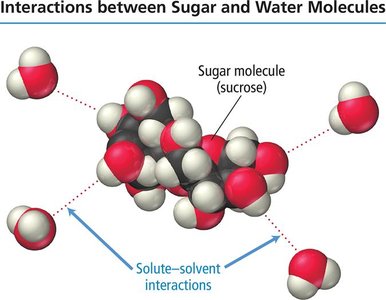
Solute-Solvent Interactions
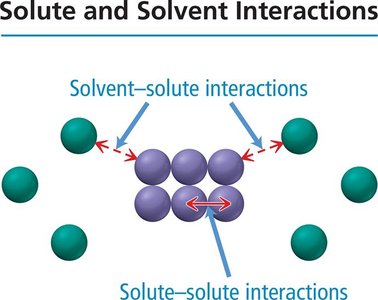
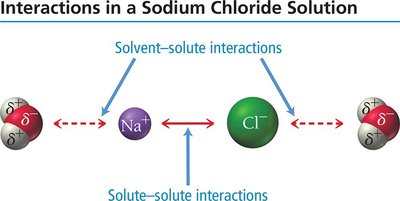
Solute and solvent particles interact through attractive forces. If these attractions are strong enough, the solute dissolves.
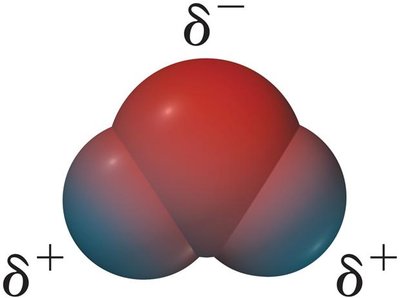
Water is a polar molecule, with partial charges on oxygen and hydrogen.
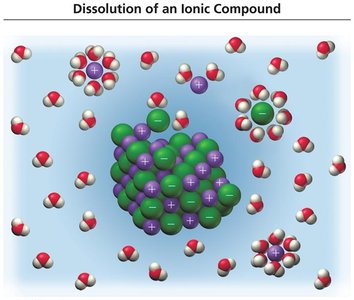
Ionic compounds dissolve when ions are attracted to water molecules.
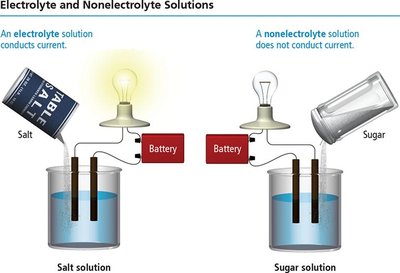
Electrolyte and Nonelectrolyte Solutions
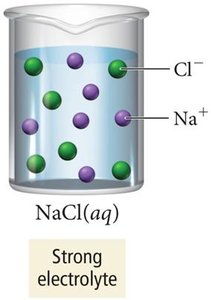
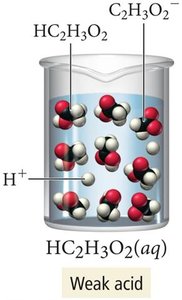
Electrolytes are substances that dissolve in water to form ions and conduct electricity. Nonelectrolytes dissolve without forming ions and do not conduct electricity.
Strong electrolytes: Completely dissociate into ions (e.g., NaCl).
Weak electrolytes: Partially dissociate (e.g., weak acids).
Nonelectrolytes: Do not dissociate (e.g., sugar).
Precipitation Reactions
Precipitation reactions occur when two solutions are mixed and an insoluble product (precipitate) forms. Solubility rules are used to predict the outcome.
Mixing solutions of ionic compounds may produce a solid precipitate.
Solubility rules determine which compounds are insoluble.
Representing Aqueous Reactions: Molecular, Ionic, and Net Ionic Equations
Chemical reactions in solution can be represented in three ways: molecular equations, complete ionic equations, and net ionic equations.
Molecular equation: Shows complete formulas for all compounds.
Complete ionic equation: Shows all strong electrolytes as ions.
Net ionic equation: Shows only the species that change during the reaction.
Acid-Base and Gas-Evolution Reactions
Acid-base reactions involve the neutralization of an acid by a base, producing water and a salt. Gas-evolution reactions produce a gas as a product.
Acid: Produces H+ in solution.
Base: Produces OH− in solution.
Neutralization reaction:
Gas-evolution reaction: Produces a gas, such as CO2 or H2S.
Oxidation–Reduction (Redox) Reactions
Redox reactions involve the transfer of electrons between reactants. Oxidation is the loss of electrons, and reduction is the gain of electrons. These reactions are fundamental to processes such as combustion and rusting.
Oxidation: Increase in oxidation state (loss of electrons).
Reduction: Decrease in oxidation state (gain of electrons).
Oxidizing agent: Causes oxidation, is itself reduced.
Reducing agent: Causes reduction, is itself oxidized.
Type of Reaction | Example |
|---|---|
Combustion | |
Metal with Nonmetal |
Rules for Assigning Oxidation States
Oxidation states are assigned based on a set of rules, which help identify redox reactions and track electron transfer.
Free elements: Oxidation state = 0.
Monatomic ions: Oxidation state equals the ion's charge.
Sum of oxidation states in a compound = 0; in a polyatomic ion = ion's charge.
Group I metals: +1; Group II metals: +2.
Nonmetals: Fluorine −1, Hydrogen +1, Oxygen −2, Group 7A −1, Group 6A −2, Group 5A −3.
Activity Series and Spontaneity of Redox Reactions
The activity series ranks metals by their tendency to lose electrons (undergo oxidation). Metals higher in the series are more easily oxidized and more reactive.
Used to predict whether a redox reaction will occur spontaneously.
Additional info:
Some examples and analogies (such as pizza ingredients) are used to illustrate limiting reactant and yield concepts. All equations are provided in LaTeX format for clarity and academic rigor.
