 뒤로
Chemical Reactions, Stoichiometry, Redox, Thermochemistry, Kinetics, and Equilibrium: General Chemistry Study Notes
스터디 가이드 - 스마트 노트
 자료에 맞춘 맞춤형 노트, 핵심 정의, 예시, 맥락을 확장해 제공합니다.
Chemical Reactions and Stoichiometry
Law of Conservation of Matter and Balancing Chemical Equations
Chemical reactions involve the transformation of reactants into products, but the total number of atoms of each element is conserved. This is known as the law of conservation of matter. Chemical equations must be balanced by adjusting coefficients, not by changing subscripts, to reflect this conservation.
Reactants: Substances that undergo chemical change.
Products: Substances formed as a result of the reaction.
Coefficients in a balanced equation indicate the relative number of moles of each substance.
Example:
Important: Never balance equations by changing the chemical formulas (subscripts) of the compounds.
The Mole and Avogadro's Number
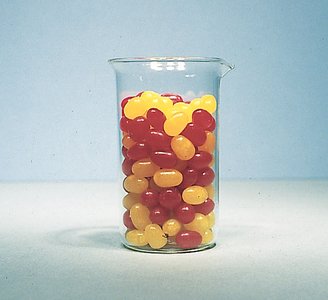
The mole (mol) is a counting unit in chemistry, representing particles (Avogadro's number). It allows chemists to relate the mass of substances to the number of particles involved in reactions.
1 mole of any element or compound contains atoms, molecules, or formula units.
The mass of 1 mole of a substance (in grams) is its molar mass.
Example: 1 mol of NaCl = 58.4 g; 1 mol of Cu = 63.55 g.
Stoichiometry and Reaction Ratios
Stoichiometry uses the coefficients of a balanced chemical equation to determine the relative amounts of reactants and products. These coefficients can be used to set up conversion factors (ratios) between substances.
Example: In , the ratio is 2 mol H2 : 1 mol O2 : 2 mol H2O.
Mass can be related to moles using molar mass:
Conservation of mass: The total mass of reactants equals the total mass of products in a chemical reaction.
Redox Reactions
Oxidation and Reduction
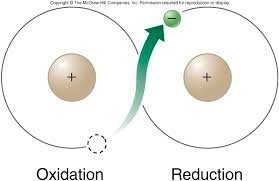
Redox reactions involve the transfer of electrons between substances. Oxidation is the loss of electrons, while reduction is the gain of electrons. These processes always occur together.
LEO says GER: Lose Electrons = Oxidation; Gain Electrons = Reduction
OIL RIG: Oxidation Is Loss, Reduction Is Gain (of electrons)
Oxidizing agent (oxidant): causes oxidation, is itself reduced.
Reducing agent (reductant): causes reduction, is itself oxidized.
Oxidation Numbers
Oxidation numbers are assigned to atoms to keep track of electron transfer in redox reactions. They help identify which atoms are oxidized or reduced.
Uncombined elements: 0
Monatomic ions: equal to their charge
Group IA: +1; Group IIA: +2
H: +1 (except in metal hydrides); O: -2 (except in peroxides)
The sum of oxidation numbers in a compound equals the overall charge.
Example: In CO2, C = +4, O = -2; in CH4, C = -4, H = +1.
Thermochemistry: Enthalpy of Reactions
Enthalpy (ΔH) and Reaction Types
Enthalpy (ΔH) is the heat energy change at constant pressure during a chemical reaction. It is calculated as the difference between the enthalpy of products and reactants:
Exothermic reactions: Release heat (ΔH < 0); energy is a product.
Endothermic reactions: Absorb heat (ΔH > 0); energy is a reactant.
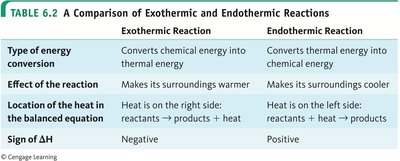
Exothermic Reaction | Endothermic Reaction | |
|---|---|---|
Type of energy conversion | Converts chemical energy into thermal energy | Converts thermal energy into chemical energy |
Effect of the reaction | Makes surroundings warmer | Makes surroundings cooler |
Location of heat in equation | Heat is on the right: reactants → products + heat | Heat is on the left: reactants + heat → products |
Sign of ΔH | Negative | Positive |
Energy in Food
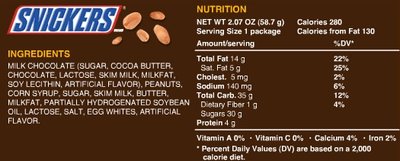
Combustion of food molecules releases energy, measured in kilocalories (kcal). Carbohydrates and proteins provide about 4 kcal/g, while fats provide about 9 kcal/g.
Thermodynamics: Spontaneity, Entropy, and Free Energy
Spontaneous Processes and Free Energy (ΔG)
A spontaneous process proceeds without external input once started. The Gibbs free energy change (ΔG) determines spontaneity:
ΔG < 0: Spontaneous (exergonic)
ΔG > 0: Non-spontaneous (endergonic)
ΔH: Enthalpy change; ΔS: Entropy change; T: Temperature (K)
Entropy (ΔS)
Entropy (ΔS) is a measure of disorder or randomness in a system. Processes that increase disorder (e.g., solid → liquid → gas, breaking molecules into smaller pieces) increase entropy.
Positive ΔS: Increased disorder
Negative ΔS: Decreased disorder
Coupled Reactions in Biochemistry
Endergonic (energy-requiring) reactions can be driven by coupling them to exergonic (energy-releasing) reactions, such as ATP hydrolysis in cells.
Chemical Kinetics: Reaction Rates
Activation Energy and Reaction Rate
Activation energy (Ea) is the minimum energy required for a reaction to occur. The reaction rate is how quickly reactants are converted to products, measured as the change in concentration over time.
Higher activation energy = slower reaction
Lower activation energy = faster reaction
Factors Affecting Reaction Rate
Temperature: Higher temperature increases rate (more energetic collisions).
Concentration: Higher concentration increases rate (more frequent collisions).
Catalyst: Lowers activation energy, increasing rate without being consumed.
Inhibitor: Slows down the reaction rate.
Chemical Equilibrium
Dynamic Equilibrium and the Equilibrium Constant (Keq)
Chemical equilibrium occurs when the rates of the forward and reverse reactions are equal. The concentrations of reactants and products remain constant, but not necessarily equal.
Equilibrium constant (Keq): (for a given temperature and pressure)
Keq > 1: Products favored (reaction "lies to the right")
Keq < 1: Reactants favored (reaction "lies to the left")
Le Châtelier’s Principle
When a system at equilibrium is disturbed (by changing concentration, temperature, or pressure), it will shift to counteract the disturbance and re-establish equilibrium.
Adding reactant or removing product: shifts right (toward products)
Adding product or removing reactant: shifts left (toward reactants)
Increasing temperature: shifts away from the side with heat (depends on exo- or endothermic reaction)
Adding a catalyst: speeds up reaching equilibrium but does not change Keq
Summary Table: Key Definitions
Term | Definition |
|---|---|
Reactant | Substance consumed in a chemical reaction |
Product | Substance formed in a chemical reaction |
Oxidizing agent | Reactant that is reduced and causes oxidation |
Reducing agent | Reactant that is oxidized and causes reduction |
Enthalpy (ΔH) | Heat energy change at constant pressure |
Entropy (ΔS) | Measure of disorder in a system |
Free energy (ΔG) | Energy available to do work; determines spontaneity |
Activation energy (Ea) | Minimum energy required for a reaction to occur |
Catalyst | Substance that increases reaction rate without being consumed |
Equilibrium constant (Keq) | Ratio of product to reactant concentrations at equilibrium |
