 뒤로
Chemistry and Measurements: Units, Significant Figures, and Problem Solving
스터디 가이드 - 스마트 노트
 자료에 맞춘 맞춤형 노트, 핵심 정의, 예시, 맥락을 확장해 제공합니다.
Chemistry and Measurements
Introduction to Chemistry and Measurements
Chemistry relies on precise measurements and standardized units to ensure clear communication and reproducibility of results. The metric system and the International System of Units (SI) are the foundations for scientific measurement worldwide. Understanding these systems, significant figures, and conversion techniques is essential for success in general chemistry.
Units of Measurement: Metric and SI Systems
Overview of Metric and SI Units
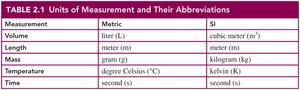
The metric system and SI units provide a universal language for scientific measurement. The main quantities measured in chemistry include volume, length, mass, temperature, and time. Each has a base unit in both the metric and SI systems.
Measurement | Metric | SI |
|---|---|---|
Volume | liter (L) | cubic meter (m3) |
Length | meter (m) | meter (m) |
Mass | gram (g) | kilogram (kg) |
Temperature | degree Celsius (°C) | kelvin (K) |
Time | second (s) | second (s) |
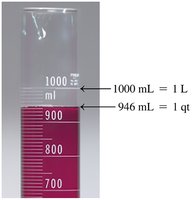
Volume: Liter (L), Milliliter (mL)
Volume is the space occupied by a substance. The SI unit is the cubic meter (m3), but the liter (L) is commonly used in chemistry. Common conversions include:
1 L = 1000 mL
1 L = 1.06 qt
946 mL = 1 qt
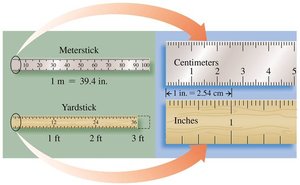
Length: Meter (m), Centimeter (cm)
Length is measured in meters (m) in both the metric and SI systems. Common conversions include:
1 m = 100 cm
1 m = 1.09 yd
1 m = 39.4 in.
2.54 cm = 1 in.
1 m = 3.28 ft
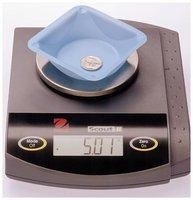
Mass: Gram (g), Kilogram (kg)
Mass measures the quantity of material in an object. The SI unit is the kilogram (kg), while the gram (g) is used for smaller masses. Common conversions include:
1 kg = 1000 g
1 kg = 2.20 lb
454 g = 1 lb
Temperature: Celsius (°C), Kelvin (K)
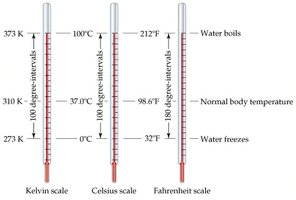
Temperature indicates how hot or cold something is. The Celsius scale is used in the metric system, and the Kelvin scale is used in SI. Key reference points:
Water freezes: 0°C (273 K)
Water boils: 100°C (373 K)
Normal body temperature: 37°C (310 K)
Significant Figures in Measurements
Definition and Importance
Significant figures (SFs) represent the digits in a measured number that are known with certainty plus one estimated digit. They reflect the precision of a measurement and are crucial for reporting scientific data accurately.

Rules for Counting Significant Figures
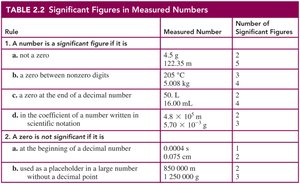
Rule | Measured Number | Number of Significant Figures |
|---|---|---|
Not a zero | 4.5 g | 2 |
Zero between nonzero digits | 205 °C | 3 |
Zero at the end of a decimal number | 50.0 L | 3 |
Zero in scientific notation coefficient | 5.70 × 10³ g | 3 |
Zero at the beginning of a decimal number (not significant) | 0.0004 s | 1 |
Zero as placeholder in large number without decimal (not significant) | 850 000 m | 2 |
Scientific Notation
Scientific notation expresses very large or small numbers as a product of a coefficient and a power of ten. This format makes it easier to handle significant figures and perform calculations.
Number | Meaning | Scientific Notation |
|---|---|---|
1,000,000 | 10 × 10 × 10 × 10 × 10 × 10 | 1 × 10⁶ |
0.0001 | 1/10 × 1/10 × 1/10 × 1/10 | 1 × 10⁻⁴ |

Significant Figures in Calculations
Multiplication and Division
When multiplying or dividing measured numbers, the final answer should have the same number of significant figures as the measurement with the fewest significant figures.
Example: (2 SFs)
Addition and Subtraction
For addition and subtraction, the final answer should have the same number of decimal places as the measurement with the fewest decimal places.
Rounding Off
When rounding numbers:
If the first digit to be dropped is 4 or less, drop it and all following digits.
If the first digit to be dropped is 5 or greater, increase the last retained digit by 1.
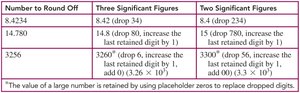
Number to Round Off | Three Significant Figures | Two Significant Figures |
|---|---|---|
8.4234 | 8.42 | 8.4 |
14.780 | 14.8 | 15 |
3256 | 3260 | 3300 |

Metric Prefixes and Equalities
Metric Prefixes
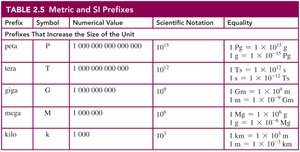
Prefixes are used to indicate multiples or fractions of base units. They are essential for expressing measurements in convenient units.
Prefix | Symbol | Numerical Value | Scientific Notation | Equality |
|---|---|---|---|---|
kilo | k | 1,000 | 103 | 1 km = 1,000 m |
centi | c | 0.01 | 10-2 | 1 cm = 0.01 m |
milli | m | 0.001 | 10-3 | 1 mg = 0.001 g |
micro | μ | 0.000001 | 10-6 | 1 μg = 0.000001 g |

Common Equalities
Quantity | Metric (SI) | U.S. | Metric-U.S. |
|---|---|---|---|
Length | 1 km = 1000 m | 1 mi = 5280 ft | 2.54 cm = 1 in. (exact) |
Volume | 1 L = 1000 mL | 1 qt = 4 cups | 946 mL = 1 qt |
Mass | 1 kg = 1000 g | 1 lb = 16 oz | 454 g = 1 lb |
Time | 1 min = 60 s | 1 min = 60 s |
Unit Conversion and Problem Solving
Conversion Factors
Conversion factors are ratios derived from equalities that allow conversion from one unit to another. For example:
Conversion factors: and


Problem Solving with Unit Conversion
To solve unit conversion problems:
Identify the given and needed units.
Write a plan to convert the given unit to the needed unit using appropriate conversion factors.
Set up the calculation so that units cancel, leaving the desired unit.
Example: Convert 164 lb to kg:

Dosage Calculations and Percentages
Dosage problems often require multiple conversion factors, including metric and clinical factors. Percentages are also used as conversion factors, relating parts to 100 parts of the whole.
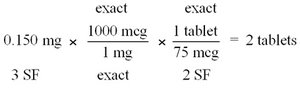
Example: If a medication contains 75 mcg per tablet, and a dose of 0.150 mg is prescribed, calculate the number of tablets needed.
Density and Specific Gravity
Density
Density is the ratio of mass to volume and is a key property for identifying substances. The formula for density is:
Units are typically g/mL or g/cm3 for solids and liquids.
Calculating Density
To determine the density of a solid, measure its mass and volume (often by water displacement). For example, if a metal sample has a mass of 48.0 g and displaces water from 25.0 mL to 33.0 mL, its density is:
Volume displaced = 33.0 mL - 25.0 mL = 8.0 mL
Density = 48.0 g / 8.0 mL = 6.0 g/mL
Specific Gravity
Specific gravity is the ratio of the density of a substance to the density of water (1.00 g/mL at 4°C). It is a unitless quantity and is used in clinical and laboratory settings.
Summary
Understanding units, significant figures, and conversion factors is foundational for all chemical calculations.
Mastery of these concepts ensures accuracy and reliability in laboratory and clinical settings.
