 뒤로
Classification of Matter & Separation Methods – General Chemistry Study Guidance
스터디 가이드 - 스마트 노트
 자료에 맞춘 맞춤형 노트, 핵심 정의, 예시, 맥락을 확장해 제공합니다.
Q1. Can we determine whether liquid A, liquid B, solid C, and liquid D are elements or compounds based on the reaction described?
Background
Topic: Classification of Matter & Chemical Reactions
This question tests your understanding of how chemical reactions (such as acid-base reactions) can provide information about the nature of reactants and products, specifically whether they are elements or compounds.
Key Terms:
Element: A pure substance consisting of only one type of atom.
Compound: A substance formed when two or more elements are chemically bonded.
Acid-Base Reaction: A chemical reaction that typically produces a salt (solid) and water (liquid).
Step-by-Step Guidance
Consider what happens in a typical acid-base reaction: two substances react to form a new solid and a new liquid.
Think about whether the information given (formation of new products) allows you to distinguish between elements and compounds for each substance.
Recall that elements cannot be broken down further by chemical reactions, while compounds can.
Ask yourself: Does the reaction description provide enough detail to identify the chemical nature (element or compound) of each substance?
Try solving on your own before revealing the answer!
Final Answer: b. No, we cannot tell
The reaction description does not provide enough information to determine whether each substance is an element or a compound. Both elements and compounds can participate in reactions, and without more specific information, we cannot classify them definitively.
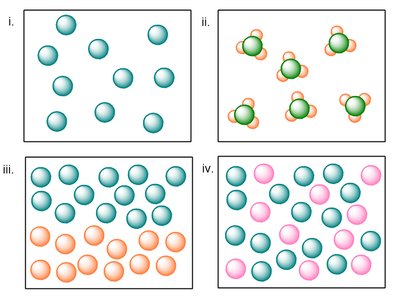
Q2. Classify each substance in the diagram as an element, a compound, a homogeneous mixture, or a heterogeneous mixture.
Background
Topic: Classification of Matter
This question tests your ability to visually identify and classify substances based on their composition and appearance.
Key Terms:
Element: Only one type of atom present.
Compound: Two or more atoms chemically bonded in fixed ratios.
Homogeneous Mixture: Uniform composition throughout.
Heterogeneous Mixture: Non-uniform composition; visibly different parts.
Step-by-Step Guidance
Examine each box in the diagram:
Box i: Contains only one type of particle, evenly distributed.
Box ii: Contains clusters of two or more different atoms bonded together.
Box iii: Contains two types of particles, but they are separated into distinct regions.
Box iv: Contains two types of particles, mixed together uniformly.
Match each box to the definitions above and select the answer choice that fits.
Try solving on your own before revealing the answer!
Final Answer: c. element, compound, heterogeneous mixture, homogeneous mixture
Box i is an element (single type of atom), box ii is a compound (clusters of bonded atoms), box iii is a heterogeneous mixture (distinct regions), and box iv is a homogeneous mixture (uniformly mixed).
Q3. Classify each substance as an element, a compound, a homogeneous mixture, or a heterogeneous mixture: i. nitrous oxide, ii. rainwater, iii. silver, iv. salad
Background
Topic: Classification of Matter
This question tests your knowledge of real-world examples and how to classify them based on their chemical and physical properties.
Key Terms:
Nitrous oxide: A chemical compound (N2O).
Rainwater: Typically a homogeneous mixture (water with dissolved gases and minerals).
Silver: An element (Ag).
Salad: A heterogeneous mixture (various ingredients, visibly different parts).
Step-by-Step Guidance
Identify the chemical nature of each substance:
Determine if it is a pure element, a compound, or a mixture.
For mixtures, decide if they are homogeneous (uniform) or heterogeneous (non-uniform).
Match each substance to the correct classification and select the answer choice that fits.
Try solving on your own before revealing the answer!
Final Answer: b. i: compound; ii: homogenous mixture; iii: element; iv: heterogenous mixture
Nitrous oxide is a compound, rainwater is a homogeneous mixture, silver is an element, and salad is a heterogeneous mixture.
Q4. Identify the hypothesis among the following statements.
Background
Topic: Scientific Method
This question tests your understanding of what constitutes a hypothesis versus an observation or a fact.
Key Terms:
Hypothesis: A testable statement or prediction about the outcome of an experiment.
Observation: A measurement or description of something that happened.
Fact: A statement that is accepted as true.
Step-by-Step Guidance
Review each statement and decide if it is a prediction or explanation (hypothesis), or a measurement/description (observation/fact).
Look for a statement that suggests a reason or expected outcome, which can be tested.
Identify which statement fits the definition of a hypothesis.
Try solving on your own before revealing the answer!
Final Answer: a. Mixing hexane and water will not form a solution because of the difference in polarity.
This is a testable prediction about the outcome of mixing hexane and water, making it a hypothesis.
Q5. Identify which of the following is NOT an observation.
Background
Topic: Scientific Method & Observations
This question tests your ability to distinguish between observations (measurable or directly perceived events) and other types of statements.
Key Terms:
Observation: Something that can be measured or seen directly.
Inference: A conclusion or explanation based on observations.
Step-by-Step Guidance
Review each statement and decide if it describes something directly observed or measured.
Identify statements that are explanations or generalizations, rather than direct observations.
Choose the statement that does not fit the definition of an observation.
Try solving on your own before revealing the answer!
Final Answer: b. Energy is converted from one form to another.
This is a general statement about energy, not a direct observation or measurement.
Q6. Classify the following separation method as distillation, filtration, or chromatography: Removing dust and other particulates from the air using air purifiers.
Background
Topic: Separation Methods
This question tests your understanding of physical separation techniques used to purify mixtures.
Key Terms:
Distillation: Separation based on differences in boiling points.
Filtration: Separation based on particle size, using a filter.
Chromatography: Separation based on movement through a medium.
Step-by-Step Guidance
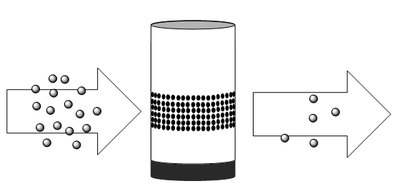
Consider the process: air containing dust passes through a device that removes the particles.
Think about which separation method uses a physical barrier to separate solid particles from a fluid.
Match the description and diagram to the correct separation method.
Try solving on your own before revealing the answer!
Final Answer: b. filtration
The process shown is filtration, where a filter removes solid particles from air.
