 뒤로
Comprehensive Study Guide for General Chemistry: Moles, Formulas, Solutions, and Solubility
스터디 가이드 - 스마트 노트
 자료에 맞춘 맞춤형 노트, 핵심 정의, 예시, 맥락을 확장해 제공합니다.
Q1. What is the molar mass of oxygen (O2)?
Background
Topic: Molar Mass Calculation
This question tests your ability to calculate the molar mass of a diatomic molecule using atomic masses from the periodic table.
Key Terms and Formulas
Molar mass: The mass of one mole of a substance, usually in grams per mole (g/mol).
Atomic mass of oxygen (O): 16.0 g/mol
Step-by-Step Guidance
Identify that O2 is a diatomic molecule, so it contains two oxygen atoms.
Find the atomic mass of oxygen from the periodic table.
Multiply the atomic mass by the number of atoms in the molecule:
Try solving on your own before revealing the answer!
Final Answer: 32.0 g/mol
The molar mass of O2 is g/mol because there are two oxygen atoms in each molecule.
Q2. A sample of gas has a volume of 7.5 L at STP. How many moles are present?
Background
Topic: Mole Conversions (Gas at STP)
This question tests your ability to use the molar volume of a gas at standard temperature and pressure (STP) to convert between volume and moles.
Key Terms and Formulas
STP: Standard Temperature and Pressure (0°C, 1 atm)
Molar volume at STP: 22.4 L/mol
Formula:
Step-by-Step Guidance
Write down the volume of the gas: 7.5 L.
Recall that at STP, 1 mole of any gas occupies 22.4 L.
Set up the conversion:
Try solving on your own before revealing the answer!
Final Answer: 0.33 mol
By dividing the volume by the molar volume, mol.
Q3. A hydrate of sodium sulfate has a mass of 5.32 g. The sample is heated until water is driven off, leaving 3.76 g of anhydrous sodium sulfate. What is the formula of the hydrate?
Background
Topic: Hydrate Formula Determination
This question tests your ability to determine the formula of a hydrate by calculating the ratio of water to anhydrous salt.
Key Terms and Formulas
Hydrate: A compound containing water molecules within its crystal structure.
Anhydrous: The compound after water is removed.
Formula:
Step-by-Step Guidance
Calculate the mass of water lost:
Convert the mass of water and anhydrous salt to moles using their molar masses.
Find the ratio of moles of water to moles of sodium sulfate.
Try solving on your own before revealing the answer!
Final Answer: Na2SO4·2H2O
The ratio of moles of water to sodium sulfate is approximately 2:1, so the formula is Na2SO4·2H2O.
Q4. Find the empirical formula for a compound with 88.8% copper and 11.2% oxygen.
Background
Topic: Empirical Formula Determination
This question tests your ability to convert percent composition to the simplest whole-number ratio of atoms in a compound.
Key Terms and Formulas
Empirical formula: The simplest ratio of elements in a compound.
Percent composition: The mass percent of each element in the compound.
Formula:
Step-by-Step Guidance
Assume 100 g of the compound, so you have 88.8 g Cu and 11.2 g O.
Convert each mass to moles using their molar masses.
Divide each by the smallest number of moles to get the simplest ratio.
Try solving on your own before revealing the answer!
Final Answer: CuO
The simplest ratio of copper to oxygen is 1:1, so the empirical formula is CuO.
Q5. What is the percent by mass/volume of a solution made from 7.5 g of NaCl dissolved in 250 mL of water?
Background
Topic: Solution Concentration (Percent by Mass/Volume)
This question tests your ability to calculate the percent concentration of a solution using mass of solute and volume of solvent.
Key Terms and Formulas
Percent by mass/volume:
Step-by-Step Guidance
Write down the mass of NaCl (solute): 7.5 g.
Write down the volume of water (solvent): 250 mL.
Set up the formula:
Try solving on your own before revealing the answer!
Final Answer: 3.0%
The percent by mass/volume is .
Q6. A stock solution of sodium nitrate, NaNO3, has a concentration of 1.00 M. The volume of the solution is 50.0 mL. How many moles of NaNO3 are present?
Background
Topic: Solution Molarity
This question tests your ability to use molarity to calculate the number of moles of solute in a given volume of solution.
Key Terms and Formulas
Molarity (M):
Formula:
Step-by-Step Guidance
Write down the molarity: 1.00 M.
Convert the volume from mL to L:
Set up the formula:
Try solving on your own before revealing the answer!
Final Answer: 0.050 mol
Multiplying molarity by volume in liters gives mol.
Q7. A gold coin contains 1.5 x 10²³ atoms of gold. How many moles of gold are present?
Background
Topic: Mole Conversions (Atoms to Moles)
This question tests your ability to convert between number of atoms and moles using Avogadro's number.
Key Terms and Formulas
Avogadro's number: atoms/mol
Formula:
Step-by-Step Guidance
Write down the number of atoms: .
Set up the formula:
Try solving on your own before revealing the answer!
Final Answer: 0.25 mol
Dividing the number of atoms by Avogadro's number gives mol.
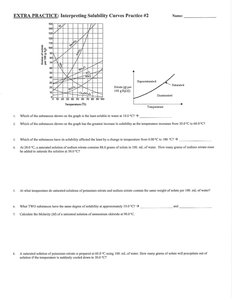
Q8. Which salt on the solubility curve graph has the lowest solubility at 0°C?
Background
Topic: Solubility Curves
This question tests your ability to interpret solubility curves and compare the solubility of different salts at a specific temperature.
Key Terms and Formulas
Solubility: The maximum amount of solute that can dissolve in a solvent at a given temperature.
Solubility curve: A graph showing how solubility changes with temperature.
Step-by-Step Guidance
Locate 0°C on the x-axis of the solubility curve graph.
Find the solubility values for each salt at 0°C.
Compare the values to determine which salt has the lowest solubility.
Try solving on your own before revealing the answer!
Final Answer: KClO3
KClO3 has the lowest solubility at 0°C according to the solubility curve graph.
