 뒤로
Covalent Bonding, Molecular Geometry, Resonance, and Bond Energies
스터디 가이드 - 스마트 노트
 자료에 맞춘 맞춤형 노트, 핵심 정의, 예시, 맥락을 확장해 제공합니다.
Covalent Bonding and Lewis Structures
Lewis Structures
Lewis structures are diagrams that show how atoms are connected in a molecule and how valence electrons are arranged. They help visualize single, double, and triple bonds, as well as lone pairs of electrons.
Single bond: Two atoms share one pair of electrons.
Double bond: Two atoms share two pairs of electrons.
Triple bond: Two atoms share three pairs of electrons.
Lone pairs: Non-bonding pairs of electrons localized on an atom.
Example: The Lewis structure for carbon dioxide (CO2) shows two double bonds between carbon and each oxygen atom.
Valence Shell Electron Pair Repulsion (VSEPR) Theory
Basic Principles of VSEPR
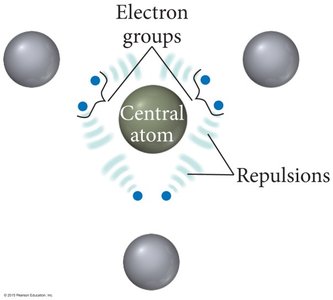
VSEPR theory is used to predict the shapes of molecules based on the repulsion between electron groups (bonding pairs and lone pairs) around a central atom. Electron groups arrange themselves as far apart as possible to minimize repulsion.
Electron group: Any region of electron density (bond or lone pair) around a central atom.
Bond angle: The angle between adjacent bonds in a molecule, determined by the number of electron groups.
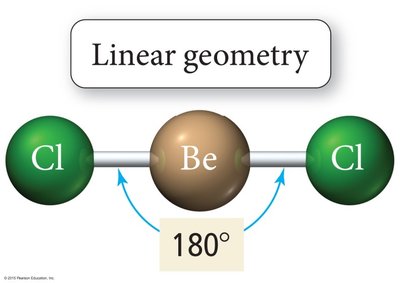
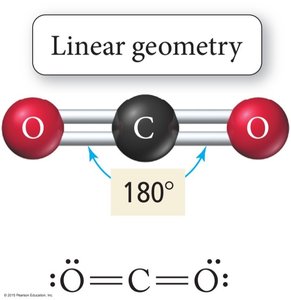
Two Electron Groups: Linear Geometry
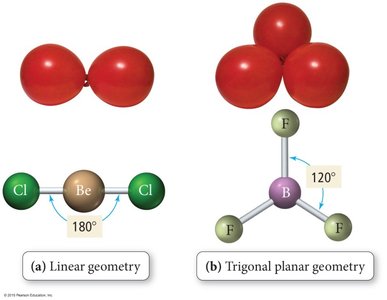
When there are two electron groups around a central atom, the geometry is linear with a bond angle of 180°.
Example: Beryllium chloride (BeCl2) and carbon dioxide (CO2) both have linear geometry.
Three Electron Groups: Trigonal Planar Geometry
With three electron groups, the geometry is trigonal planar, and the bond angles are 120°.
Example: Boron trifluoride (BF3) has a trigonal planar geometry.
Effect of lone pairs: If one group is a lone pair, the molecular geometry becomes bent, and the bond angle is slightly less than 120°.
Effect of Lone Pairs on Molecular Structure
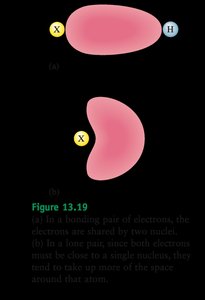
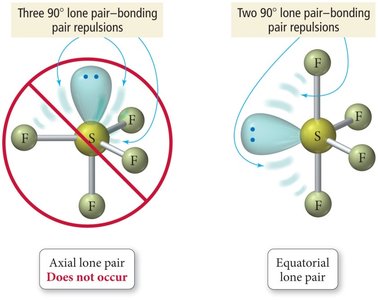
Lone pairs occupy more space than bonding pairs, causing bond angles to decrease from their ideal values. This effect is important in predicting the actual shape of molecules.
Resonance Structures and Electron Delocalization
Resonance Structures
Some molecules cannot be represented by a single Lewis structure. Resonance structures are multiple valid Lewis structures for the same molecule, differing only in the arrangement of electrons. The actual structure is a resonance hybrid, with electrons delocalized over more than two atoms.
Delocalized electrons: Electrons shared across more than two atoms, as in benzene or ozone (O3).
Localized electrons: Electrons confined between two atoms or on a single atom (lone pair).
Formal charge: Used to determine the most representative resonance structure. Minimize formal charges and place negative charges on more electronegative atoms.
Example: Ozone (O3) and benzene (C6H6) both exhibit resonance.
Four Electron Groups: Tetrahedral Geometry
Tetrahedral Electron Geometry
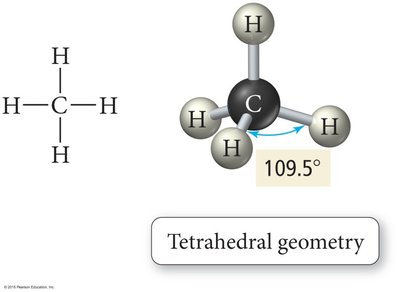
When four electron groups surround a central atom, the geometry is tetrahedral with bond angles of 109.5°.
Example: Methane (CH4) is a classic example of a tetrahedral molecule.
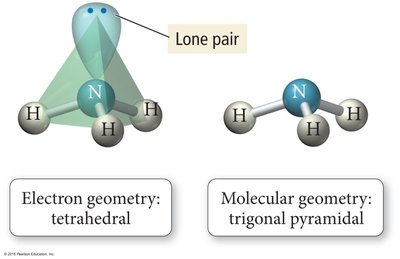
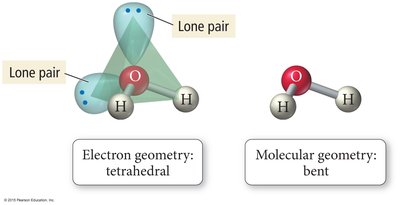
Effect of lone pairs: One lone pair results in trigonal pyramidal geometry (e.g., ammonia, NH3); two lone pairs result in bent geometry (e.g., water, H2O).
Five Electron Groups: Trigonal Bipyramidal Geometry
Trigonal Bipyramidal Electron Geometry
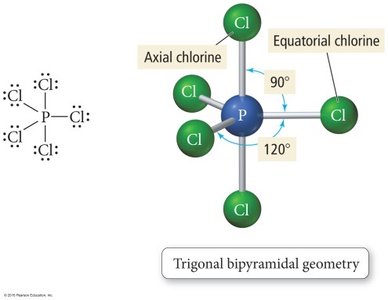
With five electron groups, the geometry is trigonal bipyramidal. There are two types of positions: axial (180° apart) and equatorial (120° apart).
Example: Phosphorus pentachloride (PCl5).
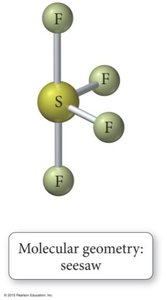
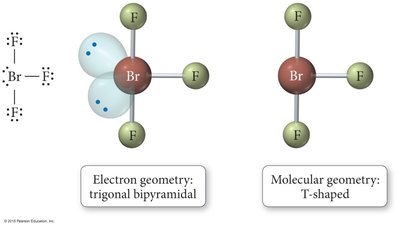
Effect of lone pairs: One lone pair gives a seesaw shape; two lone pairs give a T-shaped geometry; three lone pairs give a linear geometry.
Six Electron Groups: Octahedral Geometry
Octahedral Electron Geometry
Six electron groups around a central atom result in an octahedral geometry with 90° bond angles.
Example: Sulfur hexafluoride (SF6).
Effect of lone pairs: One lone pair gives a square pyramidal geometry; two lone pairs give a square planar geometry.
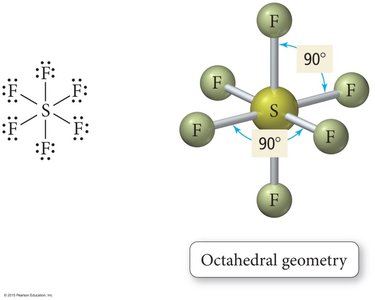
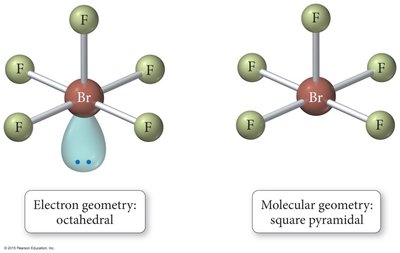
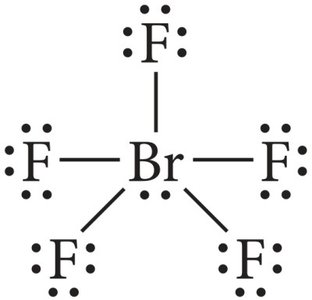
Summary Table: Electron and Molecular Geometries
The following table summarizes the relationship between the number of electron groups, lone pairs, electron geometry, molecular geometry, and bond angles.
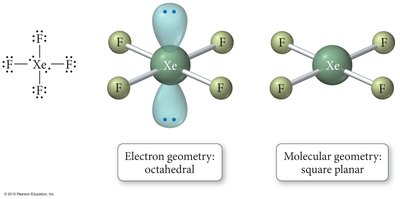
Bond Energy and Bond Length
Bond Energy (Bond Enthalpy)
Bond energy is the energy required to break one mole of a particular bond in the gas phase. It is a measure of bond strength. Higher bond energies indicate stronger bonds.
Calculation of reaction enthalpy: The enthalpy change for a reaction can be estimated using average bond energies:
Example: Calculating the enthalpy change for the formation of water from hydrogen and oxygen gases.
Bond Length
Bond length is the average distance between the nuclei of two bonded atoms. It depends on the types of atoms involved and the bond order (single, double, triple).
Shorter bonds: Generally stronger and involve more shared electrons (e.g., triple bonds are shorter than double bonds, which are shorter than single bonds).
Tables of Average Bond Lengths and Energies
The following tables provide average bond lengths and bond energies for common covalent bonds.
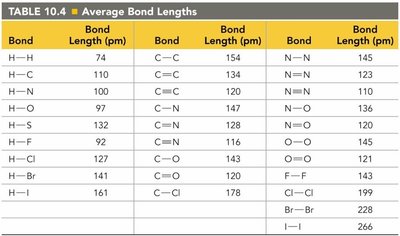
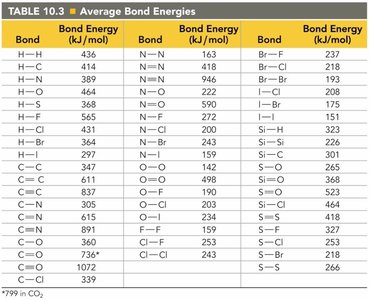
Note: These values are averages and may vary depending on the molecular environment.
Additional info: The VSEPR model is essential for predicting molecular shapes, which in turn influence molecular polarity, reactivity, and physical properties. Resonance and delocalization are key concepts for understanding stability and electron distribution in molecules.
