 뒤로
Lec 2 notes chem
스터디 가이드 - 스마트 노트
 자료에 맞춘 맞춤형 노트, 핵심 정의, 예시, 맥락을 확장해 제공합니다.
Covalent Compounds
Binary Covalent Compounds
Binary covalent compounds are formed from two nonmetals. The naming convention involves adding the suffix -ide to the second element and using numerical prefixes to indicate the number of atoms present. The prefix mono- is not used for the first element.
N2O: Dinitrogen monoxide
SF4: Sulfur tetrafluoride
Dichlorine hept(a)oxide: Cl2O7
Dihydrogen monoxide: H2O
Numerical Prefixes:
Number | Prefix |
|---|---|
1 | mono- |
2 | di- |
3 | tri- |
4 | tetra- |
5 | penta- |
6 | hexa- |
7 | hepta- |
8 | octa- |
9 | nona- |
10 | deca- |
Acids
Binary Acids
Binary acids contain hydrogen and a nonmetal, but no oxygen. Their names begin with hydro- and end with -ic acid.
HCN(aq): Hydrocyanic acid
HI(aq): Hydroiodic acid
Hydrosulfuric acid: H2S(aq)
Oxyacids
Oxyacids contain hydrogen, oxygen, and a nonmetal. The name depends on the oxoanion present:
HClO: Hypochlorous acid
HClO2: Chlorous acid
HClO3: Chloric acid
HClO4: Perchloric acid
Nitric acid: HNO3
Periodic acid: HIO4
Acid Naming Table:
Anion | Acid |
|---|---|
hypo____ite | hypo____ous acid |
___ite | ___ous acid |
___ate | ___ic acid |
per___ate | per___ic acid |
Strong and Weak Acids and Bases
Acids and bases are classified as strong or weak based on their degree of ionization in water.
Strong Acids | Weak Acids |
|---|---|
HCl (Hydrochloric acid) | HF (Hydrofluoric acid) |
HBr (Hydrobromic acid) | H3PO4 (Phosphoric acid) |
HI (Hydroiodic acid) | CH3COOH (Acetic acid) |
HNO3 (Nitric acid) | |
H2SO4 (Sulfuric acid) | |
HClO4 (Perchloric acid) |
Strong Bases | Weak Bases |
|---|---|
LiOH (Lithium hydroxide) | NH4OH (Ammonium hydroxide) |
NaOH (Sodium hydroxide) | NH3 (Ammonia) |
KOH (Potassium hydroxide) | HCO3− (Bicarbonate) |
Ca(OH)2 (Calcium hydroxide) | |
Sr(OH)2 (Strontium hydroxide) | |
Ba(OH)2 (Barium hydroxide) |
Oxidation States (Oxidation Numbers)
Definition and Assignment
The oxidation state of an atom is the number of electrons it uses or appears to use in forming bonds. In a free element, the oxidation state is 0. In a neutral compound, the sum of oxidation states is 0; in an ion, the sum equals the ion's charge. Assignment follows these conventions:
Group 1 metals: +1
Group 2 metals: +2
Fluorine: -1
Hydrogen: +1
Oxygen: -2
Group 15, 16, 17 nonmetals: -3, -2, -1 respectively
Examples:
P4: 0 (elemental form)
NaH: Na = +1, H = -1
Al2O3: Al = +3, O = -2
H2O2: H = +1, O = -1
MnO4-: Mn = +7, O = -2
Fe3O4: Fe = +8/3 (average), O = -2
Quantum Theory and Atomic Structure
Periodic Properties and Atomic Structure
Periodic properties of elements are determined by atomic structure. The classical Rutherford model is insufficient; quantum theory, developed from experiments on light and matter, provides the modern understanding.
Nature of Light
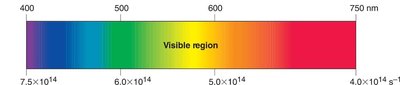
Visible light is a form of electromagnetic (EM) radiation, which consists of waves. All EM waves travel at the speed of light in a vacuum, given by:
where m/s, is wavelength, and is frequency.
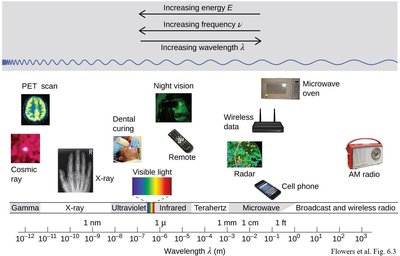
Electromagnetic Spectrum
The EM spectrum includes various types of radiation, distinguished by wavelength and frequency. Short wavelengths correspond to higher energy and frequency, while long wavelengths correspond to lower energy and frequency.
Wave Phenomena: Refraction and Diffraction
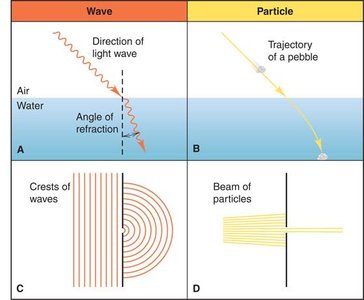
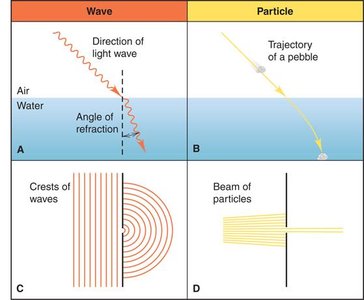
EM radiation exhibits wave-like behaviors such as refraction (bending of waves as they pass from one medium to another) and diffraction (spreading of waves around obstacles). These properties are distinct from the behavior of matter, which does not exhibit such phenomena.
Key Points:
Refraction: Change in direction of a wave as it passes from one medium to another.
Diffraction: Bending and spreading of waves around obstacles.
Particles: Do not exhibit refraction or diffraction in the same manner as waves.
Example: Light waves refract when passing from air into water, while a pebble (particle) does not.
