 뒤로
뒤로Discovery of the Electron and Structure of the Atom: Key Experiments and Models
스터디 가이드 - 스마트 노트
 자료에 맞춘 맞춤형 노트, 핵심 정의, 예시, 맥락을 확장해 제공합니다.
Discovery of the Electron and Structure of the Atom
Key Experiments in Atomic Structure
This section explores the foundational experiments that led to the discovery of the electron and the development of atomic models. Understanding these experiments is crucial for grasping how scientists determined the structure and properties of atoms.
Cathode Ray Tube Experiment
Millikan’s Oil Drop Experiment
Rutherford’s Gold Foil Experiment
Cathode Ray Tube Experiment
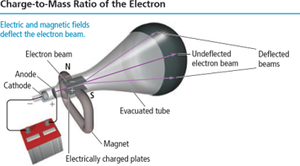
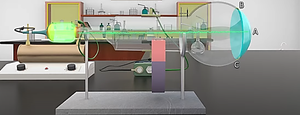
The cathode ray tube experiment, conducted by J. J. Thomson, was pivotal in identifying the electron as a fundamental particle. Thomson used a partially evacuated glass tube with electrodes at each end. When a high voltage was applied, a beam of particles (cathode rays) traveled from the negatively charged cathode to the positively charged anode.
Key Discoveries:
Electrons are negatively charged particles.
Electrons have a very low mass compared to atoms.
The charge-to-mass ratio of the electron was determined.
Led to the proposal of the plum pudding model of the atom.
Deflection in Electric and Magnetic Fields: Cathode rays were deflected towards the positive plate, indicating their negative charge.
Example: The deflection of cathode rays in an electric field demonstrates that the particles are negatively charged.



Charge-to-Mass Ratio of the Electron
Thomson measured the charge-to-mass ratio (e/m) of the electron using the cathode ray tube. By applying electric and magnetic fields, he observed the deflection of the electron beam and calculated the ratio.
Formula:
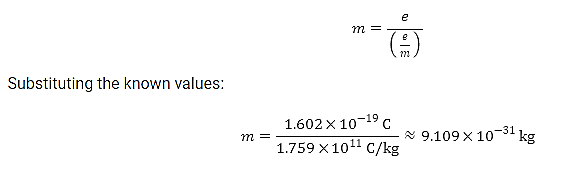
Calculation: The mass of the electron can be determined if the charge and the charge-to-mass ratio are known.
Example: Substituting known values:
Millikan’s Oil Drop Experiment
Robert Millikan performed the oil drop experiment to determine the charge of a single electron. By measuring the electric field required to halt the free fall of oil drops and calculating their mass, Millikan found that the charge on each drop was always a whole-number multiple of the fundamental charge of the electron.
Key Point: The experiment confirmed the quantization of electric charge.
Application: Allowed calculation of the mass of the electron using Thomson’s charge-to-mass ratio.
Structure of the Atom: Plum Pudding Model
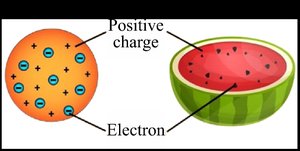
Thomson proposed the plum pudding model, where electrons were embedded within a positively charged sphere. This model was the most popular at the time, suggesting that atoms were uniform spheres of positive charge with electrons scattered throughout.
Key Point: Electrons are small, negatively charged particles within a larger, positively charged mass.
Rutherford’s Gold Foil Experiment
Ernest Rutherford conducted the gold foil experiment to test the plum pudding model. He directed alpha particles at a thin sheet of gold foil and observed their scattering.
Unexpected Results: Most particles passed through, but some were deflected or bounced back, indicating the presence of a dense, positively charged nucleus.
Conclusion: Matter contains large regions of empty space and small regions of dense matter.
Nuclear Theory of the Atom:
Most of the atom’s mass and all positive charge are in the nucleus.
Most of the atom’s volume is empty space, with electrons dispersed throughout.
The number of electrons equals the number of protons, making the atom electrically neutral.
Example: The gold foil experiment disproved the plum pudding model and led to the nuclear model of the atom.
Summary Table: Key Atomic Experiments
Experiment | Scientist | Discovery | Impact |
|---|---|---|---|
Cathode Ray Tube | J. J. Thomson | Electron, charge-to-mass ratio | Identified electron as a fundamental particle |
Oil Drop | Robert Millikan | Charge of electron | Confirmed quantization of charge |
Gold Foil | Ernest Rutherford | Nucleus, nuclear model | Disproved plum pudding model, established nuclear theory |
