 뒤로
Electron Configuration and the Periodic Table: Rules, Patterns, and Applications
스터디 가이드 - 스마트 노트
 자료에 맞춘 맞춤형 노트, 핵심 정의, 예시, 맥락을 확장해 제공합니다.
Chapter 9: Electron Configuration and the Periodic Table
Introduction to Electron Configuration
Electron configuration describes the arrangement of electrons in atomic orbitals. Understanding how electrons fill these orbitals is essential for predicting chemical properties and periodic trends.
Electron configuration is a notation that shows the distribution of electrons among the various atomic orbitals.
Each orbital can hold a maximum of two electrons with opposite spins.
Quantum Numbers and Orbitals
Atomic orbitals are defined by quantum numbers, which determine their energy, shape, and orientation.
Principal quantum number (n): Indicates the main energy level.
Angular momentum quantum number (l): Defines the sublevel (s, p, d, f).
Magnetic quantum number (ml): Specifies the orientation of the orbital.
Spin quantum number (ms): Can be +½ or −½, representing the two possible electron spins.
Maximum electrons per sublevel:
s: 1 orbital, 2 electrons max
p: 3 orbitals, 6 electrons max
d: 5 orbitals, 10 electrons max
f: 7 orbitals, 14 electrons max
Key Principles for Electron Filling
Pauli Exclusion Principle: No two electrons in the same atom can have the same set of four quantum numbers. Each orbital holds up to two electrons with opposite spins.
Aufbau Principle: Electrons fill the lowest-energy orbitals first.
Hund’s Rule: For orbitals of equal energy (degenerate), electrons fill each orbital singly before pairing up. This minimizes electron repulsion and lowers energy.
Orbital Energy, Shielding, and Penetration
In multi-electron atoms, electron–electron repulsion causes sublevels to split in energy. Two important effects are:
Shielding: Inner electrons partially block the attraction between the nucleus and outer electrons, reducing the effective nuclear charge felt by the outer electrons.
Penetration: Electrons in orbitals that spend more time closer to the nucleus (e.g., s orbitals) experience less shielding and are lower in energy than those farther away (e.g., p orbitals).
For the same principal quantum number n, the order of energy is generally: .
Order of Orbital Filling
The general order for filling orbitals in neutral atoms is:
1s → 2s → 2p → 3s → 3p → 4s → 3d → 4p → 5s → 4d → 5p → 6s → 4f → 5d → 6p, etc.
This order is determined by the relative energies of the orbitals, which are influenced by shielding and penetration effects.
Writing Electron Configurations
Electron configurations are written using the format: n(principal level) sublevelnumber of electrons. For example, 2p4 means four electrons in the entire 2p sublevel.
The superscript indicates the total number of electrons in that sublevel, not in a single orbital.
Using the Periodic Table to Determine Electron Configuration
The periodic table is organized so that each block corresponds to a type of orbital:
s-block: Groups 1–2 (n = period)
p-block: Groups 13–18 (n = period)
d-block: Transition metals (n = period − 1)
f-block: Lanthanides and actinides (n = period − 2)
Each element’s position in the table helps determine its electron configuration.
Examples of Electron Configurations
Hydrogen (H, Z = 1): 1s1
Helium (He, Z = 2): 1s2
Lithium (Li, Z = 3): 1s2 2s1
Oxygen (O, Z = 8): 1s2 2s2 2p4
Chlorine (Cl, Z = 17): 1s2 2s2 2p6 3s2 3p5
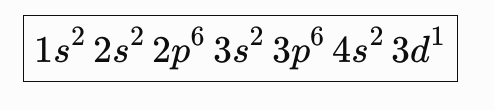
Scandium (Sc, Z = 21): 1s2 2s2 2p6 3s2 3p6 4s2 3d1
Condensed (Noble Gas) Electron Configuration
To simplify electron configurations, use the symbol of the preceding noble gas in brackets to represent core electrons. For example:
Chlorine (Cl): [Ne] 3s2 3p5
Calcium (Ca): [Ar] 4s2
Scandium (Sc): [Ar] 4s2 3d1
Exceptions to Predicted Configurations
Some transition metals have electron configurations that differ from the expected order due to increased stability of half-filled or fully filled d sublevels:
Chromium (Cr, Z = 24): [Ar] 4s1 3d5 (instead of [Ar] 4s2 3d4)
Copper (Cu, Z = 29): [Ar] 4s1 3d10 (instead of [Ar] 4s2 3d9)
Additional info: These exceptions are determined experimentally and reflect the extra stability associated with half-filled and fully filled d sublevels.
Valence and Core Electrons
Electrons in the outermost principal energy level (highest n) are called valence electrons. The remaining electrons are core electrons.
Main-group elements: Valence electrons are those in the highest n value.
Example (Sulfur, S): [Ne] 3s2 3p4 — 6 valence electrons (n = 3), 10 core electrons ([Ne]).
Periodic Table Patterns and Chemical Behavior
Elements in the same group (vertical column) have similar valence electron configurations, leading to similar chemical properties.
Group 1 (Alkali metals): ns1 — commonly form +1 ions by losing one electron.
Group 17 (Halogens): ns2np5 — commonly form −1 ions by gaining one electron.
Group 18 (Noble gases): ns2np6 — have filled outer shells and are generally unreactive.
Summary Table: Main-Group Valence Electron Patterns
Group | General Configuration | Valence Electrons |
|---|---|---|
1 | ns1 | 1 |
2 | ns2 | 2 |
13 | ns2np1 | 3 |
14 | ns2np2 | 4 |
15 | ns2np3 | 5 |
16 | ns2np4 | 6 |
17 | ns2np5 | 7 |
18 | ns2np6 | 8 |
Connection to Chemical Reactivity
Valence electrons are responsible for chemical bonding and ion formation. Elements with similar valence configurations exhibit similar chemical behavior, which explains the periodic repetition of properties in the periodic table.
Example: Li, Na, and K all have one valence electron and commonly form +1 ions.
Example: F, Cl, and Br all have seven valence electrons and commonly form −1 ions.
