 뒤로
Electron Configurations and Periodic Trends – Guided Study Notes
스터디 가이드 - 스마트 노트
 자료에 맞춘 맞춤형 노트, 핵심 정의, 예시, 맥락을 확장해 제공합니다.
Q1. Use the Aufbau principle to obtain the complete and condensed ground-state electron configurations for selected elements.
Background
Topic: Electron Configurations & Aufbau Principle
This question tests your understanding of how electrons fill atomic orbitals in order of increasing energy, following the Aufbau principle, and how to write both full and condensed electron configurations for elements.
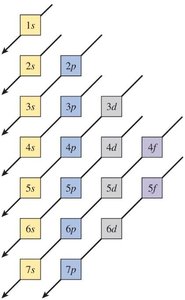
Key Terms and Formulas:
Aufbau Principle: Electrons occupy the lowest energy orbitals first.
Pauli Exclusion Principle: Each orbital can hold a maximum of two electrons with opposite spins.
Hund's Rule: Electrons fill degenerate orbitals singly before pairing.
Condensed Configuration: Uses the previous noble gas to abbreviate the configuration.
Step-by-Step Guidance
Identify the atomic number of each element (B, Cr, Cu, Ge, Fe, Zn) to determine the number of electrons.
Use the Aufbau diagram (see image above) to fill orbitals in the correct order: , etc.
For each element, assign electrons to orbitals, following Hund's rule and the Pauli exclusion principle.
For condensed configurations, replace the core electrons with the symbol of the previous noble gas in brackets (e.g., [Ar], [Ne]).
Stop before writing the final electron configuration for each element; set up the sequence of orbitals to be filled.
Try solving on your own before revealing the answer!
Final Answer:
a. Complete ground-state configurations:
Boron (B):
Chromium (Cr): (note the exception for Cr)
Copper (Cu): (note the exception for Cu)
b. Condensed ground-state configurations:
Germanium (Ge): [Ar]
Iron (Fe): [Ar]
Zinc (Zn): [Ar]
Chromium and copper are exceptions due to extra stability of half-filled and fully-filled d subshells.
Q2. Identify atoms from their excited-state electron configurations and write their ground-state configurations.
Background
Topic: Excited States & Ground-State Electron Configurations
This question tests your ability to recognize excited-state configurations and convert them to ground-state configurations for neutral atoms.
Key Terms and Formulas:
Excited State: An atom with one or more electrons in higher energy orbitals than in the ground state.
Ground State: The lowest energy arrangement of electrons.
Step-by-Step Guidance
Count the total number of electrons in each configuration to identify the element.
Determine which electron has been promoted to a higher energy orbital.
Write the ground-state configuration by placing all electrons in the lowest available orbitals according to the Aufbau principle.
Set up the ground-state configuration for each atom, but do not write the final configuration yet.
Try solving on your own before revealing the answer!
Final Answer:
a. 1s12s1 → Hydrogen (Z=2), ground state: 1s2
b. 1s22s22p23d1 → Boron (Z=6), ground state: 1s22s22p3
c. 1s22s22p64s1 → Sodium (Z=11), ground state: 1s22s22p63s1
d. [Ar]4s13d104p4 → Selenium (Z=34), ground state: [Ar]4s23d104p4
e. [Ne]3s23p43d1 → Phosphorus (Z=16), ground state: [Ne]3s23p5
Each ground-state configuration places electrons in the lowest energy orbitals possible.
Q3. Analyze orbital diagrams for violations of the Pauli exclusion principle and Hund's rule.
Background
Topic: Orbital Diagrams, Pauli Exclusion Principle, Hund's Rule
This question asks you to examine orbital diagrams and determine if they violate fundamental rules governing electron arrangements in atoms.
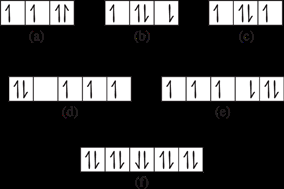
Key Terms and Formulas:
Pauli Exclusion Principle: No two electrons in the same atom can have the same set of quantum numbers (i.e., an orbital can hold a maximum of two electrons with opposite spins).
Hund's Rule: Electrons fill degenerate orbitals singly before pairing up.
Orbital Diagram: A pictorial representation of electron configuration using boxes and arrows.
Step-by-Step Guidance
Examine each orbital diagram for boxes with more than two arrows or with two arrows pointing in the same direction (Pauli violation).
Check if electrons are paired in degenerate orbitals before all orbitals are singly occupied (Hund's rule violation).
Identify which diagrams (a)-(f) violate each rule, but do not state the final answer yet.
Try solving on your own before revealing the answer!
Final Answer:
Pauli Exclusion Principle Violations: Diagram (e) (two electrons with same spin in one orbital).
Hund's Rule Violations: Diagrams (b) and (d) (pairing occurs before all orbitals are singly occupied).
Remember, each orbital can have at most two electrons with opposite spins, and electrons fill degenerate orbitals singly first.
