 뒤로
Electronic Structure of Atoms: Polyelectronic Atoms and Electron Configurations
스터디 가이드 - 스마트 노트
 자료에 맞춘 맞춤형 노트, 핵심 정의, 예시, 맥락을 확장해 제공합니다.
Electronic Structure of Atoms
Polyelectronic Atoms
Polyelectronic atoms are atoms that contain more than one electron. The presence of multiple electrons introduces additional complexity to the solutions of the Schrödinger wave equation due to electron-electron interactions. These interactions, which include both repulsions and attractions, cannot be calculated exactly because the precise pathways of electrons are unknown. This challenge is referred to as the electron correlation problem.
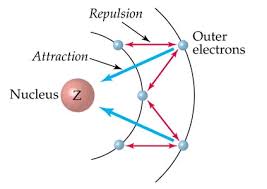
Electron correlation problem: The difficulty in accounting for the interactions between electrons in multi-electron atoms.
Quantum mechanical treatment: Approximations are made by treating each electron as if it moves in an average field created by the nucleus and other electrons.
Degenerate orbitals: All orbitals within a given subshell (e.g., p or d) have the same energy.
Electron Spin and the Pauli Exclusion Principle
Each orbital can accommodate two electrons, but these electrons must be distinguished by their spin quantum number (ms), which can have values of +½ or -½. This property is interpreted as electrons spinning in opposite directions.
Spin quantum number (ms): Specifies the orientation of the electron's intrinsic angular momentum (spin).
Pauli Exclusion Principle: No two electrons in an atom can have the same set of four quantum numbers (n, l, ml, ms).
As a result, an orbital can hold a maximum of two electrons with opposite spins.

Electron Configuration
Electron configuration describes the arrangement of electrons in the orbitals of an atom. The most stable, lowest-energy arrangement is called the ground state. Electrons fill orbitals in order of increasing energy, with no more than two electrons per orbital.
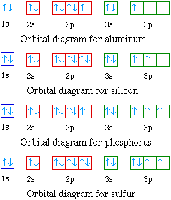
Orbital diagram: Uses lines and arrows to represent orbitals and electron spins.
Orbital notation: Uses numbers and letters (e.g., 1s22s2).
Hund’s Rule
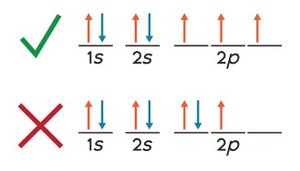
When electrons occupy degenerate orbitals (orbitals of equal energy), the lowest energy is achieved when the number of electrons with the same spin is maximized. In other words, electrons fill each orbital singly before any orbital is doubly occupied.
Hund’s Rule: "When you have orbitals with equal energy, each gets one electron before any get a second."
Condensed Electron Configuration (Noble Gas Configuration)
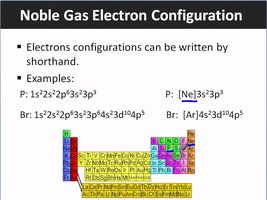
Condensed or noble gas configuration is a shorthand notation for electron configurations. The core electrons are represented by the symbol of the nearest noble gas in brackets, followed by the configuration of the valence electrons.
Core electrons: Electrons represented by the noble gas symbol.
Valence electrons: Electrons outside the noble gas core, involved in chemical bonding.
For elements with atomic number 30 or below, all outer-shell electrons are considered valence electrons.
Transition Metals
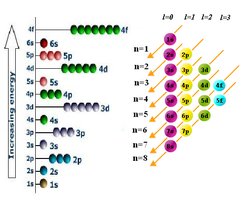
Transition metals involve the filling of d orbitals. The s orbital of a higher energy level is filled before the d orbital of a lower energy level. This leads to unique electron configurations for these elements.
d orbitals: Five degenerate orbitals per energy level, starting from n = 3.
Filling order: The (n+1)s orbital fills before the nd orbital.
Lanthanides and Actinides
The lanthanide and actinide series involve the filling of f orbitals. The 4f orbitals are filled in the lanthanide series, and the 5f orbitals are filled in the actinide series. The energies of the 4f and 5d, as well as 5f and 6d orbitals, are very close, leading to some irregularities in electron configurations.
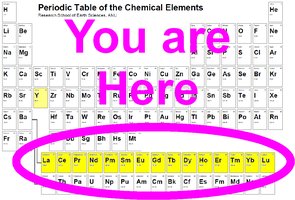
Lanthanides: Elements in which the 4f orbitals are being filled (atomic numbers 57–71).
Actinides: Elements in which the 5f orbitals are being filled (atomic numbers 89–103).
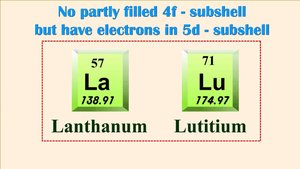
Some elements (e.g., La, Ac) may have electrons in d orbitals instead of f, depending on their chemical properties.
Electron Configuration and the Periodic Table
The arrangement of electrons in atoms explains the structure of the periodic table. Elements in the same group have similar valence electron configurations, which accounts for their similar chemical properties.
Exceptions to Predicted Electron Configurations
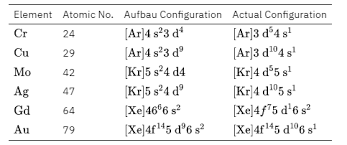
Some elements, particularly transition metals, have electron configurations that differ from the expected order. For example, chromium and copper have configurations that maximize the stability of half-filled or fully filled d subshells. This is due to the very similar energies of the 3d and 4s orbitals, making it energetically favorable to promote an electron.
Element | Atomic No. | Aufbau Configuration | Actual Configuration |
|---|---|---|---|
Cr | 24 | [Ar] 4s2 3d4 | [Ar] 4s1 3d5 |
Cu | 29 | [Ar] 4s2 3d9 | [Ar] 4s1 3d10 |
Mo | 42 | [Kr] 5s2 4d4 | [Kr] 5s1 4d5 |
Ag | 47 | [Kr] 5s2 4d9 | [Kr] 5s1 4d10 |
Gd | 64 | [Xe] 4f6 6s2 | [Xe] 4f7 5d1 6s2 |
Au | 79 | [Xe] 4f14 5d9 6s2 | [Xe] 4f14 5d10 6s1 |
Example: Chromium: [Ar] 4s1 3d5 (instead of [Ar] 4s2 3d4)
Reason: Half-filled and fully filled d subshells are particularly stable.
Key Equations and Principles
Aufbau Principle: Electrons fill orbitals starting with the lowest available energy levels before filling higher levels.
Pauli Exclusion Principle: No two electrons in an atom can have the same set of four quantum numbers.
Hund’s Rule: Electrons occupy degenerate orbitals singly before pairing up.
Quantum numbers:
Principal quantum number (n): Energy level (n = 1, 2, 3, ...)
Angular momentum quantum number (l): Subshell (l = 0 for s, 1 for p, 2 for d, 3 for f)
Magnetic quantum number (ml): Orientation of orbital (-l to +l)
Spin quantum number (ms): +½ or -½
Order of orbital filling:
