 뒤로
Electronic Structure of Atoms: Study Guide for General Chemistry
스터디 가이드 - 스마트 노트
 자료에 맞춘 맞춤형 노트, 핵심 정의, 예시, 맥락을 확장해 제공합니다.
Electronic Structure of Atoms
Introduction to Electronic Structure
The electronic structure of atoms refers to the arrangement and energy of electrons within an atom. Understanding this structure is fundamental to explaining chemical properties and reactions. The study begins with the nature of waves, as extremely small particles like electrons exhibit wave-like behavior.
Waves and Electromagnetic Radiation
Wave Properties
Electromagnetic radiation moves as waves through space at the speed of light. Key properties include:
Wavelength (\lambda): The distance between corresponding points on adjacent waves.
Frequency (\nu): The number of waves passing a given point per unit time. For waves traveling at the same velocity, longer wavelength means lower frequency.
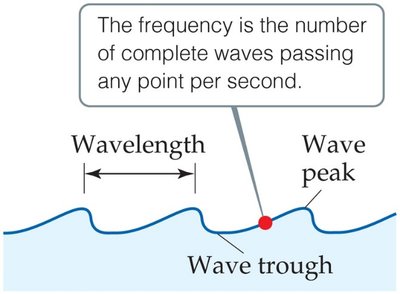
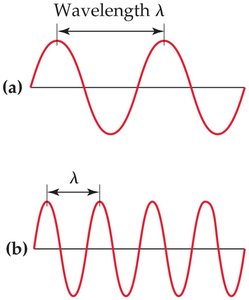
Electromagnetic Spectrum
All electromagnetic radiation travels at the same velocity, the speed of light (c):
Speed of light:
Relationship:
The electromagnetic spectrum includes gamma rays, X-rays, ultraviolet, visible, infrared, microwaves, and radio waves, each with characteristic wavelengths and energies.
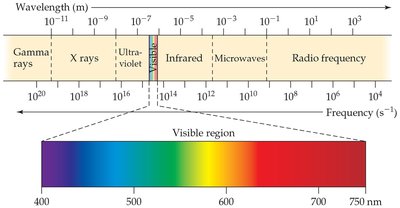
Wave-Particle Duality and Quantum Theory
Phenomena Not Explained by Classical Waves
Three key atomic phenomena require quantum explanations:
Blackbody radiation: Emission of light from hot objects.
Photoelectric effect: Emission of electrons from metal surfaces when illuminated.
Emission spectra: Light emission from excited gas atoms.
Quantization of Energy
Max Planck proposed that energy is quantized, coming in discrete packets called quanta (singular: quantum). This concept explains why objects glow at high temperatures.
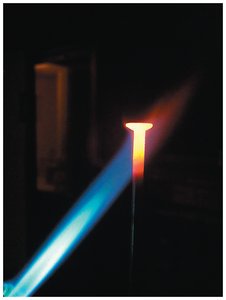

The Photoelectric Effect
Einstein explained the photoelectric effect using quanta. The energy of ejected electrons depends on the frequency of incident light:
Energy equation:
Planck's constant:
Atomic Emission and Spectra
Emission Spectra
Atoms emit light at discrete wavelengths, producing line spectra unique to each element. Unlike continuous spectra (rainbow), line spectra consist of specific colors.
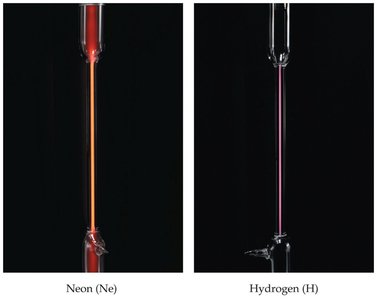

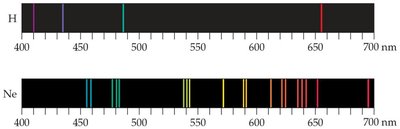

The Hydrogen Spectrum and Mathematical Relationships
Johann Balmer and Johannes Rydberg developed formulas relating spectral lines to integers. The Rydberg formula for hydrogen is:
Where is the Rydberg constant, and are integers.
The Bohr Model of the Atom
Bohr's Postulates
Niels Bohr explained atomic spectra by proposing:
Electrons occupy only certain allowed orbits with specific energies.
Electrons in allowed states do not radiate energy.
Energy is absorbed or emitted only when electrons transition between energy levels, as photons.
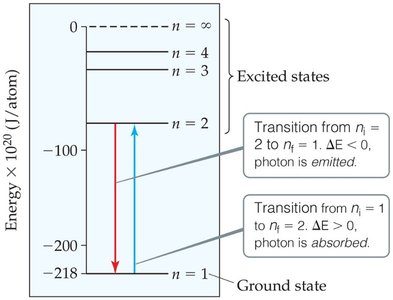
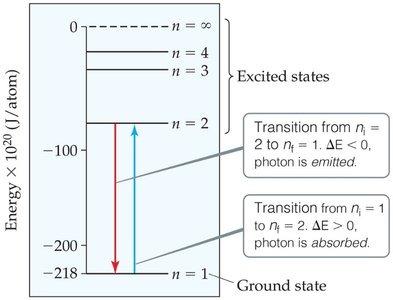
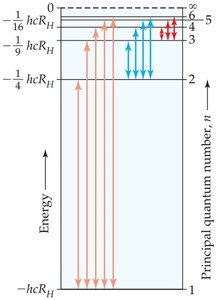
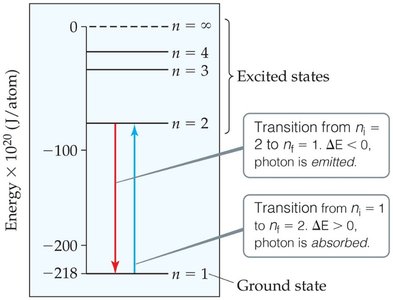
Energy Levels and Transitions
Electrons in the lowest energy state are in the ground state; higher energies are excited states. The energy change for transitions is:
Interpretation of Transition Values
Positive : Energy absorbed, photon absorbed ().
Negative : Energy released, photon emitted ().
Limitations and Legacy of the Bohr Model
The Bohr model only works for hydrogen and does not account for electron wave-like behavior. However, it introduced key ideas:
Electrons exist in discrete energy levels (quantum numbers).
Energy is involved in electron transitions.
The Wave Nature of Matter
de Broglie Hypothesis
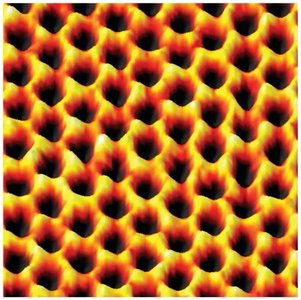
Louis de Broglie proposed that matter, like light, exhibits wave properties. The wavelength of a particle is:
Heisenberg Uncertainty Principle
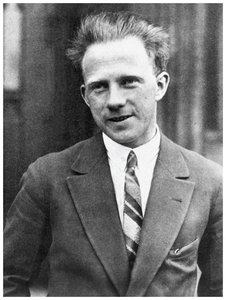
Werner Heisenberg showed that the more precisely a particle's momentum is known, the less precisely its position can be known:
Quantum Mechanics and Atomic Orbitals
Schrödinger Equation and Wave Functions
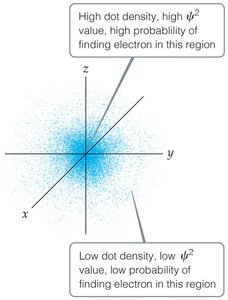
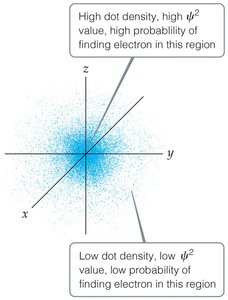
Erwin Schrödinger developed quantum mechanics, combining wave and particle nature. The solution yields wave functions (\psi), whose square gives electron density (probability of finding an electron).
Quantum Numbers
Each orbital is described by three quantum numbers:
Principal quantum number (n): Energy level, n ≥ 1.
Angular momentum quantum number (l): Shape of orbital, l = 0 to n-1. (s, p, d, f)
Magnetic quantum number (m_l): Orientation, m_l = -l to +l.
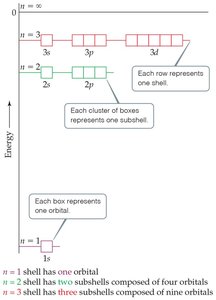
Orbitals with the same n form a shell; different types within a shell are subshells.
n | l | Subshell | m_l | Number of Orbitals |
|---|---|---|---|---|
1 | 0 | 1s | 0 | 1 |
2 | 0,1 | 2s, 2p | 0; -1,0,1 | 1; 3 |
3 | 0,1,2 | 3s, 3p, 3d | 0; -1,0,1; -2,-1,0,1,2 | 1; 3; 5 |
4 | 0,1,2,3 | 4s, 4p, 4d, 4f | 0; -1,0,1; -2,-1,0,1,2; -3,-2,-1,0,1,2,3 | 1; 3; 5; 7 |
Shapes and Properties of Atomic Orbitals
s Orbitals
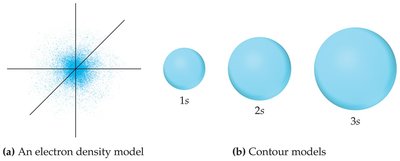
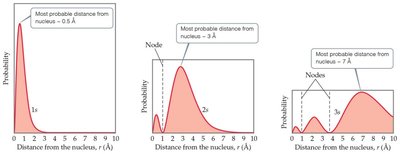
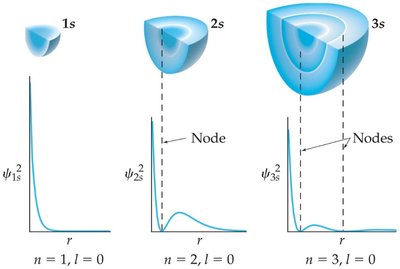
s orbitals (l = 0) are spherical. The radius increases with n. Electron density is more spread out as n increases.
p Orbitals
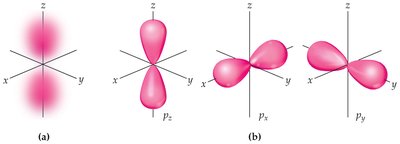
p orbitals (l = 1) have two lobes with a node between them. There are three p orbitals per energy level (px, py, pz).
d and f Orbitals
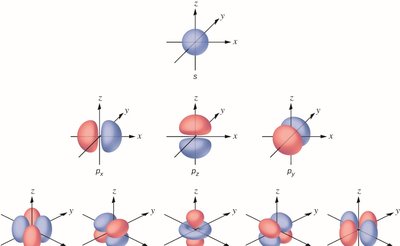
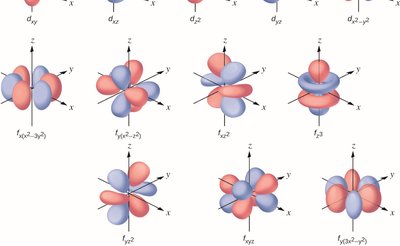
d orbitals (l = 2) have four lobes, except one with a doughnut shape. f orbitals (l = 3) have complex shapes and seven orbitals per sublevel.
Orbital Energies and Electron Configurations
Hydrogen vs. Many-Electron Atoms
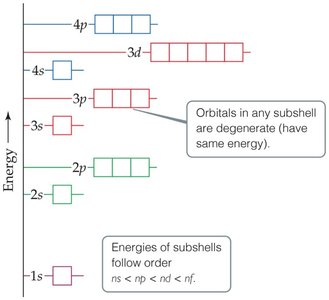
In hydrogen, all orbitals of the same energy level are degenerate (same energy). In many-electron atoms, electron repulsion causes energy splitting; not all orbitals of the same n are degenerate.
Spin Quantum Number (m_s) and Pauli Exclusion Principle
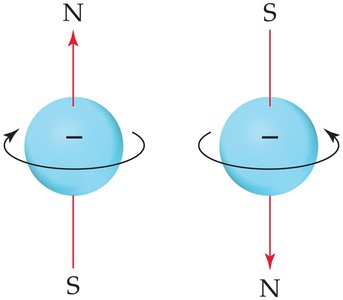
Electrons have a property called spin, described by m_s, which can be +1/2 or -1/2. The Pauli Exclusion Principle states that no two electrons in the same atom can have the same set of four quantum numbers.
Electron Configurations and Orbital Diagrams
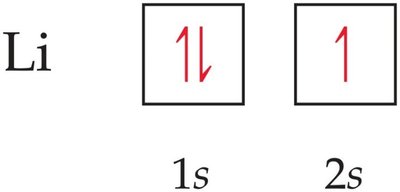
Electron configuration describes the distribution of electrons in an atom. The ground state is the lowest energy arrangement. Each configuration includes:
Energy level (number)
Type of orbital (letter)
Number of electrons (superscript)
Hund's Rule
When filling degenerate orbitals, electrons occupy separate orbitals with the same spin before pairing. This maximizes stability.
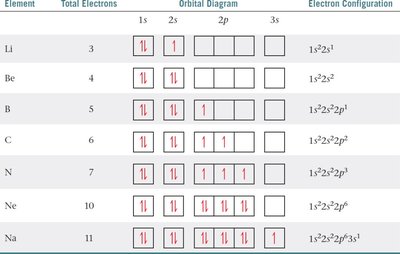
Condensed Electron Configurations
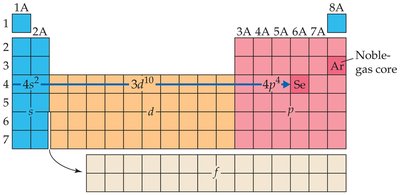
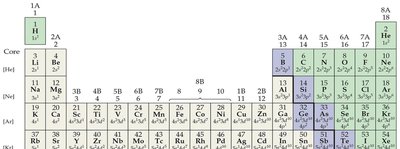
Condensed configurations use noble gas symbols in brackets to represent core electrons, listing only valence electrons. Elements in the same group have the same number of valence electrons.
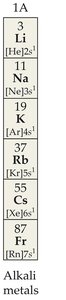
Transition Metals, Lanthanides, and Actinides
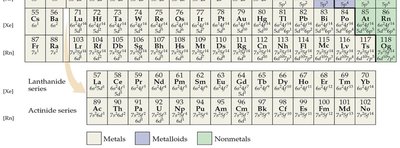
Transition metals fill 3d after 4s. Lanthanides (atomic numbers 57–70) fill 4f; actinides (including uranium and plutonium) fill 5f.
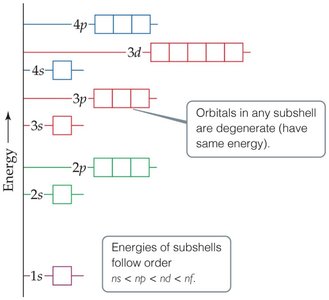
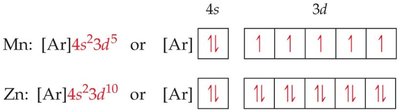
Periodic Table and Electron Configuration
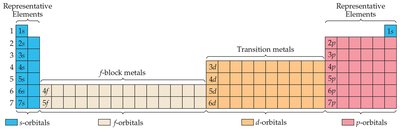
Orbital filling order follows the periodic table. Different blocks correspond to s, p, d, and f orbitals. Main-group elements are in the s and p blocks.
Electron Configuration Anomalies
Some elements, such as chromium, have irregular electron configurations due to the close energy of s and d orbitals. For example:
Chromium: [Ar] 4s1 3d5 (not [Ar] 4s2 3d4)
Similar anomalies occur in f-block elements.
Summary Table: Quantum Numbers and Orbitals
Quantum Number | Symbol | Allowed Values | Physical Meaning |
|---|---|---|---|
Principal | n | 1, 2, 3, ... | Energy level, size of orbital |
Angular Momentum | l | 0 to n-1 | Shape of orbital (s, p, d, f) |
Magnetic | m_l | -l to +l | Orientation in space |
Spin | m_s | +1/2, -1/2 | Spin direction |
Key Equations
Speed of light:
Energy of photon:
de Broglie wavelength:
Heisenberg uncertainty:
Rydberg formula:
Bohr energy levels:
Additional info: Academic context and expanded explanations were added to ensure completeness and clarity for exam preparation.
