 뒤로
Chapter 3: Electronic Structure of the Atom: Waves, Photons, and Quantum Theory
스터디 가이드 - 스마트 노트
 자료에 맞춘 맞춤형 노트, 핵심 정의, 예시, 맥락을 확장해 제공합니다.
Electronic Structure of the Atom
Introduction
The electronic structure of the atom is fundamental to understanding chemical properties and behavior. This chapter explores the nature of electromagnetic radiation, the dual properties of light and matter, and the quantum mechanical model of the atom.
Electromagnetic Radiation
Wave Properties of Electromagnetic Radiation
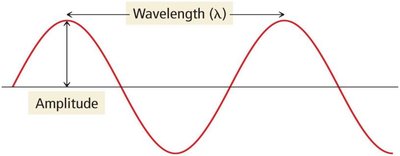
Electromagnetic radiation is energy that travels through space as waves. The main properties of these waves are wavelength, amplitude, frequency, and speed.
Wavelength (\(\lambda\)): The distance between two consecutive peaks or troughs in a wave. Units: meters (m), nanometers (nm), etc.
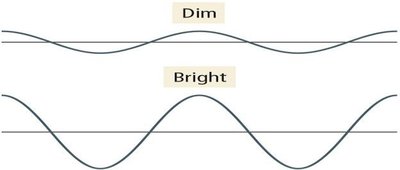
Amplitude (A): The height of the wave from the center to the peak or trough. It measures light intensity; higher amplitude means brighter light.
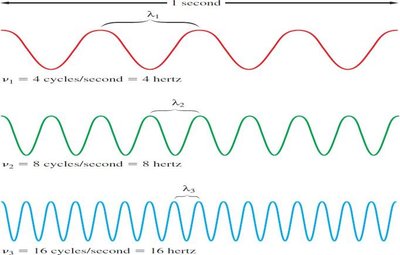
Frequency (\(\nu\)): The number of waves passing a point per second. Units: Hertz (Hz) = 1/s.
Speed (c): The speed of light in a vacuum is \(3.00 \times 10^8\) m/s. Related by \(c = \lambda \nu\).
The Electromagnetic Spectrum
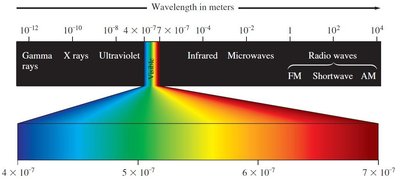
The electromagnetic spectrum includes all types of electromagnetic radiation, from gamma rays to radio waves. Visible light is only a small portion of this spectrum.
Gamma rays: Highest frequency, shortest wavelength.
Radio waves: Lowest frequency, longest wavelength.
Visible light: Different wavelengths correspond to different colors.
Dual Properties of Light: Wave-Particle Duality
Quantization of Energy and Photons
Experiments such as blackbody radiation, the photoelectric effect, and atomic line spectra demonstrated that light energy is quantized, not continuous. Light can behave as both a wave and a particle (photon).
Planck: Energy is quantized; only emitted or absorbed in discrete amounts.
Einstein: Light consists of particles called photons; explained the photoelectric effect.
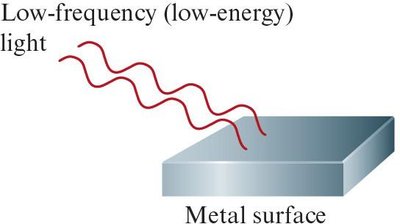
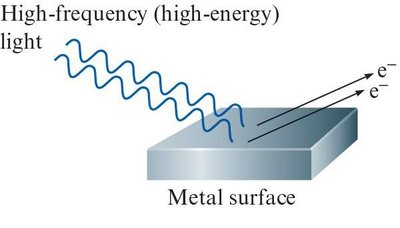
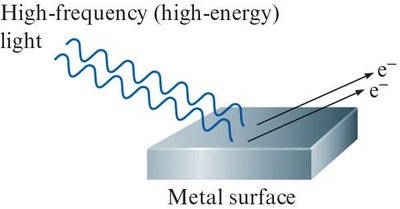
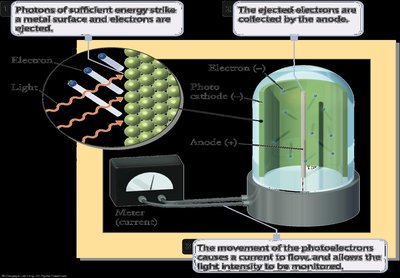
Photoelectric Effect: Electrons are emitted from a metal surface when struck by light above a threshold frequency.


Photoelectric Effect: Characteristics and Applications
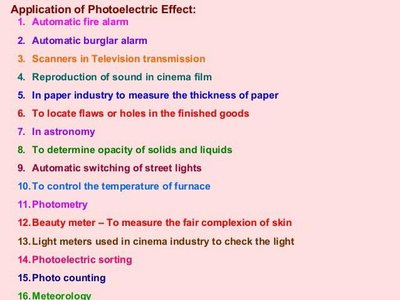
The photoelectric effect shows that light must have a minimum frequency to eject electrons from a metal. Increasing intensity increases the number of electrons, but not their energy unless frequency is increased.
Work function (\(\Phi\)): Minimum energy needed to remove an electron from a metal.
Energy of a photon: \(E = h\nu = \frac{hc}{\lambda}\), where \(h\) is Planck's constant.

The Atomic Spectrum and Bohr Model
Atomic Line Spectra
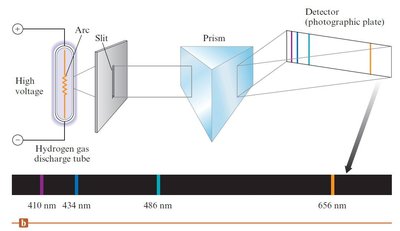
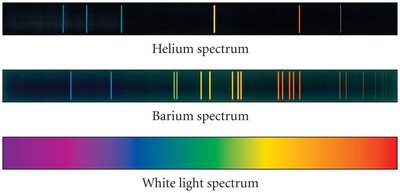
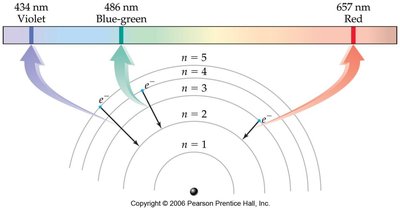
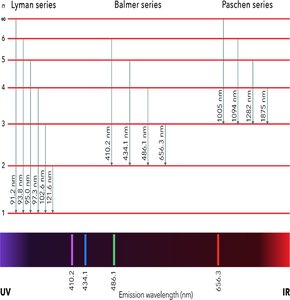
Atoms emit light at specific wavelengths, producing line spectra. Each element has a unique set of spectral lines, which can be used for identification.
Continuous spectrum: Contains all wavelengths of visible light.
Line spectrum: Contains only specific wavelengths.



Bohr Model of the Atom
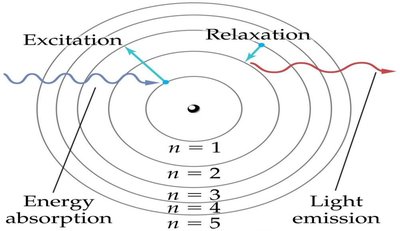
Niels Bohr proposed that electrons travel in discrete energy levels (orbits) around the nucleus. Energy is absorbed or emitted when electrons transition between these levels.
Ground state: Lowest energy level (n=1).
Excited state: Higher energy levels (n>1).
Absorption: Electron moves to higher n; photon absorbed.
Emission: Electron moves to lower n; photon emitted.

Calculating Energies and Wavelengths: Rydberg Equation
The energy and wavelength of photons emitted or absorbed during electron transitions in hydrogen can be calculated using the Rydberg equation:
Rydberg Equation:

Quantum Mechanical Model of the Atom
Wave-Particle Duality and the Schrödinger Equation
Modern atomic theory describes electrons as having both wave and particle properties. The Schrödinger equation provides a mathematical description of electron behavior, leading to the concept of atomic orbitals.
de Broglie Hypothesis: Matter (including electrons) has wavelike character. Wavelength is given by .
Heisenberg Uncertainty Principle: It is impossible to know both the position and momentum of an electron with certainty.
Wave function (\(\psi\)): Describes the probability of finding an electron in a region of space.
Quantum Numbers and Atomic Orbitals
Quantum numbers describe the properties of atomic orbitals and the electrons within them:
Principal quantum number (n): Size and energy of the orbital.
Angular momentum quantum number (l): Shape of the orbital (s, p, d, f).
Magnetic quantum number (ml): Orientation of the orbital in space.
Spin quantum number (ms): Spin of the electron (+½ or -½).
Pauli Exclusion Principle: No two electrons in an atom can have the same four quantum numbers; each orbital can hold two electrons with opposite spins.
Electron Configurations and the Periodic Table
Aufbau Principle, Hund’s Rule, and Electron Filling Order
Electrons fill orbitals in order of increasing energy, following the Aufbau principle, Pauli exclusion principle, and Hund’s rule.
Aufbau Principle: Electrons occupy the lowest energy orbitals first.
Hund’s Rule: Electrons fill degenerate orbitals singly before pairing.
Pauli Exclusion Principle: No more than two electrons per orbital, with opposite spins.
Valence, Core, and Outer Electrons
Valence electrons are those involved in chemical bonding. For main group elements, valence electrons are the outer electrons. For transition elements, valence electrons include outer electrons and (n-1)d electrons.
Periodic Trends in Atomic Properties
Atomic and Ionic Size
Atomic radius increases down a group and decreases across a period. Ionic radius depends on whether the atom is a cation or anion.
Cations: Smaller than their neutral atoms.
Anions: Larger than their neutral atoms.
Isoelectronic series: Atoms/ions with the same number of electrons; the one with more protons is smaller.
Ionization Energy and Electron Affinity
Ionization energy is the energy required to remove an electron; it increases across a period and decreases down a group. Electron affinity is the energy released when an atom gains an electron; it generally becomes more negative across a period.
Metallic Character
Metallic character increases down a group and decreases across a period. Metals tend to lose electrons, while nonmetals tend to gain electrons.
Summary
The electromagnetic spectrum and wave properties of light
Dual properties of matter and quantization of energy
Photoelectric effect and photon energy
Atomic line spectra and the Bohr model
Quantum mechanical model, quantum numbers, and atomic orbitals
Electron configurations and periodic trends
