 뒤로
lecture 8 (ns) Enthalpy and Calorimetry: Energy Changes in Chemical Reactions
스터디 가이드 - 스마트 노트
 자료에 맞춘 맞춤형 노트, 핵심 정의, 예시, 맥락을 확장해 제공합니다.
Enthalpy and Calorimetry
Types of Energy
Energy is the capacity to do work and is fundamental to all physical and chemical changes. In chemistry, energy is categorized into two main types: kinetic energy (energy of motion) and potential energy (energy due to position or composition). Kinetic energy includes thermal energy, which is associated with temperature, while potential energy includes chemical energy, which is related to the positions of electrons and nuclei in atoms and molecules.
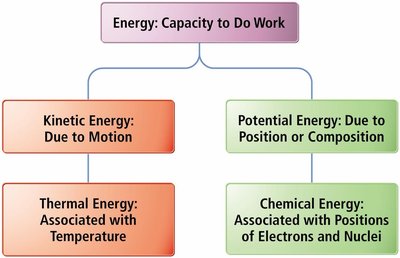
Kinetic Energy: Energy due to motion, such as the movement of molecules.
Potential Energy: Energy due to position or composition, such as the arrangement of atoms in a molecule.
Chemical Potential Energy: Energy stored in chemical bonds, released or absorbed during chemical reactions.
Thermal Energy: The energy associated with the temperature of a substance.
Energy Units
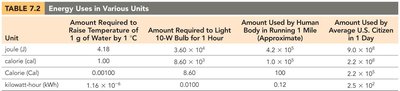
The SI unit of energy is the joule (J), defined as 1 kg·m2/s2. Other common units include the calorie (cal), where 1 cal = 4.184 J, and the kilowatt-hour (kWh). Energy units are used to quantify the amount of energy transferred or transformed in chemical processes.
Unit | Amount Required to Raise Temperature of 1 g of Water by 1°C | Amount Required to Light 10-W Bulb for 1 Hour | Amount Used by Human Body in Running 1 Mile | Amount Used by Average U.S. Citizen in 1 Day |
|---|---|---|---|---|
joule (J) | 4.18 | 3.6 × 10⁴ | 4.2 × 10⁴ | 9.0 × 10⁶ |
calorie (cal) | 1.00 | 8.60 | 10.0 | 2.2 × 10⁶ |
Calorie (Cal) | 0.00100 | 0.00860 | 0.10 | 2.2 × 10³ |
kilowatt-hour (kWh) | 1.16 × 10⁻⁶ | 0.010 | 0.12 | 2.5 × 10⁻¹ |
Conservation of Energy
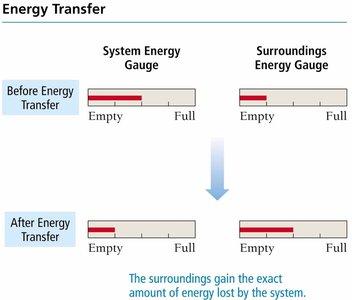
The law of conservation of energy states that energy cannot be created or destroyed, only transferred between the system and its surroundings. The change in energy of the system is equal and opposite to the change in energy of the surroundings:
Equation:
Energy lost by the system is gained by the surroundings, and vice versa.
Internal Energy
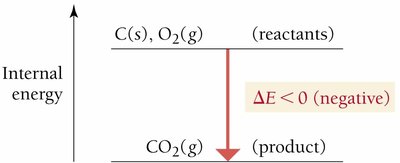
The internal energy (E) of a system is the sum of its kinetic and potential energies. Internal energy is a state function, meaning it depends only on the initial and final states, not the path taken. The change in internal energy () can be measured as:
Equation:
Equation:
State Functions
State functions are properties that depend only on the state of the system, not on how it got there. Examples include energy, pressure, enthalpy, temperature, and volume. For internal energy, only the initial and final values matter.
State Function Examples: Energy, Pressure, Enthalpy, Temperature, Volume
Energy Transfer: Heat and Work
Energy is transferred between the system and surroundings as heat (q) and work (w). The total change in internal energy is given by:
Equation:
Sign Conventions:
q (+): System gains thermal energy
q (–): System loses thermal energy
w (+): Work done on the system
w (–): Work done by the system
(+): Energy flows into system
(–): Energy flows out of system

Heat (q) and Heat Capacity (C)
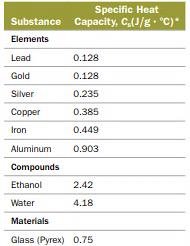
Heat is calculated from the temperature change of a substance. The specific heat capacity (c) is the amount of heat required to raise the temperature of 1 gram of a substance by 1°C. The formula for heat is:
Equation:
Where m is mass (g), c is specific heat capacity (J/g·°C), and is temperature change (°C).
Substance | Specific Heat Capacity, (J/g·°C) |
|---|---|
Lead | 0.128 |
Gold | 0.128 |
Silver | 0.235 |
Copper | 0.385 |
Iron | 0.449 |
Aluminum | 0.903 |
Ethanol | 2.42 |
Water | 4.18 |
Glass (Pyrex) | 0.75 |
Calorimetry
Calorimetry is the measurement of heat transfer in chemical reactions. There are two main types: constant volume calorimetry (bomb calorimetry) and constant pressure calorimetry (coffee cup calorimetry).
Constant Volume Calorimetry: Measures at constant volume, where and .
Constant Pressure Calorimetry: Measures at constant pressure, where .
Pressure–Volume Work
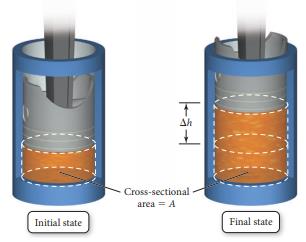
When a system expands or contracts against an external pressure, it does work. The work done is given by:
Equation:
Where is the external pressure and is the change in volume.
Enthalpy (H)
Enthalpy (H) is the sum of internal energy and the product of pressure and volume. At constant pressure, the change in enthalpy () is the heat gained or lost:
Equation:
Equation:
Endothermic Process: (heat absorbed)
Exothermic Process: (heat released)
Thermochemical Equations
Thermochemical equations show both the chemical changes and the associated energy changes. The sign of indicates whether the reaction is endothermic or exothermic.
Example (Endothermic): , kJ/mol
Example (Exothermic): , kJ/mol
Reaction Energy and Stoichiometry
Energy changes in reactions can be calculated using stoichiometry. For example, the combustion of propane:
Equation: , kJ/mol
To find energy released when 5.00 g of CO2 is produced:
Calculation:
Calorimetry Practice
Calorimetry can be used to determine the energy change in a reaction, such as the combustion of biphenyl in a bomb calorimeter:
Equation:
Example:
Energy per mole:
Summary Table: Specific Heat Capacities
Substance | Specific Heat Capacity, (J/g·°C) |
|---|---|
Lead | 0.128 |
Gold | 0.128 |
Silver | 0.235 |
Copper | 0.385 |
Iron | 0.449 |
Aluminum | 0.903 |
Ethanol | 2.42 |
Water | 4.18 |
Glass (Pyrex) | 0.75 |
Additional info: All equations are provided in LaTeX format for clarity and academic rigor. Practice problems and worked examples reinforce the application of concepts in calorimetry and enthalpy calculations.
