 뒤로
Exam 1 Study Guide: Liquids, Solutions, and Chemical Kinetics
스터디 가이드 - 스마트 노트
 자료에 맞춘 맞춤형 노트, 핵심 정의, 예시, 맥락을 확장해 제공합니다.
Chapter 11 – Liquids and Intermolecular Forces
11.1 Molecular Comparison of Gases, Liquids, and Solids
This section explores the differences between gases, liquids, and solids, focusing on the role of intermolecular forces (IM forces) in determining physical state.
Intermolecular Forces (IM Forces): Attractive forces between molecules, distinct from the stronger intramolecular (covalent or ionic) bonds within molecules.
Strength and Physical State: Solids have the strongest IM forces, followed by liquids, then gases with the weakest.
Example: Water is liquid at room temperature due to strong hydrogen bonding, while methane is a gas due to weak dispersion forces.
Comparison: Ionic bonds > Covalent bonds > IM forces (ion-dipole > hydrogen bonding > dipole-dipole > dispersion).
11.2 Types of Intermolecular Forces
Four main types of IM forces are discussed, each with unique characteristics and effects on physical properties.
Dispersion Forces: Present in all molecules; arise from temporary dipoles. Weakest IM force.
Dipole-Dipole Interactions: Occur between polar molecules; strength depends on dipole moment.
Hydrogen Bonding: Special dipole-dipole interaction involving H bonded to N, O, or F. Strongest among molecular IM forces.
Ion-Dipole Interactions: Occur between ions and polar molecules; important in solutions.
Boiling/Melting Points: Higher IM force strength leads to higher boiling/melting points.
Ranking Example: H2O (hydrogen bonding) > CH3Cl (dipole-dipole) > CH4 (dispersion).
Chapter 13 – Properties of Solutions
13.1 The Solution Process
Solutions form due to a natural tendency for substances to mix, driven by entropy and intermolecular forces.
Entropy: A measure of disorder; higher entropy is more favorable.
Solvation: The process of surrounding solute particles with solvent molecules; hydration is solvation in water.
IM Forces: The predominant IM force in a solution depends on the solute and solvent.
Example: NaCl dissolving in water involves ion-dipole interactions.
13.2 Saturated Solutions and Solubility
Solubility describes how much solute can dissolve in a solvent at a given temperature, with equilibrium between dissolving and crystallizing.
Saturated Solution: Contains the maximum amount of dissolved solute; equilibrium exists between dissolved and undissolved solute.
Supersaturated Solution: Contains more solute than equilibrium allows; unstable.
Solubility Factors: IM forces, temperature, and pressure affect solubility.
Example: Sugar is more soluble in hot water than cold.
13.3 Factors Affecting Solubility
Solubility and miscibility depend on IM forces, molecular polarity, temperature, and pressure.
Miscible: Liquids that mix in all proportions (e.g., ethanol and water).
Immiscible: Liquids that do not mix (e.g., oil and water).
"Like Dissolves Like": Polar solvents dissolve polar solutes; nonpolar solvents dissolve nonpolar solutes.
Pressure: Affects gas solubility; described by Henry’s Law:
Temperature: Solubility of solids generally increases with temperature; gas solubility decreases.
13.4 Expressing Solution Concentration
Several units are used to express solution concentration, each with specific formulas and applications.
Mass Percent:
ppm/ppb: ;
Mole Fraction:
Molarity (M):
Molality (m):
Conversion: Use molar mass and density for unit conversions.
Example: Calculate molarity from grams and volume.
13.5 Colligative Properties
Colligative properties depend on the number of solute particles, not their identity, and include freezing-point depression and boiling-point elevation.
Colligative Property: Property that depends on solute concentration.
Freezing-Point Depression:
Boiling-Point Elevation:
van’t Hoff Factor (i): Number of particles produced per formula unit; for nonelectrolytes, for electrolytes.
Example: NaCl in water ().
Chapter 14 – Chemical Kinetics
14.1 Reaction Rates
Chemical kinetics studies the speed of reactions and the factors that affect them.
Rate of Reaction: Change in concentration of reactant/product per unit time; units: M/s.
Factors Affecting Rate: Concentration, temperature, surface area, and presence of catalyst.
Average Rate:
Stoichiometry: Rate expressions must account for coefficients in the balanced equation.
Example: For ,
14.2 Reaction Laws and Rate Constants
Rate laws describe how reaction rate depends on reactant concentrations, with the rate constant (k) indicating speed.
Rate Law:
Reaction Order: Exponents m and n; overall order is .
Rate Constant (k): Units depend on reaction order; larger k means faster reaction.
Method of Initial Rates: Used to determine reaction order from experimental data.
Example: If doubling [A] doubles rate, order in A is 1.
14.3 Integrated Rate Laws
Integrated rate laws relate concentration to time for different reaction orders, allowing determination of rate order from data graphs.
Zero Order:
First Order:
Second Order:
Graph Linearity: Linear plot of [A] vs time (zero order), ln[A] vs time (first order), 1/[A] vs time (second order).
Slope: Slope of line equals -k or k, depending on order.
Example: Use integrated rate law to solve for k or [A] at a given time.
14.4 Temperature and Rate
Temperature affects reaction rate by influencing activation energy, as described by the Arrhenius equation.
Activation Energy (Ea): Minimum energy required for reaction; higher Ea means slower rate.
Arrhenius Equation:
Exothermic vs Endothermic: Energy diagrams differ in relative positions of reactants and products.
Temperature: Higher temperature increases rate by lowering effective Ea.
14.6 Catalysis
Catalysts increase reaction rate by lowering activation energy, without being consumed in the reaction.
Catalyst: Substance that speeds up a reaction by providing an alternative pathway with lower Ea.
Effect: Rate increases, but catalyst is not consumed.
Example: Enzymes are biological catalysts.
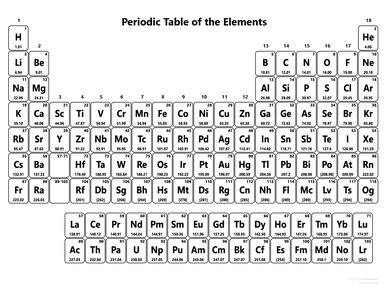
Additional info: The periodic table is included as a reference for element properties, atomic masses, and to support calculations involving molar mass and chemical formulas, which are essential for solution concentration and reaction stoichiometry.
