 뒤로
General Chemistry 121: Matter, Measurement, and Atomic Structure
스터디 가이드 - 스마트 노트
 자료에 맞춘 맞춤형 노트, 핵심 정의, 예시, 맥락을 확장해 제공합니다.
Introduction to Chemistry
Overview of Chemistry 121
Chemistry 121 introduces the foundational concepts of matter, energy, and measurement, as well as the structure of atoms, molecules, and ions. These topics are essential for understanding chemical reactions and the properties of substances.
Matter: Anything that has mass and occupies space.
Energy: The capacity to do work or produce heat.
Measurement: Quantitative observation involving numbers and units.
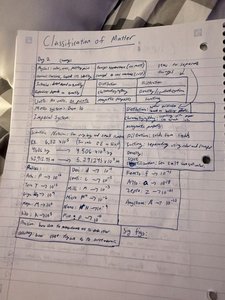
Classification of Matter
Types of Matter
Matter can be classified based on its physical state and composition. Understanding these classifications is crucial for identifying substances and predicting their behavior in chemical processes.
States of Matter: Solid, Liquid, Gas
Pure Substances: Elements and compounds with fixed composition and distinct properties.
Mixtures: Physical combinations of two or more substances. Can be homogeneous (uniform composition) or heterogeneous (non-uniform composition).
Examples: Salt water (homogeneous mixture), sand and iron filings (heterogeneous mixture), oxygen gas (element), water (compound).
Physical and Chemical Properties
Properties of matter are used to distinguish between substances and to separate them. These properties can be classified as physical or chemical.
Physical Properties: Can be observed without changing the identity of the substance (e.g., color, melting point, density).
Chemical Properties: Describe how a substance reacts with other substances (e.g., flammability, reactivity with acid).
Physical and Chemical Changes
Changes in matter can be classified as physical or chemical.
Physical Change: Alters the form or appearance but not the composition (e.g., melting, boiling).
Chemical Change: Results in the formation of new substances (e.g., rusting of iron, combustion).
Measurement and Uncertainty
Scientific Measurement
Measurements in chemistry require accuracy and precision. The International System of Units (SI) is used for standardization.
SI Base Units: Meter (m) for length, kilogram (kg) for mass, second (s) for time, kelvin (K) for temperature, mole (mol) for amount of substance.
Derived Units: Formed from combinations of base units (e.g., m/s for speed).
Uncertainty in Measurement
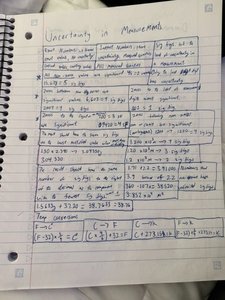
All measurements have some degree of uncertainty, which is reflected in significant figures and error analysis.
Accuracy: How close a measurement is to the true value.
Precision: How close repeated measurements are to each other.
Significant Figures: Digits in a measurement that are known with certainty plus one estimated digit.
Example: The measurement 4.56 g has three significant figures.
Scientific Notation and Unit Conversions
Scientific notation is used to express very large or small numbers. Unit conversions are performed using conversion factors.
Scientific Notation: where and is an integer.
Conversion Factors: Ratios used to convert from one unit to another.
Example: To convert 5.0 cm to meters:
Temperature Scales
Temperature can be measured in Celsius, Kelvin, or Fahrenheit. Conversions between these scales are common in chemistry.
Celsius to Kelvin:
Celsius to Fahrenheit:
Fahrenheit to Celsius:
Atoms, Molecules, and Ions
Atomic Structure
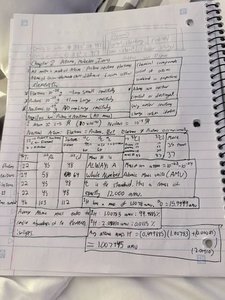
Atoms are the basic units of matter, composed of protons, neutrons, and electrons. The arrangement and number of these subatomic particles determine the properties of elements.
Proton: Positively charged particle in the nucleus.
Neutron: Neutral particle in the nucleus.
Electron: Negatively charged particle outside the nucleus.
Atomic Number (Z): Number of protons in the nucleus.
Mass Number (A): Total number of protons and neutrons.
Isotopes: Atoms of the same element with different numbers of neutrons.
Elements and Compounds
Elements are pure substances consisting of only one type of atom. Compounds are substances composed of two or more elements chemically combined in fixed ratios.
Example of Element: Oxygen (O2), Gold (Au)
Example of Compound: Water (H2O), Sodium chloride (NaCl)
Ions and Ionic Compounds
Ions are atoms or molecules that have gained or lost electrons, resulting in a net charge. Ionic compounds are formed from the electrostatic attraction between cations and anions.
Cation: Positively charged ion (e.g., Na+)
Anion: Negatively charged ion (e.g., Cl-)
Example: Sodium chloride (NaCl) is composed of Na+ and Cl- ions.
Atomic Mass and the Mole
The atomic mass of an element is the weighted average of the masses of its isotopes. The mole is a counting unit used to express amounts of a chemical substance.
Atomic Mass Unit (amu): 1/12 the mass of a carbon-12 atom.
Mole: entities (Avogadro's number).
Molar Mass: Mass of one mole of a substance, expressed in grams per mole (g/mol).
Example: 1 mole of carbon-12 has a mass of exactly 12 g.
Summary Table: Classification of Matter
Type | Description | Example |
|---|---|---|
Element | Pure substance, one type of atom | O2, Au |
Compound | Pure substance, two or more elements chemically combined | H2O, NaCl |
Homogeneous Mixture | Uniform composition throughout | Salt water, air |
Heterogeneous Mixture | Non-uniform composition | Sand and iron filings, salad |
Additional info: These notes provide a foundation for understanding more advanced topics in chemistry, such as chemical reactions, stoichiometry, and atomic theory.
