 뒤로
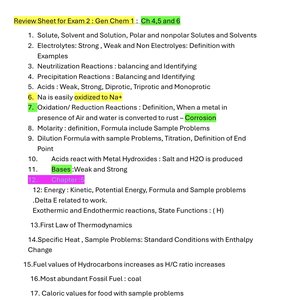
General Chemistry Exam 2 Review: Chapters 4, 5, and 6 Study Notes
스터디 가이드 - 스마트 노트
 자료에 맞춘 맞춤형 노트, 핵심 정의, 예시, 맥락을 확장해 제공합니다.
Review Sheet for Exam 2: General Chemistry I
Chapters 4, 5, and 6 Overview
This review sheet covers essential topics from Chapters 4, 5, and 6 of a General Chemistry I course, focusing on reactions in aqueous solution, thermochemistry, and electronic structure. The following study notes expand on each listed topic, providing definitions, examples, and key equations.
Reactions in Aqueous Solution
Solute, Solvent, and Solution; Polar and Nonpolar Solutes and Solvents
Understanding the nature of solutions is fundamental in chemistry. A solute is the substance dissolved, while the solvent is the substance doing the dissolving. Solutions can be classified based on the polarity of their components:
Polar solutes dissolve in polar solvents (e.g., salt in water).
Nonpolar solutes dissolve in nonpolar solvents (e.g., oil in hexane).
Example: Sugar (polar) dissolves in water (polar), but not in oil (nonpolar).
Electrolytes: Strong, Weak, and Non-Electrolytes
Electrolytes are substances that produce ions when dissolved in water, enabling the solution to conduct electricity.
Strong electrolytes: Completely dissociate into ions (e.g., NaCl).
Weak electrolytes: Partially dissociate (e.g., acetic acid).
Non-electrolytes: Do not produce ions (e.g., sugar).
Example: (strong electrolyte)
Neutralization Reactions
Neutralization occurs when an acid reacts with a base to produce water and a salt.
General equation:
Example:
Precipitation Reactions
Precipitation reactions involve the formation of an insoluble product (precipitate) when two solutions are mixed.
Balancing: Ensure the number of atoms and charges are equal on both sides.
Identifying: Use solubility rules to predict if a precipitate will form.
Example:
Acids: Weak, Strong, Diprotic, Triprotic, and Monoprotic
Acids are classified by their strength and the number of protons (H+) they can donate.
Strong acids: Completely ionize (e.g., HCl).
Weak acids: Partially ionize (e.g., acetic acid).
Monoprotic: Donate one proton (e.g., HCl).
Diprotic: Donate two protons (e.g., H2SO4).
Triprotic: Donate three protons (e.g., H3PO4).
Oxidation and Reduction Reactions
Oxidation-reduction (redox) reactions involve the transfer of electrons between substances.
Oxidation: Loss of electrons (e.g., Na is easily oxidized to Na+).
Reduction: Gain of electrons.
Corrosion: A metal reacts with air and water, converting to rust (iron oxide).
Example: (rust formation)
Polarity: Definition and Formula
Polarity refers to the distribution of electrical charge over the atoms in a molecule.
Formula: Dipole moment where is charge and is distance.
Sample problems: Calculate dipole moments for molecules like HCl.
Acids React with Metal Hydroxides
Acids react with metal hydroxides to form a salt and water.
General equation:
Example:
Bases: Weak and Strong
Bases are substances that accept protons or donate hydroxide ions in solution.
Strong bases: Completely dissociate (e.g., NaOH).
Weak bases: Partially dissociate (e.g., NH3).
Thermochemistry
Energy: Kinetic, Potential, and Internal Energy
Thermochemistry studies the energy changes during chemical reactions.
Kinetic energy: Energy of motion.
Potential energy: Stored energy due to position.
Internal energy: Total energy contained within a system.
Formula: where is heat and is work.
Enthalpy and State Functions
Enthalpy (H) is the heat content of a system at constant pressure. State functions depend only on the initial and final states, not the path taken.
Formula:
Example: Calculating enthalpy change for a reaction.
First Law of Thermodynamics
The first law states that energy cannot be created or destroyed, only transferred.
Equation:
Application: Energy changes in chemical reactions.
Specific Heat and Standard Conditions
Specific heat is the amount of heat required to raise the temperature of one gram of a substance by one degree Celsius.
Formula:
Standard conditions: 1 atm pressure, 25°C temperature.
Properties of Hydrocarbons and Fossil Fuels
Hydrocarbons and Caloric Values
Hydrocarbons are compounds composed of hydrogen and carbon. Their caloric value increases as the hydrogen-to-carbon ratio increases.
Example: Methane (CH4) has a higher caloric value than coal.
Caloric value: Amount of energy released during combustion.
Fossil Fuels: Coal
Coal is a major fossil fuel used for energy production. Its caloric value can be calculated using sample problems.
Application: Calculating energy output from coal combustion.
Summary Table: Types of Electrolytes
Type | Definition | Example |
|---|---|---|
Strong Electrolyte | Completely dissociates in water | NaCl |
Weak Electrolyte | Partially dissociates in water | CH3COOH |
Non-Electrolyte | Does not dissociate in water | Sucrose |
Summary Table: Types of Acids
Type | Definition | Example |
|---|---|---|
Monoprotic | Donates one proton | HCl |
Diprotic | Donates two protons | H2SO4 |
Triprotic | Donates three protons | H3PO4 |
Additional info: Some details, such as sample problems and specific formulas, were inferred based on standard General Chemistry curriculum topics for Chapters 4, 5, and 6.
