 뒤로
General Chemistry Exam 2 Study Guide: Chemical Bonding, Stoichiometry, Solutions, and Redox
스터디 가이드 - 스마트 노트
 자료에 맞춘 맞춤형 노트, 핵심 정의, 예시, 맥락을 확장해 제공합니다.
Chemical Bonding
Ionic and Covalent Bonds
Chemical bonds are the forces that hold atoms together in compounds. The two main types are ionic bonds and covalent bonds.
Ionic bonds: Formed between metals and nonmetals, where electrons are transferred from one atom to another, resulting in positive and negative ions (e.g., CaO).
Covalent bonds: Formed between nonmetals, where electrons are shared between atoms (e.g., F2, CO2).
Example: CaO is an ionic compound, while F2 is covalent.
Stoichiometry and Chemical Quantities
Mole Calculations
The mole is a fundamental unit in chemistry for counting particles. The number of moles is calculated using the formula:
Formula:
Example: To find moles in 10.1 g of sucrose (C12H22O11), use its molar mass.
Empirical and Molecular Formulas
The empirical formula is the simplest whole-number ratio of atoms in a compound. The molecular formula shows the actual number of atoms.
Example: C12H24O4 has an empirical formula of C3H6O.
Naming Compounds
Compounds are named according to their composition and type:
FeSO3: Iron(II) sulfite
HI (aq): Hydroiodic acid
Potassium phosphate: K3PO4
Chemical Reactions and Balancing Equations
Balancing Chemical Equations
Balancing equations ensures the conservation of mass. Coefficients are used to balance the number of atoms on each side.
Example: KClO3 → KCl + O2 (coefficient for O2 is 3)
Stoichiometry in Reactions
Stoichiometry involves calculating reactants and products in a chemical reaction.
Example: 3 CuO + 2 Al → 3 Cu + Al2O3 (theoretical yield of copper depends on limiting reagent)
Percent yield:
Solutions and Concentration
Molarity and Solution Preparation
Molarity (M) is the concentration of a solution, defined as moles of solute per liter of solution.
Formula:
Example: To prepare 600 mL of 0.125 M Ca(NO3)2, calculate the required mass using molar mass.
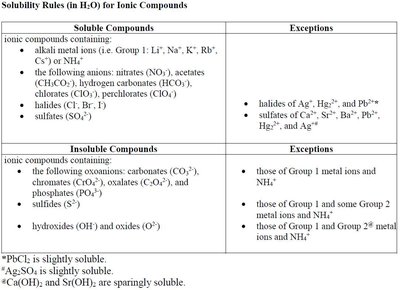
Solubility Rules for Ionic Compounds
Solubility rules help predict whether an ionic compound will dissolve in water.
Soluble compounds: Contain alkali metal ions, ammonium, nitrates, acetates, chlorates, perchlorates, halides (except Ag+, Hg22+, Pb2+), and sulfates (except Ba2+, Sr2+, Pb2+).
Insoluble compounds: Contain carbonates, chromates, oxalates, phosphates, sulfides, hydroxides, and oxides (except Group 1 and 2 metals and NH4+).
Electrolytes and Solution Properties
Strong vs. Weak Electrolytes
An electrolyte is a substance that produces ions in solution. Strong electrolytes dissociate completely, while weak electrolytes only partially dissociate.
Strong electrolytes: NaCl, BaCl2, HNO3, HI
Weak electrolytes: HF
Redox Reactions and Oxidation Numbers
Oxidation Numbers
The oxidation number indicates the charge an atom would have if electrons were transferred completely. It is used to identify redox reactions.
Example: Hydrogen in CaH2 has an oxidation number of –1.
Identifying Oxidizing Agents
The oxidizing agent is the species that causes oxidation by accepting electrons.
Example: In Zn + 2 AgClO4 → Zn(ClO4)2 + 2 Ag, AgClO4 is the oxidizing agent.
Oxidation-Reduction (Redox) Reactions
Redox reactions involve the transfer of electrons between species, changing their oxidation numbers.
Example: Mg (s) + 2 HCl (aq) → MgCl2 (aq) + H2 (g) is a redox reaction.
Net Ionic Equations
Writing Net Ionic Equations
Net ionic equations show only the species that participate in the reaction, omitting spectator ions.
Example: Ba2+ (aq) + SO42– (aq) → BaSO4 (s)
Mathematical Operations and Physical Constants
Common Conversions and Constants
Chemistry uses various physical constants and unit conversions:
Avogadro's number:
Mass, density, volume:
Temperature conversions: ,
Periodic Table and Element Properties
Periodic Table Overview
The periodic table organizes elements by atomic number and properties. It is essential for identifying element types, atomic masses, and predicting chemical behavior.
Example: Group 1 elements are alkali metals, Group 2 are alkaline earth metals.
