 뒤로
General Chemistry Foundational Concepts: Measurement, Density, and Classification
스터디 가이드 - 스마트 노트
 자료에 맞춘 맞춤형 노트, 핵심 정의, 예시, 맥락을 확장해 제공합니다.
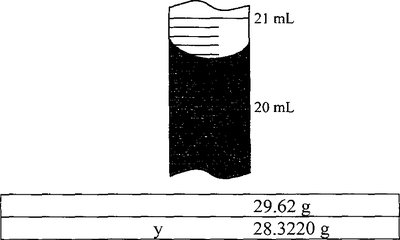
Q1. What is the correct reading of the graduated cylinder to the proper number of significant figures?
Background
Topic: Measurement and Significant Figures
This question tests your ability to read a graduated cylinder accurately and report the measurement using the correct number of significant figures. Understanding how to read the meniscus and estimate the last digit is essential for precise measurements in chemistry.
Key Terms:
Meniscus: The curved surface of a liquid in a container, read at the lowest point.
Significant Figures: Digits in a measurement that are known with certainty plus one estimated digit.
Step-by-Step Guidance
Observe the graduated cylinder and identify the scale increments (each line represents 1 mL).
Locate the meniscus and determine which two increments it falls between (e.g., between 20 and 21 mL).
Estimate the value to the nearest 0.1 mL by judging how far the meniscus is between the two marks.
Report the measurement with all certain digits plus one uncertain digit (the estimated digit).
Try solving on your own before revealing the answer!
Final Answer: 20.8 mL
The meniscus is between 20 and 21 mL, and appears to be about 0.8 of the way to 21 mL. The correct reading is 20.8 mL, using three significant figures.
Q2. Calculate the density of a substance given its mass and the volume it displaces in water.
Background
Topic: Density and Measurement
This question tests your ability to determine the density of a substance using mass and volume measurements. The volume is found by water displacement, a common method for irregularly shaped objects.
Key formula:
Where:
Mass: Measured in grams (g)
Volume: Measured in milliliters (mL) or cubic centimeters (cm3)
Step-by-Step Guidance
Record the mass of the substance (e.g., 29.62 g).
Determine the initial and final volume of water in the graduated cylinder (e.g., initial: y mL, final: 21 mL).
Calculate the volume displaced: .
Set up the density formula using the mass and calculated volume.
Try solving on your own before revealing the answer!
Final Answer: Density = 29.62 g / (21 mL - y mL)
Substitute the initial volume (y) to find the exact density. For example, if y = 20 mL, then density = 29.62 g / 1 mL = 29.62 g/cm3.
Q3. Classify the representations of matter as element, compound, or mixture based on particulate diagrams.
Background
Topic: Classification of Matter
This question tests your understanding of how to distinguish elements, compounds, and mixtures using particulate diagrams. Recognizing the arrangement and types of particles is key to classification.
Key Terms:
Element: Pure substance consisting of only one type of atom.
Compound: Pure substance consisting of two or more types of atoms chemically bonded.
Mixture: Physical combination of two or more substances, not chemically bonded.
Step-by-Step Guidance
Examine each diagram and identify the types and arrangements of particles.
Look for diagrams with only one type of atom (element), two or more types bonded together (compound), or two or more types not bonded (mixture).
Assign the correct classification to each diagram based on your observations.
Try solving on your own before revealing the answer!
Final Answer: Diagram 1 = Element, Diagram 2 = Mixture, Diagram 3 = Compound
Diagram 1 shows only one type of atom, Diagram 2 shows a mix of different atoms not bonded, and Diagram 3 shows different atoms bonded together.
