 뒤로
General Chemistry Foundations: Matter, Measurement, and Quantum Theory
스터디 가이드 - 스마트 노트
 자료에 맞춘 맞춤형 노트, 핵심 정의, 예시, 맥락을 확장해 제공합니다.
Introduction to Chemistry
The Scope and Importance of Chemistry
Chemistry is the scientific study of matter, its properties, composition, and the changes it undergoes. It plays a vital role in various fields such as health, environment, industry, and technology.
Chemistry and Health: Involves the development of medicines, medical testing, and materials used in healthcare (e.g., artificial joints, dental materials, disinfectants).
Chemistry and Environment: Addresses water treatment, air pollution, and waste management through chemical and physical processes.
Chemistry and Industry: Essential for the production of food, cosmetics, medicines, fertilizers, paints, plastics, fuels, and electronics.
Chemistry as a Career Pathway: Careers include chemist, pharmaceutical researcher, environmental chemist, food chemist, forensic chemist, material scientist, educator, and more.
Measurements in Chemistry
Physical Quantities and Units
Measurements in chemistry require standardized units for consistency and accuracy. The International System of Units (SI) is the standard system used globally.
Base SI Units: Meter (m) for length, kilogram (kg) for mass, second (s) for time, ampere (A) for electric current, kelvin (K) for temperature, mole (mol) for amount of substance, candela (cd) for luminous intensity.
English vs. Metric System: The English system uses units like inches, feet, and pounds, while the SI system is based on powers of ten, making conversions straightforward.
Physical Quantity | English Unit | Metric Unit |
|---|---|---|
Length | Yard/Inch | Meter/Centimeter |
Mass | Ounce/Pound | Gram/Kilogram |
Volume | Quart | Liter |
Temperature | Fahrenheit | Celsius/Kelvin |
Time | Second | Second |
SI Prefixes
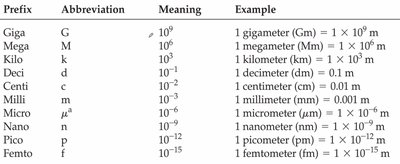
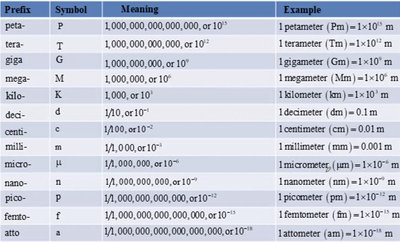
SI prefixes indicate multiples or fractions of units, facilitating the expression of very large or small quantities.
Prefix | Abbreviation | Meaning | Example |
|---|---|---|---|
Giga | G | 109 | 1 gigameter (Gm) = 1 × 10⁹ m |
Mega | M | 106 | 1 megameter (Mm) = 1 × 10⁶ m |
Kilo | k | 103 | 1 kilometer (km) = 1 × 10³ m |
Deci | d | 10-1 | 1 decimeter (dm) = 0.1 m |
Centi | c | 10-2 | 1 centimeter (cm) = 0.01 m |
Milli | m | 10-3 | 1 millimeter (mm) = 0.001 m |
Micro | μ | 10-6 | 1 micrometer (μm) = 1 × 10⁻⁶ m |
Nano | n | 10-9 | 1 nanometer (nm) = 1 × 10⁻⁹ m |
Pico | p | 10-12 | 1 picometer (pm) = 1 × 10-12 m |
Femto | f | 10-15 | 1 femtometer (fm) = 1 × 10-15 m |
Derived Units
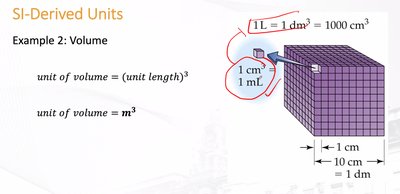
Derived units are obtained by combining base units. Common examples include units for speed, volume, and density.
Speed: (e.g., m/s)
Volume: (e.g., m3)
Density: (e.g., kg/m3)
Density
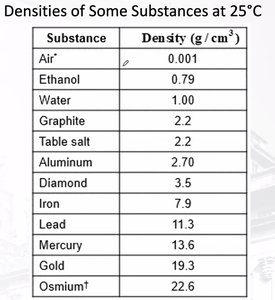
Density is a physical property defined as mass per unit volume. It is commonly used to identify substances and assess purity.
Formula: , where is density, is mass, and is volume.
Example: The density of gold is calculated as .
Substance | Density (g/cm3) |
|---|---|
Air | 0.001 |
Ethanol | 0.79 |
Water | 1.00 |
Graphite | 2.2 |
Table salt | 2.2 |
Aluminum | 2.70 |
Diamond | 3.5 |
Iron | 7.9 |
Lead | 11.3 |
Mercury | 13.6 |
Gold | 19.3 |
Osmium | 22.6 |
Scientific Notation and Significant Figures
Scientific Notation
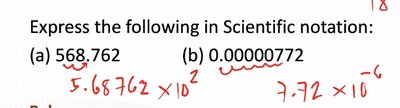
Scientific notation expresses very large or small numbers in the form , where is a number between 1 and 10, and is an integer.
Example: 568.762 = ; 0.0000772 =
Significant Figures
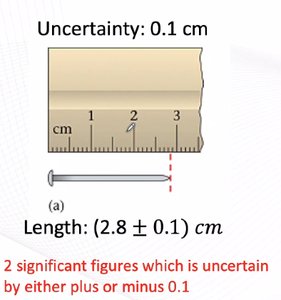
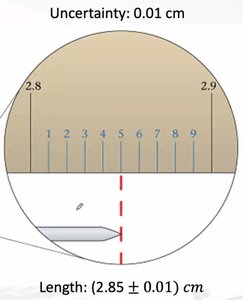
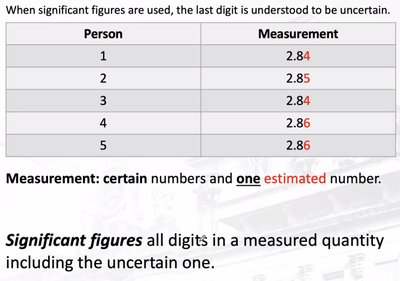
Significant figures are the meaningful digits in a measured or calculated quantity. The last digit is always uncertain.
All nonzero digits are significant.
Zeroes between significant digits are significant.
Leading zeroes are not significant.
Trailing zeroes are significant if there is a decimal point.
Rules for Calculations
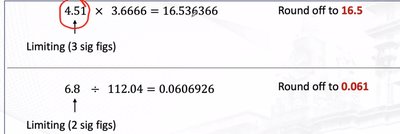
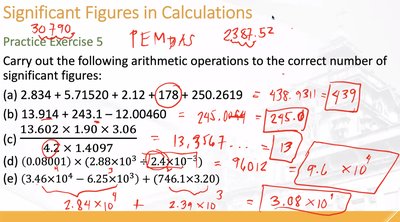
Addition/Subtraction: The result should have the same number of decimal places as the measurement with the fewest decimal places.
Multiplication/Division: The result should have the same number of significant figures as the measurement with the fewest significant figures.

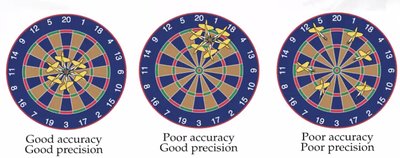
Precision, Accuracy, and Error
Definitions
Precision: How close a set of measurements are to each other.
Accuracy: How close a measurement is to the true value.
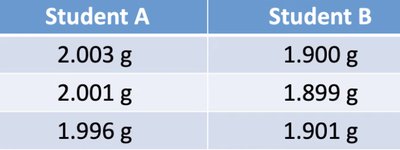

Types of Error
Random Error: Unpredictable variations that affect precision.
Systematic Error: Consistent deviations that affect accuracy, often due to faulty equipment or calibration.
Dimensional Analysis and Unit Conversion
Conversion Factors and Method
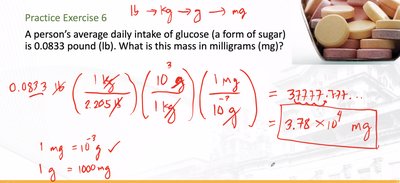
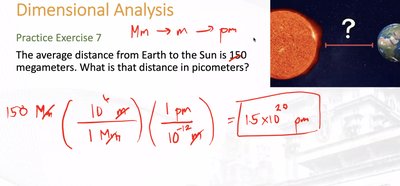
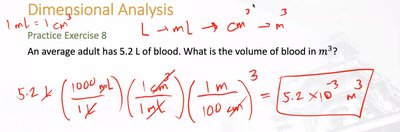
Dimensional analysis uses conversion factors (fractions equal to one) to convert between units. The process involves multiplying the given quantity by appropriate conversion factors so that units cancel, leaving the desired unit.
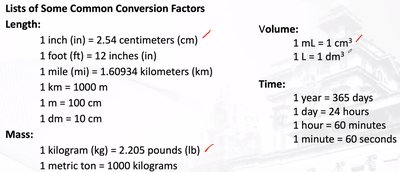
Worked Examples
Mass Conversion: 0.0833 lb to mg


Distance Conversion: 150 Mm to pm
Volume Conversion: 5.2 L to m3
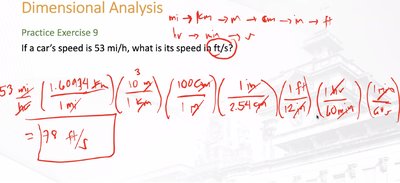
Speed Conversion: 53 mi/h to ft/s

Density Conversion: 0.808 g/cm3 to lb/in3
Properties and Classification of Matter
Physical and Chemical Properties
Physical Property: Can be observed without changing the substance's composition (e.g., shape, odor, density).
Chemical Property: Observed during or after a chemical reaction (e.g., flammability, acidity).
Physical and Chemical Changes
Physical Change: Does not alter the chemical composition (e.g., melting, dissolving).
Chemical Change: Produces new substances (e.g., burning, rusting).
Intensive vs. Extensive Properties
Intensive Property: Independent of the amount of substance (e.g., density, boiling point).
Extensive Property: Dependent on the amount of substance (e.g., mass, volume).
Classification of Matter
Pure Substance: Has uniform properties and composition (elements and compounds).
Mixture: Combination of substances with variable composition (homogeneous or heterogeneous).
Quantum Theory and Electronic Structure
Atomic Models
Plum Pudding Model (Thomson): Electrons embedded in a positively charged sphere.
Rutherford Model: Dense nucleus with electrons orbiting around it.
Bohr Model: Electrons move in fixed orbits around the nucleus.
Quantum Mechanical Model: Electrons exist in probabilistic orbitals, described by quantum numbers.
Quantum Numbers
Principal Quantum Number (n): Energy level (n = 1, 2, 3, ...).
Azimuthal Quantum Number (l): Orbital shape (l = 0 to n-1; s, p, d, f).
Magnetic Quantum Number (ml): Orbital orientation (ml = -l to +l).
Spin Quantum Number (ms): Electron spin (+1/2 or -1/2).
Electronic Configuration Principles
Aufbau Principle: Electrons fill lowest energy orbitals first.
Pauli Exclusion Principle: No two electrons in an atom can have the same set of four quantum numbers.
Hund's Rule: Electrons occupy separate orbitals in the same subshell before pairing.
Magnetic Properties
Paramagnetic: Atoms with unpaired electrons; attracted to magnetic fields.
Diamagnetic: Atoms with all electrons paired; repelled by magnetic fields.
Isotopes and Radioisotopes
Isotopes: Atoms of the same element with different numbers of neutrons (same Z, different A).
Radioisotopes: Unstable isotopes that undergo radioactive decay, emitting radiation (alpha, beta, gamma).
Half-life (t1/2): Time required for half the nuclei in a sample to decay.
Application: Radiocarbon dating uses the half-life of carbon-14 to determine the age of organic materials.
