 뒤로
General Chemistry I – Gas Laws and Properties Study Guide
스터디 가이드 - 스마트 노트
 자료에 맞춘 맞춤형 노트, 핵심 정의, 예시, 맥락을 확장해 제공합니다.
Q4. If the atmospheric pressure is 0.995 atm, what is the pressure of the enclosed gas in each of the three cases depicted in the drawing? Assume that the gray liquid is mercury.
Background
Topic: Gas Pressure Measurement Using Manometers
This question tests your understanding of how to use a manometer to determine the pressure of a gas sample, given atmospheric pressure and the height difference in mercury. It also requires you to distinguish between open-ended and closed-ended manometers.
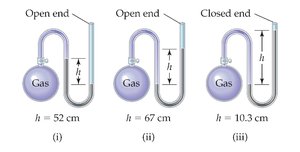
Key Terms and Formulas:
Manometer: A device used to measure the pressure of a gas in a container.
Atmospheric Pressure (): The pressure exerted by the atmosphere, given as 0.995 atm.
Height Difference (): The difference in mercury levels, measured in centimeters (cm).
Gas Pressure (): The pressure of the gas in the container.
Key Formulas:
For open-ended manometers:
If the gas pushes mercury higher on the open side:
If the gas pushes mercury higher on the closed side:
For closed-ended manometers:
Conversion factors:
Step-by-Step Guidance
Identify the type of manometer for each case (i, ii, iii) using the diagram: open-ended or closed-ended.
For each case, note the height difference () in centimeters. Convert $h$ from centimeters to millimeters if needed ().
For open-ended manometers (i and ii), determine whether the gas pressure is greater or less than atmospheric pressure based on which side the mercury is higher.
Set up the appropriate formula for each case:
Case (i): (if mercury is higher on the open end)
Case (ii): (if mercury is higher on the gas side)
Case (iii): (closed-ended manometer)
Convert the calculated pressure values to the requested units: atm, mmHg, torr, pascals, bars, and psi using the appropriate conversion factors.
Try solving on your own before revealing the answer!
Final Answer:
Case (i):
Case (ii):
Case (iii):
Each case uses the correct manometer formula and conversion factors to determine the gas pressure in multiple units.
