 뒤로
General Chemistry I: Molecular Structure, Bonding, and Hybridization Study Guide
스터디 가이드 - 스마트 노트
 자료에 맞춘 맞춤형 노트, 핵심 정의, 예시, 맥락을 확장해 제공합니다.
Q1. How many electron domains surround the C atom in difluoromethane (CH2F2)? Would the molecule have a nonzero dipole moment? If the molecule is polar, draw the overall dipole moment vector.
Background
Topic: Molecular Geometry and Polarity
This question tests your understanding of electron domain counting, molecular shape, and dipole moments. Electron domains include both bonding pairs and lone pairs around the central atom. Determining polarity involves considering the shape and the distribution of electronegative atoms.
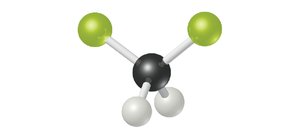
Key Terms and Formulas:
Electron domain: A region where electrons are found, either as a bond (single, double, triple) or a lone pair.
Dipole moment: A measure of molecular polarity, resulting from differences in electronegativity and molecular shape.
Lewis structure: A diagram showing the arrangement of atoms and electron domains.
Step-by-Step Guidance
Draw the Lewis structure for CH2F2, showing all bonds and lone pairs around the central carbon atom.
Count the number of electron domains (bonding and lone pairs) around the carbon atom. Remember, each single bond counts as one domain.
Determine the molecular geometry based on the electron domain count (use VSEPR theory).
Consider the electronegativity of the atoms attached to carbon (F and H) and the geometry to assess if the dipole moments cancel or add up.
Set up how you would draw the overall dipole moment vector if the molecule is polar, based on the direction of individual bond dipoles.
Try solving on your own before revealing the answer!
Final Answer:
The carbon atom in CH2F2 is surrounded by 4 electron domains (2 C–F bonds and 2 C–H bonds). The molecular geometry is tetrahedral. The molecule is polar because the dipole moments from the C–F bonds do not cancel out with the C–H bonds, resulting in a net dipole moment. The overall dipole moment vector points toward the fluorine atoms, which are more electronegative.
Q2. According to the potential energy plot for two Cl atoms, what is their potential energy of interaction when far apart? What is the approximate bond length and bond strength for the Cl–Cl bond in Cl2? If Cl2 is compressed under high pressure, does the Cl–Cl bond become stronger or weaker?
Background
Topic: Chemical Bonding and Potential Energy
This question tests your understanding of potential energy curves, bond length, bond strength, and how external conditions affect bonds.
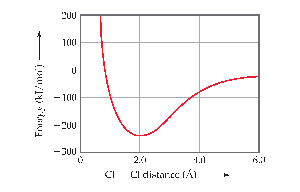
Key Terms and Formulas:
Potential energy curve: Shows how the energy changes as the distance between two atoms changes.
Bond length: The distance at which the energy is minimized (the bottom of the curve).
Bond strength: The depth of the energy well (difference between minimum and zero).
Compression: Decreasing the bond length below equilibrium.
Step-by-Step Guidance
Examine the potential energy curve and identify the energy when the Cl atoms are very far apart (right side of the graph).
Find the minimum point on the curve, which corresponds to the equilibrium bond length and bond strength.
Estimate the bond length from the x-axis value at the minimum.
Estimate the bond strength from the y-axis value at the minimum (difference from zero).
Consider what happens to the bond strength if the bond is compressed (distance decreases below equilibrium).
Try solving on your own before revealing the answer!
Final Answer:
When Cl atoms are far apart, their potential energy of interaction is approximately zero. The bond length for Cl–Cl in Cl2 is about 2.0 Å, and the bond strength is the depth of the energy well (about –240 kJ/mol). If Cl2 is compressed, the bond becomes weaker because the energy increases above the minimum, making the bond less stable.
Q3. In the hydrocarbon shown below, what is the hybridization around each carbon atom? How many σ bonds are there in the molecule? How many π bonds are there in the molecule?
Background
Topic: Hybridization and Bond Types
This question tests your ability to identify hybridization states (sp, sp2, sp3) and count sigma (σ) and pi (π) bonds in a molecule.
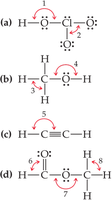
Key Terms and Formulas:
Hybridization: The mixing of atomic orbitals to form new hybrid orbitals (sp, sp2, sp3).
σ bond: A single covalent bond formed by head-on overlap of orbitals.
π bond: A bond formed by side-on overlap of p orbitals, present in double and triple bonds.
Step-by-Step Guidance
Identify each carbon atom in the molecule and determine its bonding pattern (number of bonds and lone pairs).
Assign hybridization to each carbon based on its bonding: sp3 (4 domains), sp2 (3 domains), sp (2 domains).
Count the number of σ bonds: every single bond is a σ bond, and each double/triple bond contains one σ bond.
Count the number of π bonds: double bonds have one π bond, triple bonds have two π bonds.
Set up the bond counts for the molecule based on the structure shown.
Try solving on your own before revealing the answer!
Final Answer:
Each carbon atom's hybridization depends on its bonding: sp3 for single bonds, sp2 for double bonds, sp for triple bonds. The molecule contains 8 σ bonds and 3 π bonds (based on the structure shown). Hybridization and bond counts are determined by the number of electron domains and the types of bonds present.
