 뒤로
General Chemistry I: Practice Problems Step-by-Step Guidance
스터디 가이드 - 스마트 노트
 자료에 맞춘 맞춤형 노트, 핵심 정의, 예시, 맥락을 확장해 제공합니다.
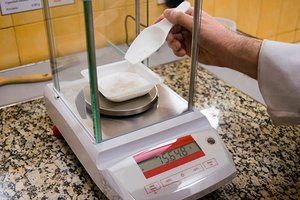
Q26. You weigh an object on a balance and read the mass in grams according to the picture. How would you record this mass, and how many significant figures are in this measurement?
Background
Topic: Measurement and Significant Figures
This question tests your understanding of how to properly record measurements from a digital balance and how to determine the number of significant figures in a measurement.
Key Terms:
Significant Figures: Digits in a measurement that are known with certainty plus one digit that is estimated.
Digital Balance: An instrument used to measure mass with high precision.
Step-by-Step Guidance
Observe the digital display on the balance to determine the mass reading. Make sure to record all digits shown, including zeros after the decimal point.
Write down the mass exactly as it appears on the display, since digital balances report all significant digits.
Count the number of digits in the recorded mass to determine the number of significant figures.
Consider whether the measurement includes any estimated digits (usually the last digit on a digital balance is estimated).
Try solving on your own before revealing the answer!
Final Answer:
The mass should be recorded as 75.648 g, with five significant figures.
All digits shown on the digital balance are significant, including the last digit, which is estimated by the instrument.
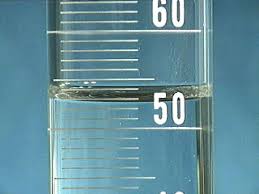
Q27. You have a graduated cylinder that contains a liquid as shown in the picture. Write the volume of the liquid, in milliliters, using the proper number of significant figures.
Background
Topic: Measurement and Significant Figures
This question tests your ability to read the volume from a graduated cylinder and record it with the correct number of significant figures.
Key Terms:
Meniscus: The curved surface of a liquid in a container; always read at the lowest point.
Significant Figures: The digits in a measurement that are known with certainty plus one estimated digit.
Step-by-Step Guidance
Look at the graduated cylinder and identify the lowest point of the meniscus.
Read the value at the bottom of the meniscus, making sure your eye is level with the liquid.
Estimate the value between the smallest marked divisions to add one more digit (the estimated digit).
Record the volume in milliliters, including all certain digits and one estimated digit.
Try solving on your own before revealing the answer!
Final Answer:
The volume should be recorded as 51.0 mL, with three significant figures.
The last digit is estimated based on the position of the meniscus between the markings.
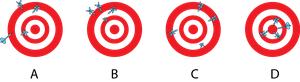
Q30. Comment on the accuracy and precision of these dartboard throws.
Background
Topic: Accuracy and Precision in Scientific Measurement
This question tests your understanding of the difference between accuracy (closeness to the true value) and precision (repeatability or consistency of results).
Key Terms:
Accuracy: How close a measurement is to the true or accepted value.
Precision: How close repeated measurements are to each other.
Step-by-Step Guidance
Examine each dartboard (A, B, C, D) and observe the pattern of dart throws.
Determine whether the darts are clustered together (precision) and whether they are near the center (accuracy).
For each board, decide if the throws are accurate, precise, both, or neither.
Describe the differences between accuracy and precision using the dartboard examples.
Try solving on your own before revealing the answer!
Final Answer:
A: Not accurate, not precise (darts are scattered and not near the center).
B: Accurate, not precise (darts are near the center but not clustered).
C: Precise, not accurate (darts are clustered but not near the center).
D: Accurate and precise (darts are clustered and near the center).
Accuracy refers to closeness to the target, while precision refers to how close the darts are to each other.
