 뒤로
General Chemistry Study Guidance: Solutions, Solubility, and Intermolecular Forces
스터디 가이드 - 스마트 노트
 자료에 맞춘 맞춤형 노트, 핵심 정의, 예시, 맥락을 확장해 제공합니다.
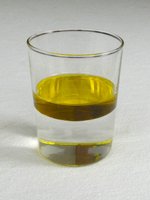
Q1. What does the image of oil and water in a glass illustrate about solutions?
Background
Topic: Types of Mixtures and Solubility
This question is testing your understanding of the difference between solutions, colloids, and suspensions, as well as the concept of solubility and miscibility.
Key Terms:
Solution: A homogeneous mixture where the solute is dissolved in the solvent.
Suspension: A heterogeneous mixture where components separate on standing.
Solubility: The ability of one substance to dissolve in another.
Miscibility: The ability of two liquids to mix in all proportions.
Step-by-Step Guidance
Observe the image: Oil and water are clearly separated, forming two distinct layers.
Recall that oil and water are immiscible, meaning they do not mix to form a homogeneous solution.
Think about the types of intermolecular forces present in each liquid: water is polar, oil is nonpolar.
Consider the chemist's rule of thumb: "like dissolves like." Polar solvents dissolve polar solutes, nonpolar solvents dissolve nonpolar solutes.
Try solving on your own before revealing the answer!
Final Answer:
The image illustrates a suspension, not a solution. Oil and water are immiscible because their intermolecular forces are not compatible (polar vs. nonpolar), so they do not mix to form a homogeneous solution.
This demonstrates the concept of solubility and miscibility: only substances with similar intermolecular forces will form solutions.
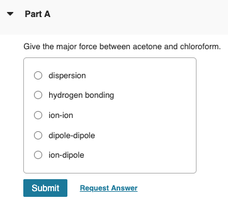
Q2. Give the major force between acetone and chloroform.
Background
Topic: Intermolecular Forces
This question is testing your ability to identify the dominant intermolecular force between two molecules based on their structure and properties.
Key Terms and Concepts:
Dispersion (London) forces: Present in all molecules, especially nonpolar ones.
Hydrogen bonding: Occurs when H is bonded to N, O, or F and interacts with lone pairs on N, O, or F.
Ion-ion: Occurs between ions.
Dipole-dipole: Occurs between polar molecules.
Ion-dipole: Occurs between ions and polar molecules.
Step-by-Step Guidance
Identify the molecular structures: Acetone is a polar molecule with a carbonyl group; chloroform is also polar due to its three Cl atoms and one H.
Consider the possible intermolecular forces: Both molecules are not ionic, so ion-ion and ion-dipole are not relevant.
Check for hydrogen bonding: Acetone has no H bonded to N, O, or F, but chloroform has a hydrogen attached to a highly electronegative Cl, which can participate in hydrogen bonding with acetone's oxygen.
Compare the strength of possible forces: Hydrogen bonding is stronger than dipole-dipole or dispersion forces.
Try solving on your own before revealing the answer!
Final Answer:
The major force between acetone and chloroform is hydrogen bonding. The hydrogen of chloroform can interact with the oxygen of acetone, forming a hydrogen bond.
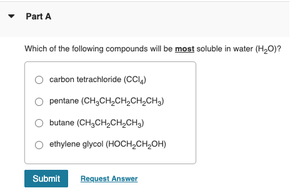
Q3. Which of the following compounds will be most soluble in water (H2O)?
Background
Topic: Solubility and "Like Dissolves Like" Principle
This question is testing your understanding of how molecular structure and polarity affect solubility in water.
Key Terms:
Polarity: Water is a polar solvent.
Hydrogen bonding: Molecules capable of hydrogen bonding are more soluble in water.
"Like dissolves like": Polar solutes dissolve in polar solvents; nonpolar solutes dissolve in nonpolar solvents.
Step-by-Step Guidance
Examine the structures of the four compounds: carbon tetrachloride, pentane, butane, and ethylene glycol.
Identify which compounds are polar and which are nonpolar.
Determine which compounds can form hydrogen bonds with water.
Recall that water is polar and favors dissolving polar or hydrogen-bonding solutes.
Try solving on your own before revealing the answer!
Final Answer:
Ethylene glycol (HOCH2CH2OH) will be most soluble in water because it is polar and can form hydrogen bonds with water.
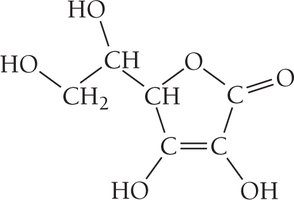
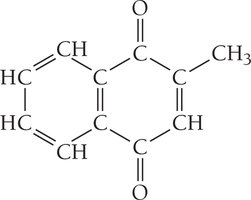
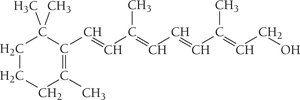
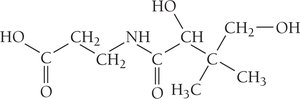
Q4. Which of the following vitamins would be water soluble and which would be fat soluble?
Background
Topic: Solubility of Biomolecules
This question is testing your ability to analyze molecular structure to predict solubility in water (hydrophilic) or fat (hydrophobic).
Key Terms:
Hydrophilic: Water-soluble, usually polar, often with -OH or -NH groups.
Hydrophobic: Fat-soluble, usually nonpolar, often with long hydrocarbon chains.
Functional groups: Presence of polar groups increases water solubility.
Step-by-Step Guidance
Examine the structures of each vitamin for polar groups (e.g., -OH, -COOH, -NH).
Identify vitamins with many polar groups as likely water-soluble.
Identify vitamins with large nonpolar regions (hydrocarbon chains/rings) as likely fat-soluble.
Compare the number and type of functional groups in each structure.
Try solving on your own before revealing the answer!
Final Answer:
Vitamin C and Vitamin B5 are water-soluble due to their multiple polar groups. Vitamin K3 and Vitamin E are fat-soluble because they have large nonpolar regions.
