뒤로
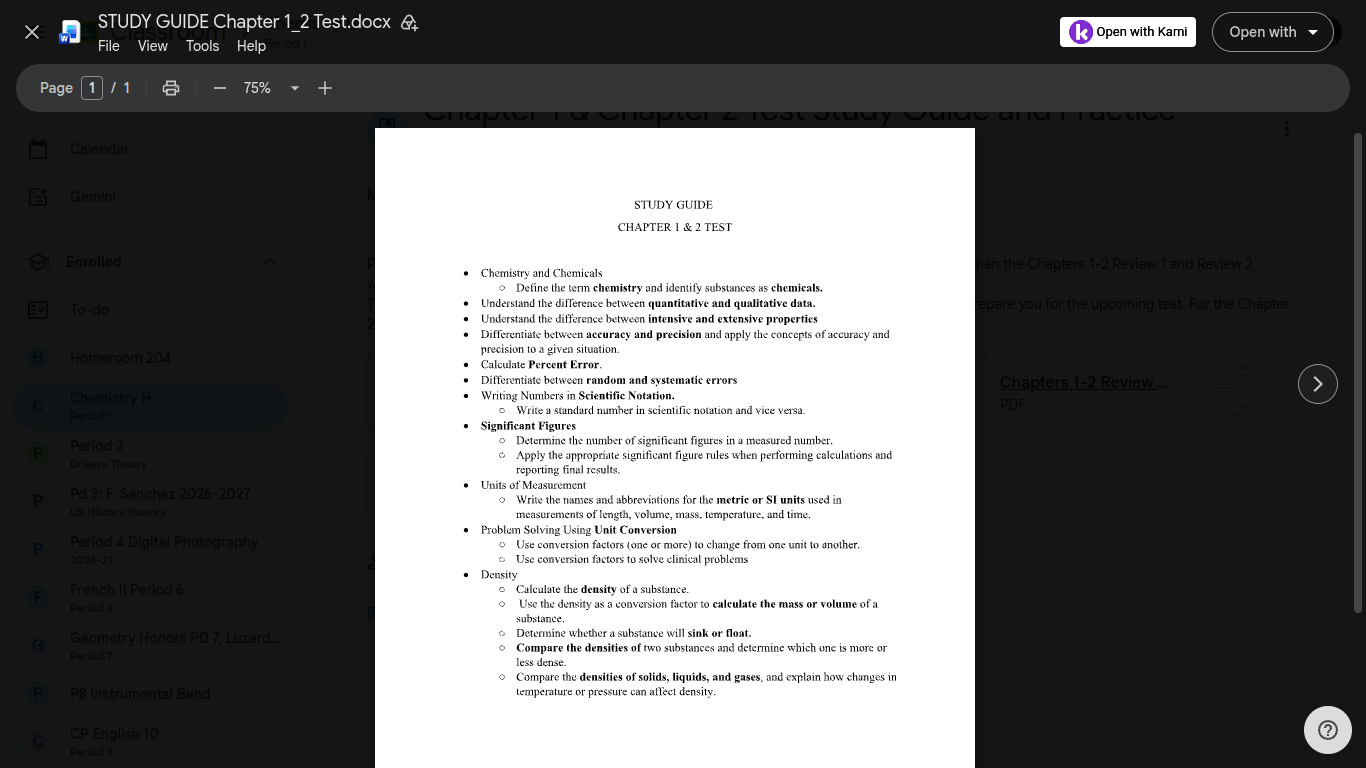
General Chemistry Study Guide: Chapters 1 & 2
스터디 가이드 - 스마트 노트
 자료에 맞춘 맞춤형 노트, 핵심 정의, 예시, 맥락을 확장해 제공합니다.
Chemistry and Chemicals
Definition and Identification
Chemistry is the scientific study of matter, its properties, and the changes it undergoes. Substances that have a definite composition are called chemicals. - Chemistry: The branch of science concerned with the composition, structure, and properties of substances and the transformations they undergo. - Chemicals: Any substance with a defined composition, such as water (H2O), sodium chloride (NaCl), or glucose (C6H12O6).
Quantitative vs. Qualitative Data
Data in chemistry can be classified as quantitative or qualitative. - Quantitative data: Numerical measurements (e.g., mass, volume, temperature). - Qualitative data: Descriptive observations (e.g., color, texture, odor).
Intensive vs. Extensive Properties
Properties of matter are categorized as intensive or extensive. - Intensive properties: Do not depend on the amount of matter (e.g., density, boiling point). - Extensive properties: Depend on the amount of matter (e.g., mass, volume).
Accuracy and Precision
Accuracy and precision are important concepts in measurement. - Accuracy: How close a measurement is to the true value. - Precision: How close repeated measurements are to each other. Example: If a balance consistently measures a 10 g mass as 9.8 g, it is precise but not accurate.
Percent Error
Percent error quantifies the difference between an experimental value and the accepted value. - Formula:
Random vs. Systematic Errors
Errors in measurement can be random or systematic. - Random errors: Occur unpredictably and affect precision. - Systematic errors: Consistent inaccuracies due to faulty equipment or bias, affecting accuracy.
Numbers in Scientific Notation
Writing and Interpreting Scientific Notation
Scientific notation expresses numbers as a product of a coefficient and a power of ten. - Example: 0.00045 can be written as - Conversion: Move the decimal point to create a number between 1 and 10, then multiply by the appropriate power of ten.
Significant Figures
Determining Significant Figures
Significant figures reflect the precision of a measured value. - Rules: All nonzero digits are significant; zeros between nonzero digits are significant; leading zeros are not significant; trailing zeros are significant if there is a decimal point.
Calculations with Significant Figures
- Addition/Subtraction: The result should have the same number of decimal places as the measurement with the fewest decimal places. - Multiplication/Division: The result should have the same number of significant figures as the measurement with the fewest significant figures.
Units of Measurement
Metric and SI Units
Chemistry uses the metric system and SI units for measurements.
Quantity | Unit Name | Abbreviation |
|---|---|---|
Length | meter | m |
Volume | liter | L |
Mass | gram | g |
Temperature | kelvin | K |
Time | second | s |
Problem Solving Using Unit Conversion
Conversion Factors
Conversion factors are ratios used to convert from one unit to another. - Example: To convert 5 cm to meters: - Clinical Application: Dosage calculations in medicine often require unit conversions.
Density
Calculating Density
Density is the mass per unit volume of a substance. - Formula:
Using Density as a Conversion Factor
- To find mass: - To find volume:
Sink or Float
Whether a substance sinks or floats depends on its density relative to the surrounding medium. - If density is greater than the liquid: The substance sinks. - If density is less than the liquid: The substance floats.
Comparing Densities
- Solids: Usually have higher densities than liquids and gases. - Liquids: Intermediate densities. - Gases: Lowest densities.
Effect of Temperature and Pressure
- Temperature: Increasing temperature generally decreases density (except water near 4°C). - Pressure: Increasing pressure increases density, especially for gases. Example: Hot air rises because it is less dense than cold air.