 뒤로
General Chemistry Study Guide: Measurement, Atomic Structure, and Periodic Properties
스터디 가이드 - 스마트 노트
 자료에 맞춘 맞춤형 노트, 핵심 정의, 예시, 맥락을 확장해 제공합니다.
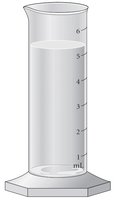
Q4. Read the water level with the correct number of significant figures.
Background
Topic: Measurement and Significant Figures
This question tests your ability to correctly read a graduated cylinder and report the measurement with the appropriate number of significant figures.
Key Terms:
Significant Figures: Digits in a measurement that are known with certainty plus one digit that is estimated.
Graduated Cylinder: A tool used to measure the volume of liquids.
Step-by-Step Guidance
Observe the water level in the graduated cylinder and identify the smallest division marked on the scale.
Estimate the value between the smallest divisions to add one more digit (the uncertain digit).
Report the measurement using all certain digits plus one estimated digit, ensuring the correct number of significant figures.
Try solving on your own before revealing the answer!
Final Answer: 5.3 mL
The water level is between 5 and 6 mL, and the smallest division is 1 mL. You estimate to the tenths place, so the correct reading is 5.3 mL (2 significant figures).
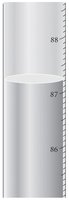
Q5. Read the temperature with the correct number of significant figures.
Background
Topic: Measurement and Significant Figures
This question tests your ability to read a thermometer and report the temperature with the correct number of significant figures.
Key Terms:
Significant Figures: Digits in a measurement that are known with certainty plus one digit that is estimated.
Thermometer: An instrument used to measure temperature.
Step-by-Step Guidance
Look at the thermometer and identify the smallest division marked (e.g., 1°C, 0.1°C).
Estimate the value between the smallest divisions to add one more digit (the uncertain digit).
Report the temperature using all certain digits plus one estimated digit, ensuring the correct number of significant figures.
Try solving on your own before revealing the answer!
Final Answer: 87.20°C
The thermometer shows a value between 87 and 88°C, and the smallest division is 0.1°C. You estimate to the hundredths place, so the correct reading is 87.20°C (4 significant figures).
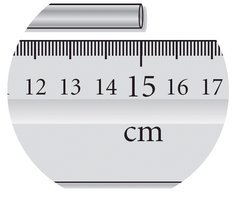
Q6. Read the length of the metal bar with the correct number of significant figures.
Background
Topic: Measurement and Significant Figures
This question tests your ability to read a ruler and report the length with the correct number of significant figures.
Key Terms:
Significant Figures: Digits in a measurement that are known with certainty plus one digit that is estimated.
Ruler: An instrument used to measure length.
Step-by-Step Guidance
Observe the position of the metal bar on the ruler and identify the smallest division marked (e.g., 1 cm, 0.1 cm).
Estimate the value between the smallest divisions to add one more digit (the uncertain digit).
Report the length using all certain digits plus one estimated digit, ensuring the correct number of significant figures.
Try solving on your own before revealing the answer!
Final Answer: 15.00 cm
The ruler shows the bar at 15 cm, and the smallest division is 0.1 cm. You estimate to the hundredths place, so the correct reading is 15.00 cm (4 significant figures).
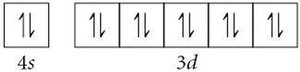
Q14. Select the orbital diagram for the Ni2+ ion and whether the ion is diamagnetic or paramagnetic.
Background
Topic: Electron Configuration and Magnetism
This question tests your understanding of how to draw orbital diagrams for ions and determine if the ion is diamagnetic (all electrons paired) or paramagnetic (unpaired electrons present).
Key Terms:
Orbital Diagram: Visual representation of electron arrangement in orbitals.
Diamagnetic: Substance with all electrons paired; not attracted to a magnetic field.
Paramagnetic: Substance with unpaired electrons; attracted to a magnetic field.
Step-by-Step Guidance
Write the electron configuration for neutral Ni (Nickel), then remove two electrons for Ni2+.
Draw the orbital diagram for the resulting electron configuration, showing how electrons fill the 4s and 3d orbitals.
Check if all electrons are paired in the diagram to determine if the ion is diamagnetic or paramagnetic.
Try solving on your own before revealing the answer!
Final Answer: Diamagnetic
The orbital diagram for Ni2+ shows all electrons paired, so the ion is diamagnetic.
