 뒤로
General Chemistry Study Notes: Matter, Atoms, Elements, and Compounds
스터디 가이드 - 스마트 노트
 자료에 맞춘 맞춤형 노트, 핵심 정의, 예시, 맥락을 확장해 제공합니다.
Chapter 1: Matter, Measurement & Problem Solving
Physical and Chemical Properties
Understanding the distinction between physical properties and chemical properties is fundamental in chemistry. Physical properties are characteristics that can be observed or measured without changing the substance's identity (e.g., color, density, melting point). Chemical properties describe a substance's ability to undergo changes that transform it into different substances (e.g., flammability, reactivity).
Physical Property: Observable without changing the substance (e.g., density, boiling point).
Chemical Property: Describes how a substance reacts (e.g., iron rusting).
Density and Its Calculation
Density is a key physical property defined as mass per unit volume. The density equation and its rearrangements are essential for solving problems involving mass, volume, and density.
Density Equation:
Mass Equation:
Volume Equation:
Example: If a sample increases water volume from 15.0 mL to 21.6 mL and weighs 22.35 g, its density is .
Chapter 2: Atoms & Elements
Subatomic Particles and Atomic Structure
Atoms are composed of three main subatomic particles: protons, neutrons, and electrons. Their arrangement and properties define the identity and behavior of elements.
Protons: Positively charged, located in the nucleus, define atomic number (Z).
Neutrons: Neutral, located in the nucleus, contribute to mass number (A).
Electrons: Negatively charged, orbit the nucleus, determine chemical behavior.
Atomic Number, Chemical Symbol, and Isotopes
The atomic number (Z) is the number of protons and uniquely identifies an element. The chemical symbol is a shorthand notation for elements. Isotopes are atoms of the same element with different numbers of neutrons, resulting in different mass numbers (A).
Isotope Notation: or X-A (where X is the chemical symbol, A is mass number, Z is atomic number).
Example: or U-238.
Mass Number (A):
Atoms, Ions, and the Periodic Table
Atoms are electrically neutral, while ions are charged particles formed by gaining or losing electrons. The periodic table organizes elements by their properties and typical charges.
Cations: Positively charged ions (loss of electrons).
Anions: Negatively charged ions (gain of electrons).
Periodic Table Groups: Metals, nonmetals, metalloids, main group elements, transition metals, noble gases, alkali metals, alkaline earth metals, halogens.
Isotope Abundance and Atomic Mass Calculation
The atomic mass of an element is calculated based on the masses and natural abundances of its isotopes. This is a weighted average.
Formula:
Example: For neon, using the table below:
Symbol | Number of Protons | Number of Neutrons | A, Mass Number | Percent Natural Abundance |
|---|---|---|---|---|
Ne-20 or Ne | 10 | 10 | 19.9924 | 90.48% |
Ne-21 or Ne | 10 | 11 | 20.9938 | 0.27% |
Ne-22 or Ne | 10 | 12 | 21.9914 | 9.25% |
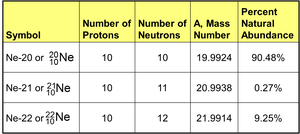
Calculated Atomic Mass:
Mole-Mass Conversions
The mole is a fundamental unit in chemistry for counting atoms, molecules, or ions. Conversions between moles and mass (grams) are based on molar mass.
Formula:
Example: 65.0 g of copper contains mol.
Chapter 3: Molecules and Compounds
Types of Chemical Bonds
Chemical bonds are the forces holding atoms together in compounds. There are three main types:
Ionic Bond: Occurs between metal and nonmetal ions, or ammonium and nonmetal ions. Forms ionic compounds.
Covalent Bond: Occurs between nonmetal atoms, resulting from shared electrons. Forms molecular compounds.
Metallic Bond: Occurs between metal atoms (e.g., Na-Na, Cu-Ni).
Classification of Substances
Substances are classified based on their atomic or molecular structure:
Atomic Elements: Elements existing as single atoms (e.g., noble gases).
Molecular Elements: Elements naturally occurring as molecules (e.g., diatomic molecules: H2, N2, O2, F2, Cl2, Br2, I2).
Note: Diatomic molecules only exist in pairs in their elemental form, not in compounds.
Naming and Writing Formulas for Compounds
It is essential to be able to write names from formulas and vice versa for both ionic and molecular compounds. Practice with common compounds such as sodium sulfide, aluminum oxide, calcium iodide, and others.
Example: Sodium sulfide: Na2S; Disulfur tetroxide: S2O4
Mass Percent of Elements in Compounds
The mass percent of an element in a compound is calculated as follows:
Formula:
Example: Mass percent of carbon in acetylene (C2H2):
Empirical and Molecular Formulas from Combustion Analysis
Combustion analysis is used to determine the empirical and molecular formulas of compounds containing C, H, and O.
Empirical Formula: Simplest whole-number ratio of atoms in a compound.
Molecular Formula: Actual number of atoms in a molecule, determined from molar mass.
Example: A 13.42 g sample produces 39.6 g CO2 and 9.01 g H2O; molar mass is 268 g/mol. Empirical formula: C9H10O; Molecular formula: C18H20O2.
