 뒤로
General Chemistry Study Notes: Measurement, Matter, and Energy
스터디 가이드 - 스마트 노트
 자료에 맞춘 맞춤형 노트, 핵심 정의, 예시, 맥락을 확장해 제공합니다.
2.1 The Metric Mix-Up: A Cautionary Tale
Introduction to Measurement Errors in Chemistry
Measurement errors can have significant consequences in science and engineering. A famous example is the loss of NASA's Mars Climate Orbiter in 1999 due to a mix-up between metric and imperial units. This incident highlights the importance of using correct units and conversions in all scientific calculations.
Key Point: Always check and convert units appropriately to avoid costly mistakes.
Example: The Mars Climate Orbiter was lost because one team used newton-seconds (metric) and another used pound-seconds (imperial) for force calculations.
2.2 Scientific Notation
Using Powers of Ten for Large and Small Numbers
Scientific notation is a method for expressing very large or very small numbers in a compact form using powers of ten. This is essential for clarity and precision in chemistry calculations.
Definition: A number is written as the product of a coefficient (between 1 and 10) and a power of ten.
Examples:
10,000 =
0.00001 =
5,963,000 =
0.00042 =
2.3 Significant Figures (Sig Figs)
Rules for Counting and Using Significant Figures
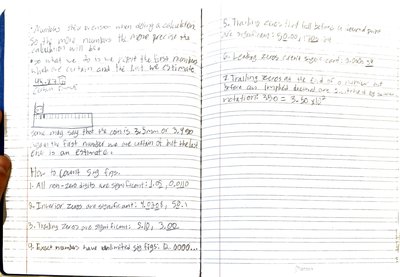
Significant figures reflect the precision of a measured or calculated quantity. The number of significant figures in a value indicates the certainty of the measurement.
Definition: All nonzero digits are significant; zeros may or may not be significant depending on their position.
Rules for Counting Sig Figs:
All nonzero digits are significant (e.g., 2.91 has 3 sig figs).
Interior zeros (between nonzero digits) are significant (e.g., 2.001 has 4 sig figs).
Leading zeros (before the first nonzero digit) are not significant (e.g., 0.0032 has 2 sig figs).
Trailing zeros after a decimal point are significant (e.g., 3.00 has 3 sig figs).
Trailing zeros before a decimal point (and after a nonzero digit) are significant if the decimal is shown (e.g., 500. has 3 sig figs).
Trailing zeros in a whole number with no decimal shown are ambiguous (e.g., 500 could have 1, 2, or 3 sig figs).
Example: 0.00230 has 3 significant figures.
2.4 Significant Figures in Calculations
Applying Sig Fig Rules to Mathematical Operations
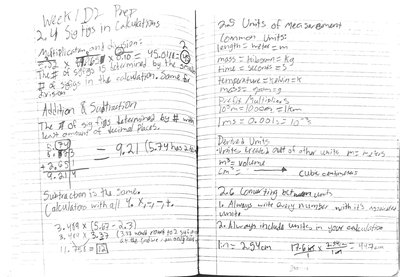
Multiplication and Division: The result should have the same number of significant figures as the measurement with the fewest significant figures.
Addition and Subtraction: The result should have the same number of decimal places as the measurement with the fewest decimal places.
Example (Multiplication): (rounded to 2 sig figs: 39)
Example (Addition): (rounded to 2 decimal places: 14.56)
2.5 Units of Measurement
Common and Derived Units in Chemistry
Common SI Units:
Length: meter (m)
Mass: kilogram (kg)
Time: second (s)
Temperature: kelvin (K)
Volume: liter (L) or cubic meter (m3)
Derived Units: Formed by combining base units (e.g., m/s for speed, m3 for volume).
Unit Conversions: Always include units in calculations and convert as needed.
Example:
2.7-2.8 Multiplication, Conversion, and Density
Unit Conversions and Density Calculations
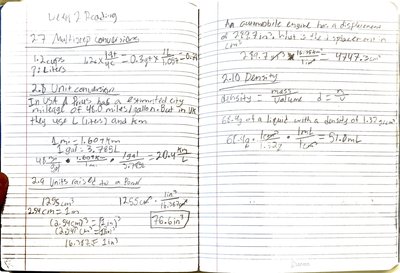
Multiplication and Conversion: Use conversion factors to change units (e.g., ).
Density: Density is mass per unit volume, calculated as .
Example: If a liquid has a mass of 13.2 g and a volume of 51.6 mL, its density is .
3.5 Energy
Energy in Chemical and Physical Changes
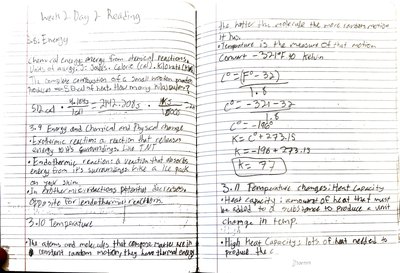
Definition: Energy is the capacity to do work or produce heat. It is involved in all chemical and physical changes.
Types of Energy:
Kinetic Energy: Energy of motion
Potential Energy: Stored energy due to position or composition
Units: Joule (J) is the SI unit of energy. 1 calorie (cal) = 4.184 J.
Example: Calculating energy change:
3.6 Temperature
Temperature Scales and Conversions
Definition: Temperature measures the average kinetic energy of particles in a substance.
Scales: Celsius (°C), Kelvin (K), and Fahrenheit (°F).
Conversions:
3.7 Conservation of Mass
Law of Conservation of Mass in Chemical Reactions
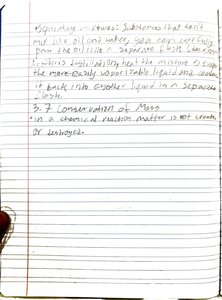
Definition: In a chemical reaction, matter is neither created nor destroyed.
Application: The total mass of reactants equals the total mass of products in a closed system.
Example: If 10 g of hydrogen reacts with 80 g of oxygen, the total mass of water produced is 90 g.
3.1-3.2 Matter and Its Classification
Types of Matter and Their Properties
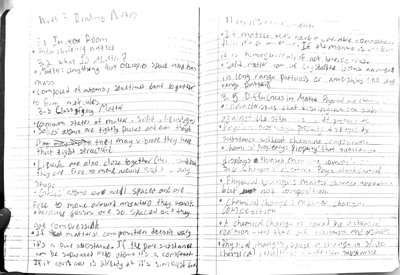
Definition: Matter is anything that has mass and occupies space.
Classification:
Pure Substances: Elements and compounds with fixed composition
Mixtures: Physical combinations of substances that can be separated by physical means
States of Matter: Solid, liquid, gas
Physical vs. Chemical Properties: Physical properties can be observed without changing the substance's identity; chemical properties describe how a substance reacts.
3.3-3.4 Physical and Chemical Changes
Understanding Changes in Matter
Physical Change: Alters the form or appearance but not the composition (e.g., melting, boiling).
Chemical Change: Produces new substances with different properties (e.g., burning, rusting).
Indicators of Chemical Change: Color change, gas production, formation of a precipitate, energy change.
Lab Techniques: Separating Mixtures
Methods for Separating Components of Mixtures
Decanting: Carefully pouring off a liquid to separate it from a solid or another liquid (e.g., oil and water).
Filtration: Using a filter to separate a solid from a liquid.
Distillation: Separating substances based on differences in boiling points.
