 뒤로
General Chemistry Study Notes: Solubility Rules, Redox, Periodic Trends, and Molecular Geometry
스터디 가이드 - 스마트 노트
 자료에 맞춘 맞춤형 노트, 핵심 정의, 예시, 맥락을 확장해 제공합니다.
Solubility Rules and Electrolytes
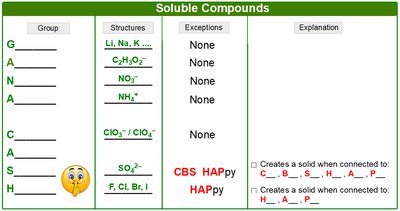
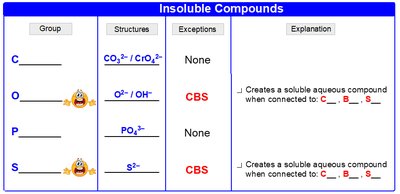
Solubility Rules: GANA CASH and COPS
Solubility rules help predict whether an ionic compound will dissolve in water. The mnemonic GANA CASH is used for soluble compounds, while COPS is used for insoluble compounds. Exceptions to these rules are important for predicting precipitation reactions.
GANA CASH (Soluble Compounds):
G: Group 1A metals (Li+, Na+, K+, etc.)
A: Acetates (C2H3O2-)
N: Nitrates (NO3-)
A: Ammonium (NH4+)
C: Chlorates/Perchlorates (ClO3-, ClO4-)
A: Alkali metal ions
S: Sulfates (SO42-)
H: Halides (F-, Cl-, Br-, I-)
Exceptions: "SHhhh! Keep quiet about the cash." (Certain cations make these otherwise soluble ions insoluble.)
COPS (Insoluble Compounds):
C: Carbonates (CO32-), Chromates (CrO42-)
O: Oxides (O2-), Hydroxides (OH-)
P: Phosphates (PO43-)
S: Sulfides (S2-)
Exceptions: "Oh Snap! It's the cops!" (Certain cations make these otherwise insoluble ions soluble.)

Redox Reactions and Oxidation Numbers
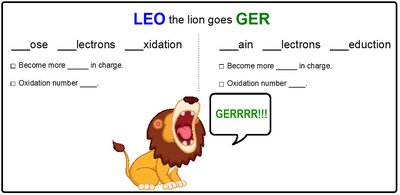
LEO the Lion Says GER
Redox reactions involve the transfer of electrons between species. The mnemonic LEO the lion goes GER helps remember the processes:
LEO: Lose Electrons = Oxidation (increase in oxidation number, more positive charge)
GER: Gain Electrons = Reduction (decrease in oxidation number, more negative charge)
Periodic Trends
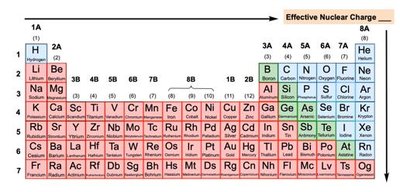
Effective Nuclear Charge and Shielding
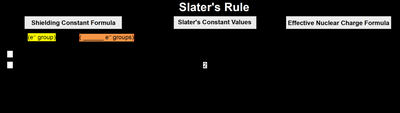
Effective nuclear charge (Zeff) is the net positive charge experienced by valence electrons. It increases across a period and slightly decreases down a group due to increased shielding by inner electrons.
Shielding Constant (S): Measures the repulsion by inner electrons.
Slater's Rules: Used to calculate the shielding constant and effective nuclear charge.
Molecular Geometry and VSEPR Theory
VSEPR Theory: Electron Groups and Molecular Shapes
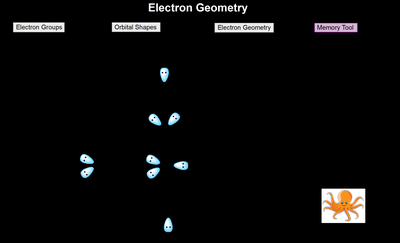
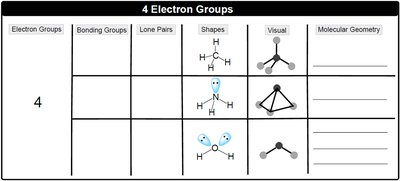
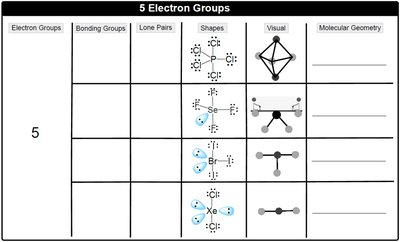
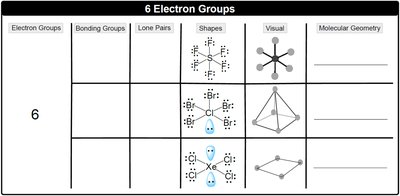
The Valence Shell Electron Pair Repulsion (VSEPR) theory predicts the geometry of molecules based on the repulsion between electron groups around a central atom. Electron groups include bonding pairs and lone pairs.
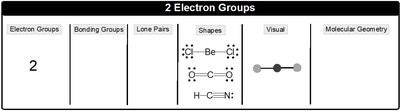
2 Electron Groups: Linear geometry
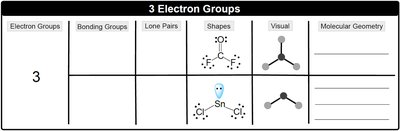
3 Electron Groups: Trigonal planar or bent geometry
4 Electron Groups: Tetrahedral, trigonal pyramidal, or bent geometry
5 Electron Groups: Trigonal bipyramidal, seesaw, T-shaped, or linear geometry
6 Electron Groups: Octahedral, square pyramidal, or square planar geometry
Equatorial and Axial Positions
In molecules with five or six electron groups, atoms or lone pairs can occupy equatorial (around the center) or axial (above and below the center) positions. Lone pairs prefer equatorial positions in trigonal bipyramidal geometries to minimize repulsion.
Practice and Application
Use solubility rules to predict precipitation reactions in aqueous solutions.
Apply LEO/GER to identify oxidizing and reducing agents in redox reactions.
Use periodic trends to compare atomic size, ionization energy, and electron affinity.
Draw Lewis structures and use VSEPR theory to predict molecular shapes.
