 뒤로
Hybridization and Bond Polarity: Lecture 18
스터디 가이드 - 스마트 노트
 자료에 맞춘 맞춤형 노트, 핵심 정의, 예시, 맥락을 확장해 제공합니다.
Valence Bond Theory
Introduction to Valence Bond Theory
Valence Bond Theory explains how atomic orbitals combine to form chemical bonds in molecules. It is fundamental to understanding molecular structure and bonding in General Chemistry. Central atoms in covalent compounds often employ hybridized orbitals to maximize bond formation and stability.
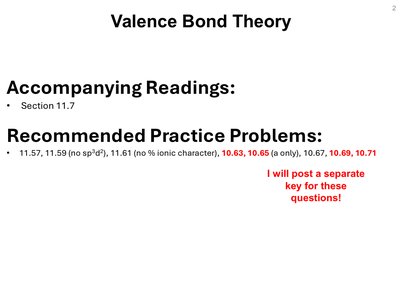
Accompanying Readings and Practice Problems
To reinforce your understanding, refer to Section 11.7 in your textbook and attempt the recommended practice problems: 11.57, 11.59 (no sp3d2), 11.61 (no % ionic character), 10.63, 10.65 (a only), 10.67, 10.69, 10.71.
Hybridization and Electron Geometry
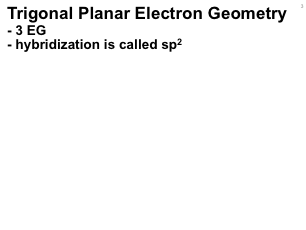
Trigonal Planar Electron Geometry (sp2 Hybridization)
When a central atom has three electron groups (EG), its electron geometry is trigonal planar. The hybridization associated with this geometry is sp2. Hybrid orbitals are formed by mixing one s orbital and two p orbitals, resulting in three equivalent sp2 orbitals oriented 120° apart.
Key Point: Trigonal planar geometry occurs in molecules like BF3 and ethene (C2H4).
Key Point: Each sp2 orbital forms a sigma bond, while the remaining p orbital can participate in pi bonding.
Example: In ethene, each carbon is sp2 hybridized, forming three sigma bonds and one pi bond.
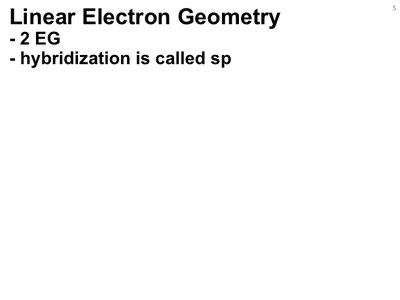
Linear Electron Geometry (sp Hybridization)
When a central atom has two electron groups, its electron geometry is linear. The hybridization is sp, formed by mixing one s and one p orbital, resulting in two sp orbitals oriented 180° apart.
Key Point: Linear geometry is found in molecules like CO2 and acetylene (C2H2).
Key Point: Each sp orbital forms a sigma bond, while the remaining two p orbitals can form pi bonds.
Example: In acetylene, each carbon is sp hybridized, forming two pi bonds and one sigma bond.
Identifying Hybridization in Molecules
To determine the hybridization of each non-hydrogen atom in a molecule, count the number of electron groups (bonding and lone pairs) around the atom:
2 EG: sp hybridization (linear)
3 EG: sp2 hybridization (trigonal planar)
4 EG: sp3 hybridization (tetrahedral)
Bond Polarity
Definition and Determination of Bond Polarity
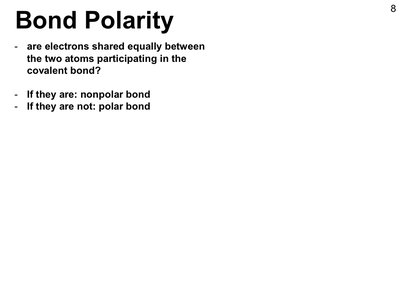
Bond polarity describes the distribution of electron density between two atoms in a covalent bond. If electrons are shared equally, the bond is nonpolar; if not, the bond is polar. The difference in electronegativity (ΔEN) between the atoms determines the bond type.
Key Point: Nonpolar bonds occur between atoms with similar electronegativities.
Key Point: Polar bonds occur when one atom is significantly more electronegative than the other.
Example: The H–Cl bond is polar because Cl is much more electronegative than H.
Electronegativity and Bond Type Classification
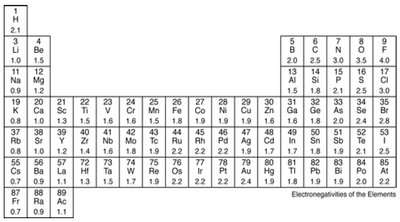
Electronegativity is a measure of an atom's ability to attract electrons in a bond. The difference in electronegativity (ΔEN) between two atoms determines the bond type:
ΔEN | Bond Type |
|---|---|
0 | Pure covalent |
0.1 – 0.4 | Non-polar covalent |
0.5 – 2.0 | Polar covalent |
>2.0 | Ionic |
Electronegativity Values of Elements
The periodic table provides electronegativity values for each element, which are essential for predicting bond polarity and type. Fluorine is the most electronegative element, while elements like cesium and francium are among the least.
Key Point: Use electronegativity values to calculate ΔEN and classify bonds.
Example: The ΔEN between H (2.1) and Cl (3.0) is 0.9, indicating a polar covalent bond.
Summary Table: Hybridization and Bond Polarity
Electron Groups | Hybridization | Geometry | Example |
|---|---|---|---|
2 | sp | Linear | CO2, C2H2 |
3 | sp2 | Trigonal Planar | BF3, C2H4 |
4 | sp3 | Tetrahedral | CH4, NH3 |
ΔEN | Bond Type |
|---|---|
0 | Pure covalent |
0.1 – 0.4 | Non-polar covalent |
0.5 – 2.0 | Polar covalent |
>2.0 | Ionic |
Additional info: Hybridization and bond polarity are essential concepts for predicting molecular structure, reactivity, and physical properties. Practice identifying hybridization and bond polarity in various molecules to strengthen your understanding for exams.
