 뒤로
Intermolecular and Intramolecular Forces: Structure and Properties of Solids, Liquids, and Gases
스터디 가이드 - 스마트 노트
 자료에 맞춘 맞춤형 노트, 핵심 정의, 예시, 맥락을 확장해 제공합니다.
Liquids, Solids & Intermolecular Forces
States of Matter and Particle Arrangement
The physical state of a substance—solid, liquid, or gas—is determined by the arrangement and movement of its particles. The kinetic molecular theory explains these differences based on particle motion and the forces between them.
Solids: Particles are tightly packed, often in a regular pattern, and vibrate about fixed positions without moving relative to each other.
Liquids: Particles are close together with no regular arrangement and can move past one another while remaining in constant contact.
Gases: Particles are far apart, move independently, and only interact during collisions.
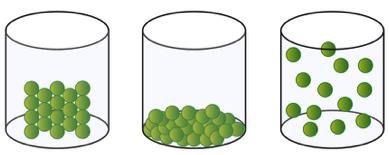
Bonding: Intramolecular vs. Intermolecular Forces
Intramolecular Forces
Intramolecular forces are the strong forces that hold atoms together within a molecule or compound. These include:
Ionic bonds: Electrostatic attraction between oppositely charged ions (e.g., Na+ and Cl-).
Covalent bonds: Sharing of electrons between two atoms.
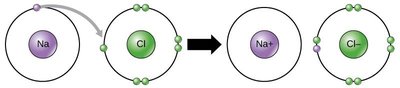
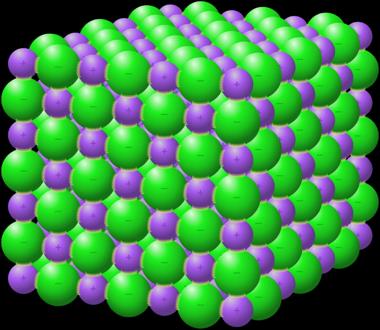
Intermolecular Forces (IMF)
Intermolecular forces are weaker attractions between molecules or atoms in a substance. They are responsible for many physical properties, such as boiling and melting points.
IMFs are always weaker than intramolecular forces.
Types of IMFs include dispersion forces, dipole-dipole forces, and hydrogen bonds.
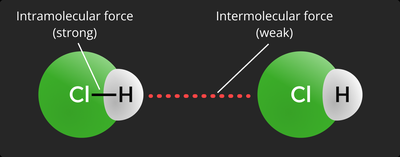
Ionic Bond Strength and Coulomb's Law
Factors Affecting Ionic Bond Strength
The strength of an ionic bond depends on:
Magnitude of charge: Higher charges result in stronger bonds.
Ionic radius: Smaller ions form stronger bonds.
The relationship is described by Coulomb's Law:
where F is the force, q1 and q2 are the charges, r is the distance between ions, and k is a proportionality constant.
Stronger ionic bonds lead to higher melting and boiling points.
Types of Intermolecular Forces
London Dispersion Forces
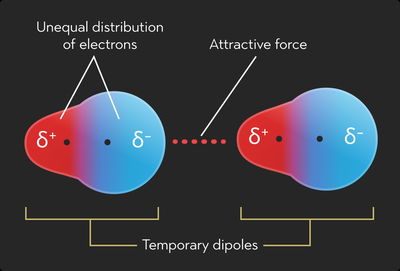
London dispersion forces arise from temporary, instantaneous dipoles created by the movement of electrons. These forces are present in all molecules but are the only IMF in nonpolar molecules.
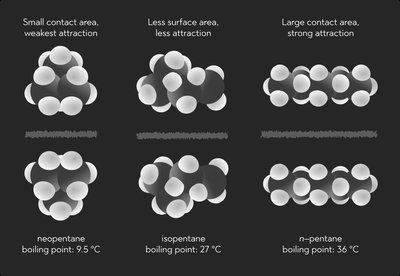
The strength increases with the size and polarizability of the electron cloud.
Larger molecules with more electrons have stronger dispersion forces.
Dipole-Dipole Intermolecular Forces
Dipole-dipole forces occur between polar molecules with permanent dipole moments. The strength of these forces depends on the magnitude of the dipole moment.
Polar molecules attract each other via their positive and negative ends.
The larger the dipole moment, the stronger the force.

Hydrogen Bonding
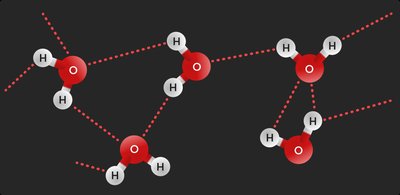
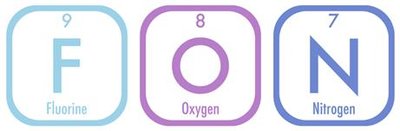
Hydrogen bonds are a special, strong type of dipole-dipole interaction. They occur when hydrogen is bonded to highly electronegative atoms: fluorine (F), oxygen (O), or nitrogen (N).
Hydrogen bonds are the strongest type of IMF.
They are responsible for unique properties of water and other molecules containing H-F, H-O, or H-N bonds.
Summary Table: Types of Intermolecular Forces
Type of Molecule | Intermolecular Forces Present |
|---|---|
Nonpolar | London dispersion forces |
Polar (no H-F, H-O, or H-N) | Dipole-dipole, London dispersion |
Polar (with H-F, H-O, or H-N) | Hydrogen bonding, dipole-dipole, London dispersion |
Comparing Strengths of Forces
Intramolecular forces (ionic and covalent bonds) are much stronger than intermolecular forces.
Among IMFs: Hydrogen bonding > Dipole-dipole > Dispersion forces.
For dipole-dipole: Larger dipole moment = stronger force.
For dispersion: Larger, more polarizable molecules = stronger force.
Predicting Ionic Bond Strength and Melting/Boiling Points
Trends in Ionic Compounds
Increasing charge on ions increases bond strength and melting/boiling points.
Decreasing ionic radius increases bond strength and melting/boiling points.
Example: Arrange NaCl, MgO, and MgF2 in order of increasing melting point:
NaCl < MgF2 < MgO
This order also applies to boiling points.
Identifying Dominant Intermolecular Forces in Molecules
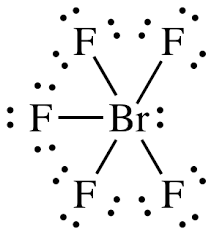
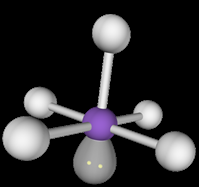
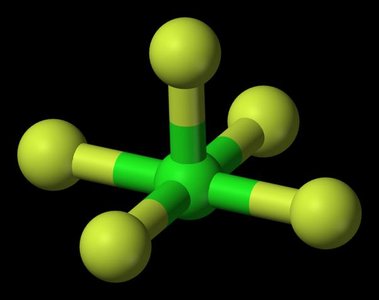
Example: BrF5
BrF5 is polar and has both dispersion and dipole-dipole forces.
No hydrogen bonding (no H-F, H-O, or H-N bonds).
Dominant force: Dipole-dipole.
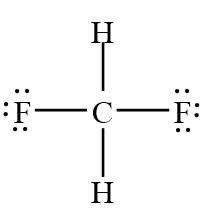
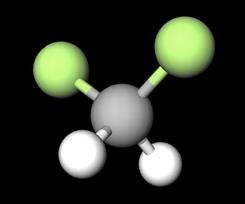
Example: CH2F2
CH2F2 is polar and has both dispersion and dipole-dipole forces.
No hydrogen bonding (no H-F, H-O, or H-N bonds).
Dominant force: Dipole-dipole.
Key Takeaways
Understand the difference between intramolecular and intermolecular forces.
Recognize the types and relative strengths of IMFs: dispersion, dipole-dipole, and hydrogen bonding.
Predict physical properties (melting/boiling points) based on the strength of forces present.
Identify the dominant IMF in a given molecule by analyzing its structure and bonding.
