뒤로
Introduction to General Chemistry: Measurement, Matter, and Mixtures
스터디 가이드 - 스마트 노트
 자료에 맞춘 맞춤형 노트, 핵심 정의, 예시, 맥락을 확장해 제공합니다.
Standard Units of Measurement
SI Units and Fundamental Quantities
The International System of Units (SI) is the standard system used in chemistry for expressing measurements. It ensures consistency and clarity in scientific communication.
Fundamental Units: These are the basic units from which all other units are derived.
Meter (m) – for length
Kilogram (kg) – for mass
Second (s) – for time
Liter (L) – for volume (commonly used in chemistry, though the SI unit is the cubic meter, m3)
Derived Units: Formed by combining fundamental units.
Cubic centimeter (cm3) – for volume
Meter per second (m/s) – for speed
Significant Figures
Definition and Importance
Significant figures are the digits in a measurement that are known with certainty plus one final digit, which is somewhat uncertain or estimated. They reflect the precision of a measurement and are crucial for reporting scientific data accurately.
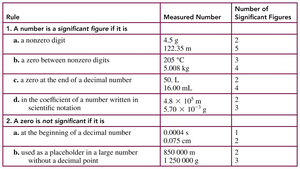
Rules for Determining Significant Figures
The following rules help identify the number of significant figures in a measured value:
Rule | Measured Number | Number of Significant Figures |
|---|---|---|
A number is significant if it is a. a nonzero digit | 4.5 g | 2 |
225 °C | 3 | |
b. a zero between nonzero digits | 205 °C | 3 |
5.008 kg | 4 | |
c. a zero at the end of a decimal number | 5.00 L | 3 |
16.00 mL | 4 | |
d. in the coefficient of a number written in scientific notation | 4.8 × 10³ m | 2 |
5.70 × 10⁻⁸ g | 3 | |
A zero is not significant if it is a. at the beginning of a decimal number | 0.004 s | 1 |
0.075 cm | 2 | |
b. used as a placeholder in a large number without a decimal point | 850 000 m | 2 |
1 250 000 g | 2 |
Examples of Significant Figures
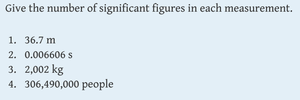
36.7 m – 3 significant figures
0.006606 s – 4 significant figures
2,002 kg – 4 significant figures
306,490,000 people – 6 significant figures (if no decimal point is present; if a decimal is present, all digits are significant)
Expressing Measurements
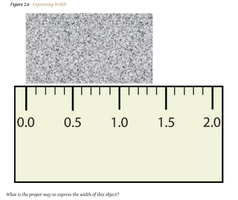
When expressing the width or length of an object, always record all certain digits plus one estimated digit. This practice ensures the measurement reflects the instrument's precision.
Calculations with Significant Figures
When performing calculations, the number of significant figures in the result depends on the operation:
Addition/Subtraction: The result should have the same number of decimal places as the measurement with the fewest decimal places.
Multiplication/Division: The result should have the same number of significant figures as the measurement with the fewest significant figures.
Examples:
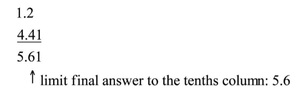
Addition: 1.2 + 4.41 = 5.61 → limit to tenths: 5.6
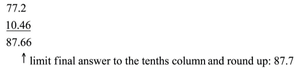
Addition: 77.2 + 10.46 = 87.66 → limit to tenths and round: 87.7
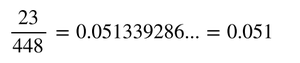
Division: (rounded to 2 significant figures)
Introduction to Chemistry
Divisions of Chemistry
Chemistry is divided into several branches, each focusing on different aspects of matter and its changes:
Organic Chemistry: Study of chemicals containing carbon.
Inorganic Chemistry: Study of chemicals that do not contain carbon.
Biochemistry: Study of processes occurring in living organisms.
Analytical Chemistry: Focuses on the composition of matter.
Physical Chemistry: Studies the mechanism, rate, and energy transfer when matter undergoes change.
Pure and Applied Chemistry
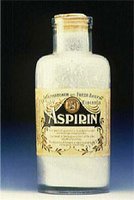
Pure chemistry is the pursuit of chemical knowledge for its own sake, while applied chemistry is research directed toward a practical goal or application. Many discoveries, such as saccharin and aspirin, began as pure research but found important applications.
Matter and Change
Properties of Matter
Matter is anything that has mass and occupies space. It can be described by its properties, which are classified as intensive or extensive:
Intensive Properties: Depend on the type of matter, not the amount (e.g., hardness, melting point).
Extensive Properties: Depend on the amount of matter (e.g., mass, volume).
Physical Properties: Can be observed or measured without changing the substance’s composition (e.g., color, melting point).
Chemical Properties: Can only be observed during a chemical reaction (e.g., reactivity of alkali metals).
States of Matter
Matter exists in four primary states, each with distinct characteristics:
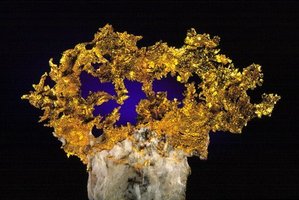
Solid: Definite shape and volume; not easily compressed.
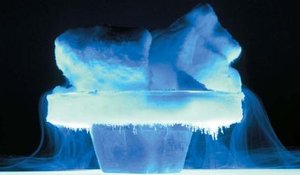
Liquid: Indefinite shape, definite volume; not easily compressed.
Gas: Indefinite shape and volume; easily compressed. A gas is in the gaseous state at room temperature, while a vapor refers to the gaseous state of a substance that is a liquid or solid at room temperature (e.g., water vapor).
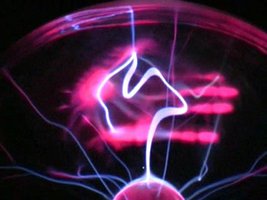
Plasma: A high-energy state where atoms are ionized; found in stars and some laboratory devices.

Mixtures
Definition and Classification
A mixture is a physical blend of two or more components. Mixtures can be classified based on the uniformity of their composition:
Heterogeneous Mixtures: Components are not evenly distributed and may separate into phases (e.g., chili, salad dressing, sand, concrete).
Homogeneous Mixtures (Solutions): Components are evenly distributed throughout (e.g., air, saltwater, alloys).
Examples of Solutions
Liquid Solutions: Water, oil, vinegar
Gaseous Solutions: Air, helium in balloons
Solid Solutions (Alloys): Stainless steel (Fe, Cr, Ni)
Separation of Mixtures
Mixtures can be separated by exploiting differences in physical properties:
Filtration: Separates solids from liquids in heterogeneous mixtures.
Distillation: Separates substances based on differences in boiling points; a liquid is boiled to produce vapor, which is then condensed back into a liquid, leaving behind dissolved solids.
Chromatography: Separates components based on their movement through a medium.
Lab Techniques: Bunsen Burner
Structure and Use
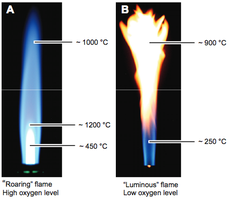
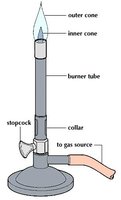
The Bunsen burner is a common laboratory device used to heat substances. It consists of a burner tube, collar, stopcock, and is connected to a gas source. The flame can be adjusted for temperature and oxygen content.
Flame Types
Roaring Flame: High oxygen level, hotter, blue in color.
Luminous Flame: Low oxygen level, cooler, yellow in color.