 뒤로
뒤로Isomerism and Intermolecular Forces in General Chemistry
스터디 가이드 - 스마트 노트
 자료에 맞춘 맞춤형 노트, 핵심 정의, 예시, 맥락을 확장해 제공합니다.
Isomerism
Types of Isomers
Isomers are compounds with the same molecular formula but different structural arrangements. Understanding isomerism is fundamental in chemistry, as isomers often exhibit distinct physical and chemical properties.
Constitutional Isomers: These have different connectivity of atoms, meaning the sequence in which atoms are bonded differs.
Stereoisomers: These have the same connectivity but differ in the three-dimensional spatial arrangement of atoms.
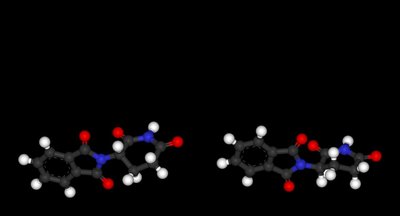
Enantiomers: Non-superimposable mirror images, often described as chiral. Chiral carbon atoms are typically sp3 hybridized and attached to four different groups.
Diastereomers: Non-superimposable, non-mirror images.
Geometric Isomers: Differ in spatial arrangement due to a non-rotating bond (often seen in alkenes).
Key Point: Isomers of a particular formula are considered different substances and may have different properties and reactivity.
Example: The drug thalidomide exists as two enantiomers: one reduces morning sickness, while the other causes birth defects.
Intermolecular Forces
London Dispersion Forces
All atoms and molecules exhibit London dispersion forces, which arise from instantaneous dipoles that induce dipoles in neighboring atoms or molecules. These forces are proportional to the number of electrons (polarizability) and are present in all substances, but are especially significant in nonpolar molecules.
Strength: Increases with the number of electrons and the size of the molecule.
Shape Effect: Branched molecules cannot approach each other closely, weakening dispersion forces.
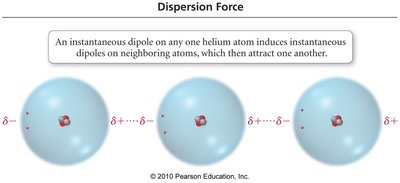
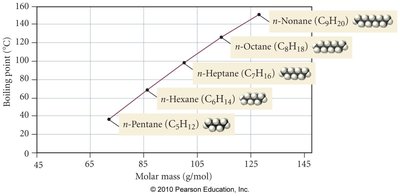
Example: The boiling points of alkanes increase with molar mass due to stronger dispersion forces.
Dipole-Dipole Interactions
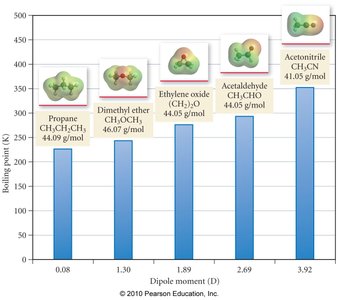
Some molecules are polar and exhibit dipole-dipole forces. These arise from permanent dipoles due to unbalanced 3D arrangements of polar bonds. The dipole moment (measured in Debye, D) quantifies the polarity of a molecule.
Determining Polarity: Polar molecules have an uneven distribution of electron density, resulting in a net molecular dipole.
Example: Carbonyl sulfide (OCS) has a net dipole moment due to differences in electronegativity between O, C, and S.
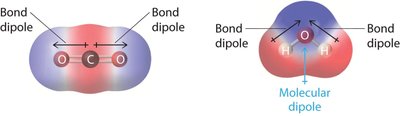
Key Point: Polar molecules exhibit both London dispersion and dipole-dipole forces. The magnitude of the dipole moment can significantly affect physical properties such as boiling point.
Hydrogen Bonding
Hydrogen bonding is a special type of dipole-dipole interaction that occurs when a hydrogen atom is bonded to a highly electronegative atom (N, O, or F) and interacts with a lone pair on another electronegative atom. Hydrogen bonds are stronger than typical dipole-dipole interactions but weaker than covalent bonds.
Requirements:
A hydrogen atom engaged in a very polar bond (commonly with N, O, or F).
An electron lone pair on the other molecule (generally also on N, O, or F).
Effect: Molecules can engage in multiple hydrogen bonding interactions, significantly affecting properties like boiling point and solubility.
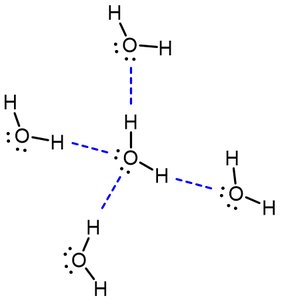
Example: In water, each molecule can form up to four hydrogen bonds, leading to high boiling point and unique properties.
Valence Bond Theory and Electron Delocalization
Valence bond theory helps explain electron delocalization in molecules. For example, the nitrogen atom's lone pair in certain geometries (such as trigonal planar, sp2 hybridized) may participate in delocalization and not be available for hydrogen bonding.
Hybridization: The local geometry and hybridization of atoms affect their ability to participate in hydrogen bonding.
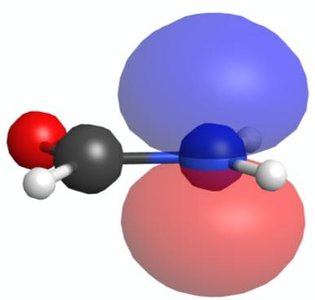
Additional info: Electron delocalization is crucial in understanding aromaticity and resonance structures in organic molecules.
Summary Table: Types of Isomers
Type | Definition | Example |
|---|---|---|
Constitutional Isomers | Different connectivity of atoms | Butane vs. isobutane |
Stereoisomers | Same connectivity, different spatial arrangement | Cis/trans alkenes |
Enantiomers | Non-superimposable mirror images | Thalidomide enantiomers |
Diastereomers | Non-superimposable, non-mirror images | Glucose vs. galactose |
Geometric Isomers | Different arrangement due to non-rotating bond | Cis/trans 2-butene |
Summary Table: Intermolecular Forces
Force Type | Origin | Relative Strength | Example |
|---|---|---|---|
London Dispersion | Instantaneous dipoles | Weakest | Alkanes |
Dipole-Dipole | Permanent dipoles | Intermediate | Acetone |
Hydrogen Bonding | H bonded to N, O, or F | Strongest (intermolecular) | Water |
