 뒤로
Lewis Structures and Formal Charge: Lecture 13
스터디 가이드 - 스마트 노트
 자료에 맞춘 맞춤형 노트, 핵심 정의, 예시, 맥락을 확장해 제공합니다.
Lewis Structures
Principles of Drawing Lewis Structures
Lewis structures are a fundamental tool in chemistry for representing the arrangement of atoms and electrons in molecules and ions. They help predict molecular geometry, reactivity, and formal charge distribution.
Step 1: Sum all valence electrons
If the molecule has a negative charge, add 1 electron per negative charge.
If the molecule has a positive charge, remove 1 electron per positive charge.
Step 2: Choose the central atom
Place the least electronegative atom in the center.
Hydrogen is never the central atom.
Avoid halogens as central atoms if possible.
Step 3: Connect outer atoms to the central atom using single bonds (1 bond = 2 electrons).
Step 4: Assign remaining electrons as lone pairs
Start with the most electronegative outer atom first.
Step 5: If you run out of electrons, use double and triple bonds to fill valence shells.
Step 6: Assign formal charge to atoms.
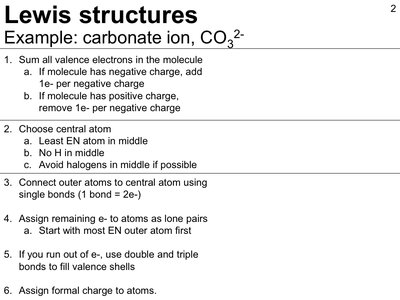
Example: The carbonate ion, CO32-, is a classic example for practicing Lewis structure construction.
Formal Charge
Definition and Calculation
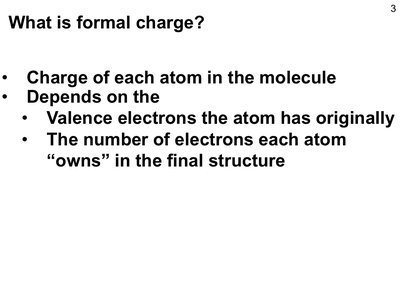
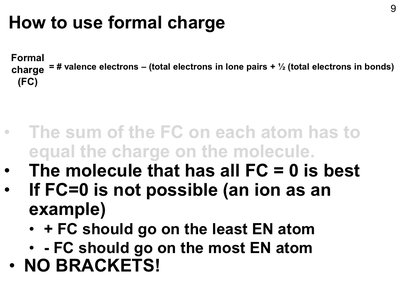
Formal charge is the charge assigned to an atom in a molecule, assuming that electrons in all chemical bonds are shared equally between atoms, regardless of relative electronegativity.
Depends on:
The number of valence electrons the atom has originally.
The number of electrons each atom "owns" in the final structure.
Formula:
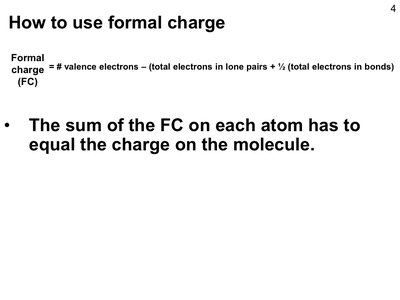
Key Point: The sum of the formal charges on all atoms must equal the overall charge of the molecule or ion.
Resonance Structures
Concept and Stability
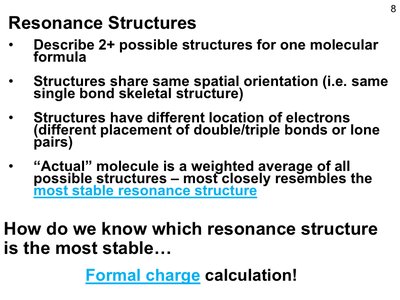
Resonance structures describe two or more possible Lewis structures for a single molecular formula. These structures share the same spatial orientation (skeletal structure) but differ in the placement of electrons (double/triple bonds or lone pairs).
The actual molecule is a weighted average of all possible resonance structures.
The most stable resonance structure contributes most to the actual molecule.
Stability is determined by minimizing formal charges and placing negative charges on the most electronegative atoms.
Example: The carbonate ion (CO32-) has three resonance structures, each with a different placement of double bonds.
How to determine the most stable resonance structure: Use formal charge calculations. The structure with all formal charges equal to zero is preferred. If this is not possible, positive formal charges should be on the least electronegative atom, and negative formal charges on the most electronegative atom.
Complexities in Lewis Structures
Multiple Possible Structures
Some molecules can have two or more possible Lewis structures, leading to resonance or structural isomers.
Resonance occurs when electrons can be distributed in multiple ways without changing the atom arrangement.

Incomplete Octets
Some atoms, especially Be, B, and Al, can have fewer than eight electrons in their valence shell, resulting in an incomplete octet. This is an exception to the octet rule.
Common in molecules like BF3 and BeCl2.
Example: Boron in BF3 has only six valence electrons.
Expanded Octets
Central atoms with atomic number Z ≥ 11 (such as S, P, halogens, and noble gases) can have more than eight electrons in their valence shell, forming expanded octets. This occurs because these elements have d orbitals available for bonding.
Common in molecules like SF6 and PCl5.
Summary Table: Lewis Structure Exceptions
Type | Elements | Example | Description |
|---|---|---|---|
Incomplete Octet | Be, B, Al | BF3, BeCl2 | Central atom has fewer than 8 electrons |
Expanded Octet | S, P, halogens, noble gases (Z ≥ 11) | SF6, PCl5 | Central atom has more than 8 electrons |
Key Takeaways
Lewis structures are essential for visualizing molecular bonding and electron distribution.
Formal charge calculations help identify the most stable structure and correct resonance forms.
Exceptions to the octet rule include incomplete and expanded octets.
Example: Drawing a Lewis structure and minimizing formal charges is a key skill in general chemistry.
