 뒤로
Light, Atomic Structure, and Electron Configuration: Chapter 5 Study Notes
스터디 가이드 - 스마트 노트
 자료에 맞춘 맞춤형 노트, 핵심 정의, 예시, 맥락을 확장해 제공합니다.
Light and the Electromagnetic Spectrum (Chapter 5 )
Electromagnetic Radiation and Its Types
The electromagnetic spectrum encompasses all forms of electromagnetic radiation, including visible light, infrared radiation, microwaves, radio waves, and X-rays. These types of radiation differ in their wavelength and frequency, but all are forms of energy that travel through space.
Electromagnetic radiation: Energy that travels in waves and includes gamma rays, X-rays, ultraviolet, visible, infrared, microwaves, and radio waves.
Visible light: Only a small portion of the electromagnetic spectrum, ranging from about 380 nm (violet) to 780 nm (red).
Wavelength (λ): The distance between two consecutive peaks of a wave.
Frequency (ν): The number of wave peaks passing a point per second, measured in hertz (Hz).
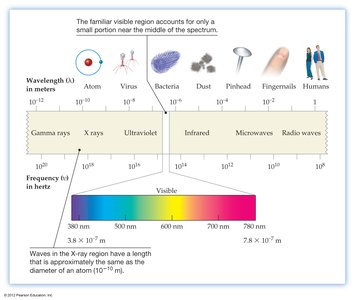
How We Describe Waves
Wave Properties: Wavelength, Frequency, and Amplitude
Electromagnetic energy travels in a wave-like manner and is characterized by three main properties: wavelength, frequency, and amplitude.
Wavelength (λ): The distance from one wave peak to the next.
Frequency (ν): The number of cycles per second (Hz).
Amplitude: The height of the wave, related to the intensity of light.
Relationship: The product of wavelength and frequency gives the speed of light (c).
Equation:
Where (speed of light).
Frequency and wavelength are inversely related: longer wavelength means lower frequency and energy; shorter wavelength means higher frequency and energy.
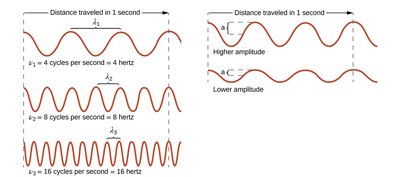
Wavelike Properties of Light
Diffraction and Interference
Light exhibits wavelike behavior, such as diffraction (bending around objects) and interference (interaction between waves).
Constructive interference: Waves in phase add together, increasing brightness.
Destructive interference: Waves out of phase cancel each other, reducing brightness.
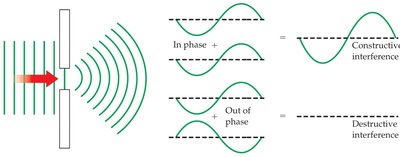
Double-Slit Experiment
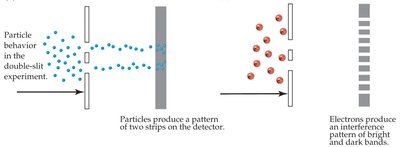
Thomas Young's double-slit experiment demonstrated the wavelike nature of light. Monochromatic light passing through two slits produces an interference pattern, confirming light's ability to diffract and interfere.
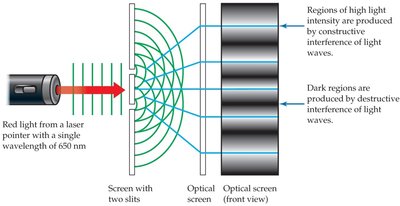
Particle-like Properties of Electromagnetic Energy
The Photoelectric Effect
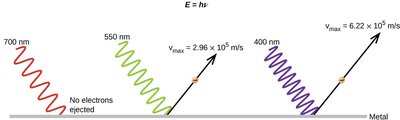
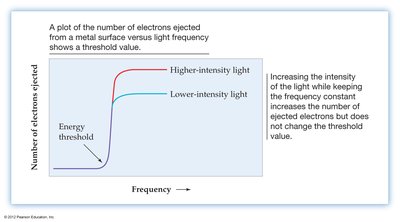
When light irradiates a clean metal surface, electrons are ejected—a phenomenon known as the photoelectric effect. This effect requires a minimum threshold energy (frequency) specific to each metal.
Threshold frequency: Minimum frequency of light required to eject electrons from a metal.
Photoelectric effect: Evidence for the particle-like nature of light.
Light: Wave-Particle Duality
Einstein's Photon Theory
Albert Einstein proposed that light is both a wave and a stream of particles called photons. The energy of a photon is related to its frequency:
Energy of a photon:
Alternate form:
Planck's constant:
Blue light (shorter wavelength) has higher energy than red light (longer wavelength).
Elemental Line Spectra
Emission Spectra and Atomic Signatures
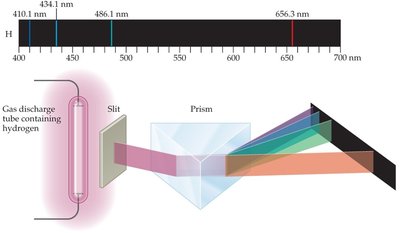
Atoms emit light at specific wavelengths when excited, producing a line spectrum unique to each element. This is observed by passing emitted light through a slit and prism.
Line spectrum: Unique set of wavelengths emitted by an element.
Spectral signature: Used to identify elements.
Hydrogen Line Spectrum & the Balmer-Rydberg Equation
Balmer-Rydberg Equation
The Balmer-Rydberg equation describes the wavelengths of light emitted by hydrogen:
(Rydberg constant)
and are integers,
This equation only works for hydrogen due to its single electron.
Bohr's Model of the Atom
Quantized Electron Orbits
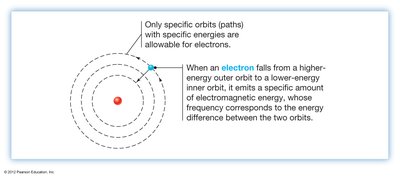
Niels Bohr proposed that electrons occupy quantized orbits around the nucleus. Light is emitted when electrons transition from higher to lower energy orbits.
Quantized orbits: Only specific energy levels are allowed.
Emission: Energy released as electrons move to lower orbits.
de Broglie and Wave-Particle Duality of Matter
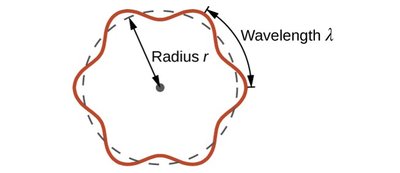
de Broglie Wavelength
Louis de Broglie extended wave-particle duality to matter, suggesting that particles like electrons have a wavelength:
Useful for atomic-scale particles: Masses and distances are very small.
Electron Wave-Particle Duality
Interference Patterns of Electrons
Electrons, like waves, can produce interference patterns in experiments such as the double-slit experiment, demonstrating their wave-like nature.
Quantum Mechanical Model of the Atom
Schrödinger's Wave Equation and Heisenberg Uncertainty Principle
Erwin Schrödinger developed the quantum mechanical model, focusing on the wave-like properties of electrons. The Heisenberg uncertainty principle states that it is impossible to know both the position and momentum of an electron with high precision:
Wave functions (orbitals): Solutions to Schrödinger's equation describe regions where electrons are likely to be found.
Quantum numbers: , , describe energy, shape, and orientation of orbitals.
Quantum Numbers and Atomic Orbitals
Principal Quantum Number (n)
The principal quantum number () is a positive integer that describes the size and energy level of the orbital. Higher means larger and higher-energy orbitals.
Angular Momentum Quantum Number (l)
The angular momentum quantum number () defines the shape of the orbital and ranges from $0n-1l$ are subshells (s, p, d, f, ...).
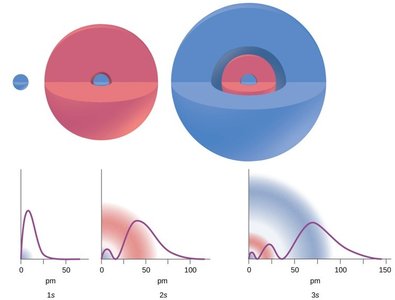
Orbital Shapes
Each orbital type has a characteristic shape:
s orbitals: Spherical
p orbitals: Dumbbell-shaped
d orbitals: Cloverleaf and donut shapes
f orbitals: Complex shapes
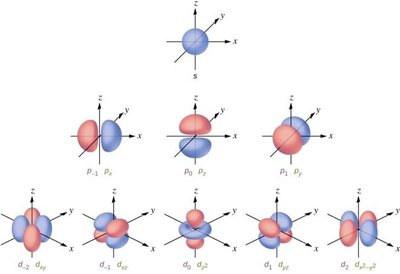
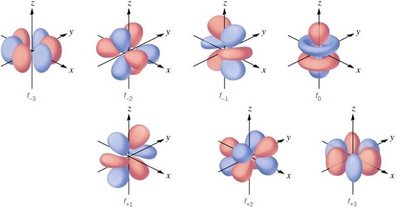
Magnetic Quantum Number (ml)
The magnetic quantum number () defines the spatial orientation of the orbital, ranging from to .
s orbital:
p orbitals:
d orbitals:
f orbitals:
Allowed Quantum Number Combinations
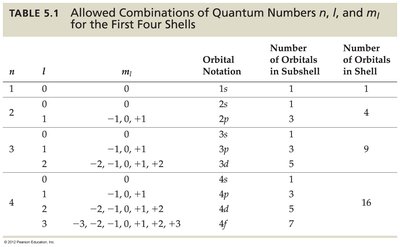
The following table summarizes allowed quantum number combinations for the first four shells:
n | l | ml | Orbital Notation | Number of Orbitals in Subshell | Number of Orbitals in Shell |
|---|---|---|---|---|---|
1 | 0 | 0 | 1s | 1 | 1 |
2 | 0 | 0 | 2s | 1 | 4 |
2 | 1 | -1, 0, +1 | 2p | 3 | 4 |
3 | 0 | 0 | 3s | 1 | 9 |
3 | 1 | -1, 0, +1 | 3p | 3 | 9 |
3 | 2 | -2, -1, 0, +1, +2 | 3d | 5 | 9 |
4 | 0 | 0 | 4s | 1 | 16 |
4 | 1 | -1, 0, +1 | 4p | 3 | 16 |
4 | 2 | -2, -1, 0, +1, +2 | 4d | 5 | 16 |
4 | 3 | -3, ..., +3 | 4f | 7 | 16 |
Orbital Shapes: s, p, and d Orbitals
s Orbitals
All s orbitals are spherical, with the probability of finding an electron highest near the nucleus and decreasing with distance. Higher energy s orbitals are larger and have nodes (regions of zero probability).
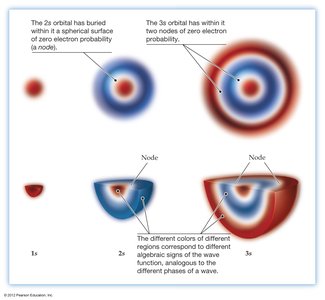
Nodes
Nodes are regions of zero amplitude in a wave, intrinsic to all wave phenomena. Electrons as waves can exist on either side of a node.
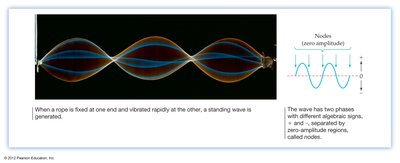
p Orbitals
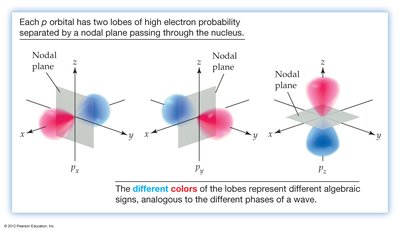
p orbitals are dumbbell-shaped, with two lobes separated by a nodal plane passing through the nucleus. Each shell starting with n = 2 has three p orbitals oriented along the x, y, and z axes.
d Orbitals
d orbitals have more complex shapes, including four-lobed cloverleaf forms and a fifth orbital with a donut-shaped region.
Orbital Energies and Effective Nuclear Charge
Effective Nuclear Charge (Zeff)
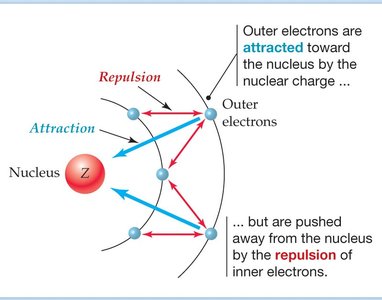
In multi-electron atoms, outer electrons experience repulsion from inner electrons, reducing their attraction to the nucleus. This is called electron shielding. The effective nuclear charge is:
Electron Shielding and Orbital Penetration
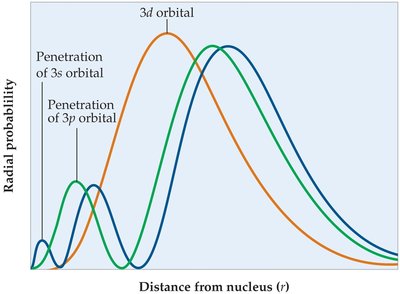
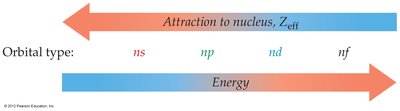
Electron shielding varies with orbital type. Lower l orbitals (s, p) penetrate closer to the nucleus and shield higher l orbitals (d, f) more effectively. The lower the l, the higher the Zeff.
Electron Configurations of Multielectron Atoms
Rules for Electron Configuration
Aufbau principle: Lower-energy orbitals fill before higher-energy orbitals.
Pauli exclusion principle: An orbital can hold only two electrons with opposite spins.
Hund's rule: Electrons fill degenerate orbitals singly before pairing.
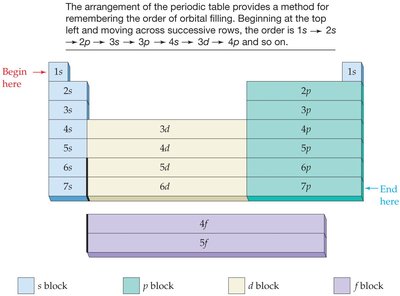
Valence Electrons and Core Notation
Valence and Core Electrons
Atoms have core electrons (inner shells) and valence electrons (outermost shell). Core notation uses the noble gas configuration for the core, followed by the remaining orbitals.
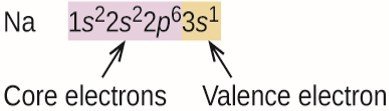
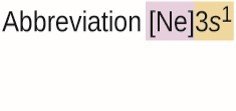
Group Number and Valence Electrons
Elements in the same group of the periodic table have the same number of valence electrons, which determines their chemical properties.
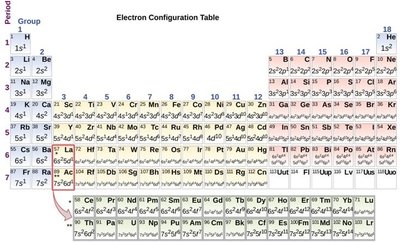
Electron Configurations and Periodic Properties: Atomic Radii
Trends in Atomic Radius
Atomic radius increases down a group and decreases across a period. This is due to increasing shell size and electron shielding down a group, and increasing effective nuclear charge across a period.
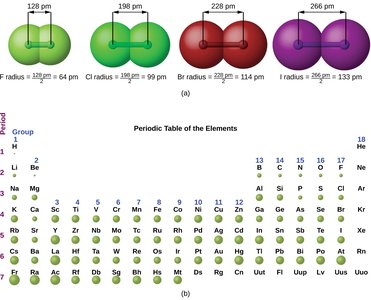
Explanation of Atomic Radius Trends
Across a period: Atomic radius decreases as electrons are added to the same shell and experience greater Zeff.
Down a group: Atomic radius increases as electrons are added to larger shells and are more shielded from the nucleus.
----------------------------------------
