 뒤로
Liquids, Solids, and Intermolecular Forces: Structure, Properties, and Phase Changes
스터디 가이드 - 스마트 노트
 자료에 맞춘 맞춤형 노트, 핵심 정의, 예시, 맥락을 확장해 제공합니다.
Liquids, Solids, and Intermolecular Forces
Introduction to States of Matter
Matter exists in three primary states: solid, liquid, and gas. The condensed states (solids and liquids) are characterized by particles that are close together and held by moderate to strong attractive forces. The properties of matter are fundamentally determined by the properties and interactions of molecules and atoms.
Solids: Definite shape and volume; particles vibrate around fixed positions.
Liquids: Indefinite shape but definite volume; particles can move past one another.
Gases: Indefinite shape and volume; particles are far apart and move freely.
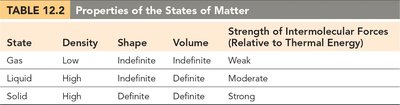
State | Density | Shape | Volume | Strength of Intermolecular Forces |
|---|---|---|---|---|
Gas | Low | Indefinite | Indefinite | Weak |
Liquid | High | Indefinite | Definite | Moderate |
Solid | High | Definite | Definite | Strong |
The Three States of Water
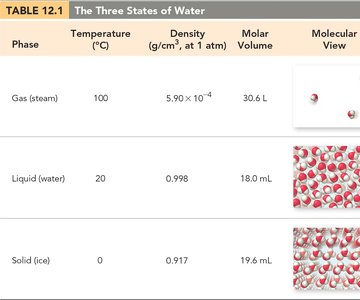
Water is an excellent example for comparing the three states of matter. The following table summarizes the physical properties of water in each state at standard conditions:
Phase | Temperature (°C) | Density (g/cm³, at 1 atm) | Molar Volume |
|---|---|---|---|
Gas (steam) | 100 | 5.90 × 10⁻⁴ | 30.6 L |
Liquid (water) | 20 | 0.998 | 18.0 mL |
Solid (ice) | 0 | 0.917 | 19.6 mL |
Changes Between States
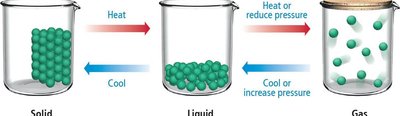
Transitions between solid, liquid, and gas occur through changes in temperature and/or pressure. Heating generally causes transitions from solid to liquid (melting/fusion) and liquid to gas (vaporization), while cooling reverses these processes. Increasing pressure favors denser states (solid or liquid), while decreasing pressure favors less dense states (gas).
Intermolecular Forces
Overview of Intermolecular Forces
Intermolecular forces are attractive forces between molecules or atoms that determine the physical properties of substances, such as boiling and melting points. The strength of these forces relative to thermal energy determines the state of matter at a given temperature.
Dispersion (London) Forces: Present in all molecules and atoms; arise from temporary fluctuations in electron distribution.
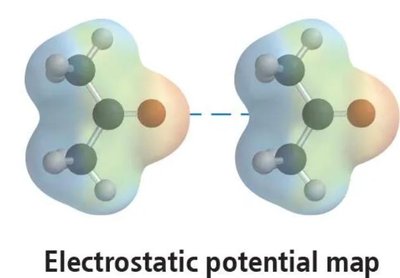
Dipole-Dipole Forces: Occur between polar molecules; positive end of one molecule attracts negative end of another.
Hydrogen Bonding: Special case of dipole-dipole; occurs when H is bonded to F, O, or N.
Ion-Dipole Forces: Occur between ions and polar molecules; strongest type of intermolecular force.
Dispersion Forces (London Forces)
Dispersion forces are the result of temporary dipoles created by fluctuations in electron distribution. The magnitude of dispersion forces increases with the size of the electron cloud (i.e., with molar mass) and with molecular shape (longer molecules have stronger dispersion forces).
All molecules experience dispersion forces.
Larger, heavier atoms/molecules have stronger dispersion forces.
Dipole-Dipole Forces
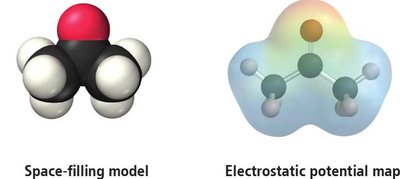
Dipole-dipole forces exist between polar molecules, where regions of partial positive and negative charge attract each other. These forces lead to higher boiling and melting points compared to nonpolar molecules of similar molar mass.
Hydrogen Bonding
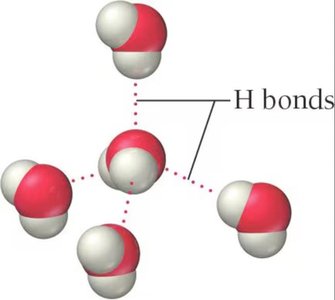
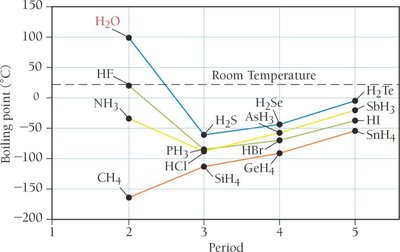
Hydrogen bonding is a particularly strong type of dipole-dipole interaction. It occurs when hydrogen is bonded to highly electronegative atoms (F, O, or N), resulting in a large partial positive charge on hydrogen and a strong attraction to lone pairs on neighboring molecules.
Hydrogen bonds are much stronger than regular dipole-dipole forces but weaker than covalent bonds.
Responsible for high boiling points of substances like water and HF.
Ion-Dipole Forces
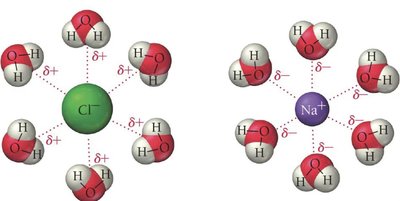
Ion-dipole forces occur when ionic compounds are mixed with polar compounds, such as when NaCl dissolves in water. These are the strongest intermolecular forces and are responsible for the solubility of ionic substances in polar solvents.
Physical Properties Related to Intermolecular Forces
Surface Tension
Surface tension is the tendency of a liquid to minimize its surface area due to intermolecular attractions. Molecules at the surface experience fewer interactions and thus have higher potential energy, leading to a resistance to increasing surface area.
Viscosity
Viscosity is a measure of a liquid's resistance to flow. Substances with strong intermolecular forces or long, entangled molecules have higher viscosity. Viscosity decreases with increasing temperature as thermal energy overcomes intermolecular attractions.
Capillary Action
Capillary action is the ability of a liquid to flow against gravity in a narrow tube, resulting from the balance between cohesive forces (liquid-liquid) and adhesive forces (liquid-tube).
Vaporization, Condensation, and Energetics
Vaporization and Condensation
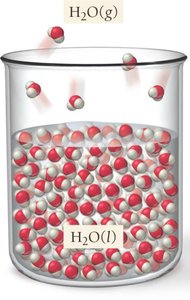
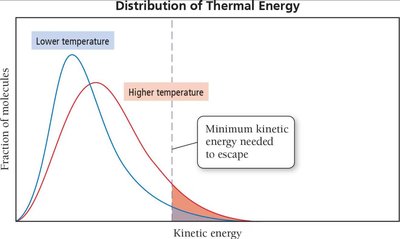
Vaporization is the process by which molecules escape from the liquid phase to the gas phase. It is an endothermic process, requiring energy input. Condensation is the reverse, exothermic process where gas molecules return to the liquid phase.
Heat of Vaporization
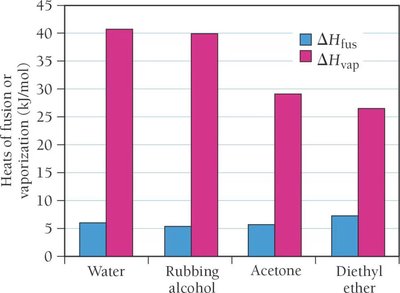
The heat of vaporization (ΔHvap) is the amount of energy required to vaporize one mole of a liquid at its boiling point. For water, ΔHvap = +40.7 kJ/mol at 100°C. The process is always endothermic (ΔH positive).
Dynamic Equilibrium and Vapor Pressure
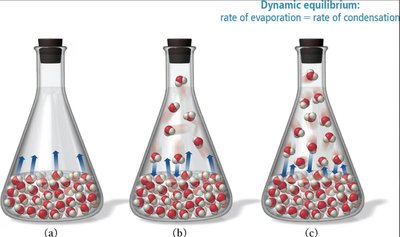
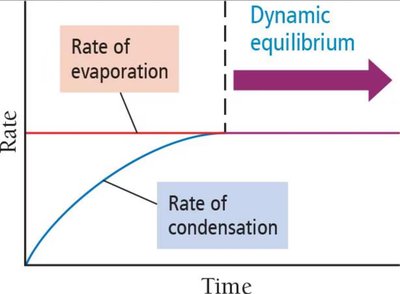
In a closed system, the rate of evaporation equals the rate of condensation at equilibrium, resulting in a constant vapor pressure. Vapor pressure depends on the strength of intermolecular forces and temperature.
Clausius-Clapeyron Equation
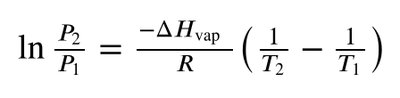
The Clausius-Clapeyron equation describes the relationship between vapor pressure and temperature:
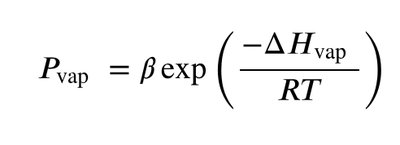
Two-point form for comparing two temperatures and pressures:
Melting, Freezing, and Sublimation
Fusion (Melting) and Freezing
Fusion is the transition from solid to liquid, while freezing is the reverse. The heat of fusion (ΔHfus) is the energy required to melt one mole of a solid. For water, ΔHfus = 6.02 kJ/mol.
Sublimation and Deposition
Sublimation is the direct transition from solid to gas, while deposition is the reverse. The heat of sublimation (ΔHsub) is the energy required to sublime one mole of a solid and is equal to the sum of the heats of fusion and vaporization.
Heating Curves
Heating Curve of Water
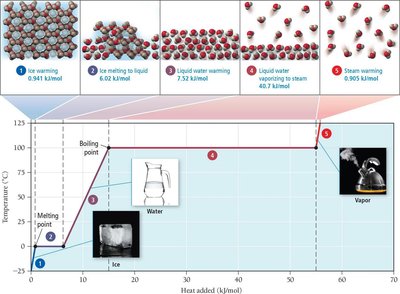
A heating curve shows the temperature of a substance as heat is added. Plateaus represent phase changes where temperature remains constant as energy is used for the transition.
q = mCsΔT for temperature changes within a phase
q = nΔHfus or q = nΔHvap for phase changes
Phase Diagrams
Understanding Phase Diagrams
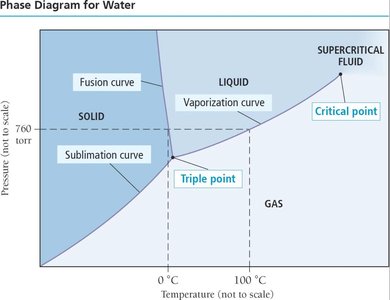
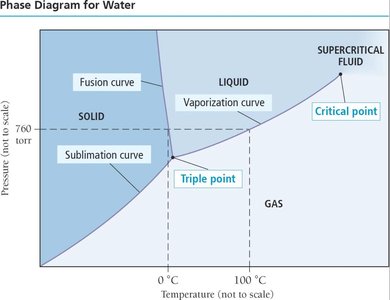
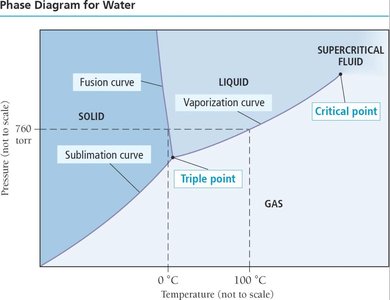
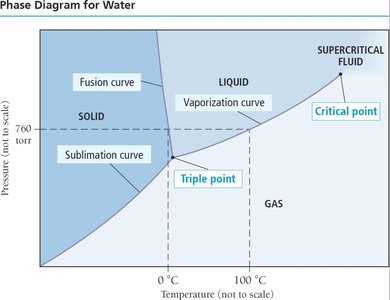
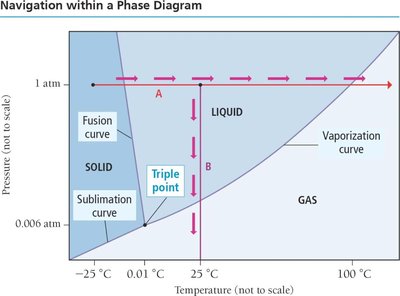
Phase diagrams map the state of a substance as a function of temperature and pressure. Regions represent solid, liquid, and gas; lines represent equilibrium between phases; and points such as the triple point and critical point have special significance.
Water: Anomalous Properties
Unique Properties of Water
Water is unique among small molecules due to its high boiling point, high specific heat capacity, and the fact that its solid form (ice) is less dense than its liquid form. These properties are due to strong hydrogen bonding and the bent geometry of the water molecule.
Water as a Solvent
Water's high polarity allows it to dissolve many ionic and polar substances, making it the main solvent in biological and environmental systems.
Water's Specific Heat Capacity
Water has a high specific heat capacity, which moderates temperature changes in the environment and living organisms.
How Water Freezes
Unlike most substances, water expands upon freezing, making ice less dense than liquid water. This property is crucial for aquatic life and environmental processes.
Summary Table: Types of Intermolecular Forces
Type of Force | Occurs Between | Relative Strength | Example |
|---|---|---|---|
Dispersion (London) | All molecules/atoms | Weakest | I2, CH4 |
Dipole-Dipole | Polar molecules | Intermediate | CH3Cl |
Hydrogen Bonding | H with F, O, or N | Strong | H2O, HF |
Ion-Dipole | Ions and polar molecules | Strongest | NaCl in H2O |
