 뒤로
Lec 5 notes chem
스터디 가이드 - 스마트 노트
 자료에 맞춘 맞춤형 노트, 핵심 정의, 예시, 맥락을 확장해 제공합니다.
Many-Electron Atoms
One-Electron vs. Many-Electron Species
Atoms with only one electron, such as hydrogen, can be treated exactly using the Schrödinger equation. However, most elements in the periodic table are many-electron atoms, where electron-electron repulsions complicate the energy structure of atomic orbitals.
One-electron atom: Example: H atom. All orbitals with the same principal quantum number (n) are degenerate (same energy).
Many-electron atom: Example: He atom. Electron-electron repulsions cause orbitals to have different energies, even within the same shell.
Orbital Energies in One- vs. Many-Electron Atoms
Orbital energy determines the stability of an electron in an atom. Lower (more negative) energy means greater stability. In one-electron atoms, orbitals within a shell are degenerate. In many-electron atoms, several factors affect orbital energies:
Nuclear charge: Greater nuclear charge lowers orbital energy, making electrons harder to remove.
Electron-electron repulsions: Increase orbital energy, making electrons easier to remove.
Shielding: Electrons in outer orbitals are shielded from the full nuclear charge, resulting in higher energy.
Penetration: Orbitals with electron density close to the nucleus (good penetration) have lower energy.
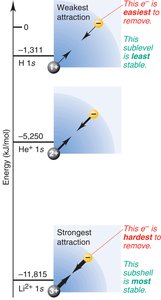
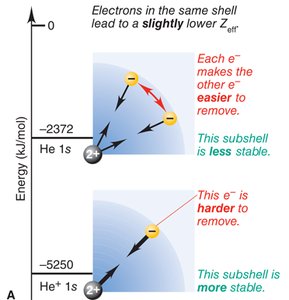
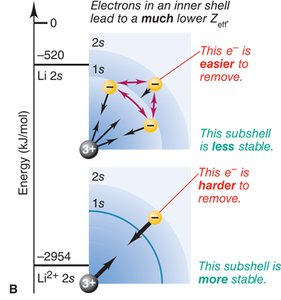
Example: The effective nuclear charge (Zeff) felt by a 2s electron in Li is less than the full nuclear charge due to shielding by inner electrons.
Penetration and Shielding Order: For orbitals in the same shell: s < p < d < f (s is most penetrating and least shielded, f is least penetrating and most shielded).
Quantum Numbers and the Stern-Gerlach Experiment
Quantum Numbers
Each electron in an atom is described by four quantum numbers:
Principal quantum number (n): Determines orbital energy and size. Allowed values: 1, 2, 3, ...
Angular momentum quantum number (l): Determines orbital shape. Allowed values: 0, ..., (n–1)
Magnetic quantum number (ml): Determines orbital orientation. Allowed values: –l, ..., 0, ..., +l
Spin quantum number (ms): Introduced by the Stern-Gerlach experiment, which showed that electrons have intrinsic spin (±1/2).
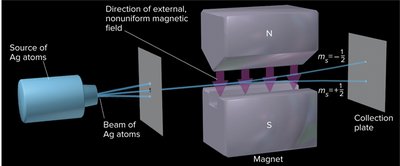
Additional info: The Stern-Gerlach experiment demonstrated the quantization of electron spin by splitting a beam of silver atoms in a magnetic field.
Electron Configurations
Rules for Electron Configuration
In the ground state, electrons fill orbitals to minimize total energy, following these principles:
Aufbau Principle: Electrons are added to the lowest energy orbitals first.
Pauli Exclusion Principle: No two electrons in an atom can have the same set of four quantum numbers. Each orbital can hold a maximum of two electrons with opposite spins.
Hund's Rule: When orbitals of equal energy are available, electrons occupy them singly with parallel spins before pairing up.
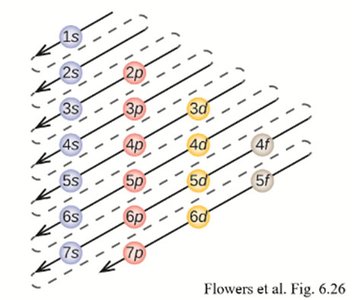
Example: The two electrons in a He atom have quantum numbers n=1, l=0, ml=0, ms=+1/2 and n=1, l=0, ml=0, ms=–1/2.
Electron Configurations and the Periodic Table
The periodic table is organized into blocks (s, p, d, f) based on electron configurations. Elements in the same group have similar valence electron configurations, explaining their chemical similarities.
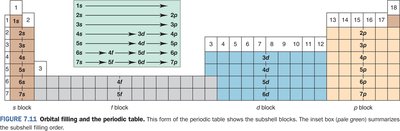
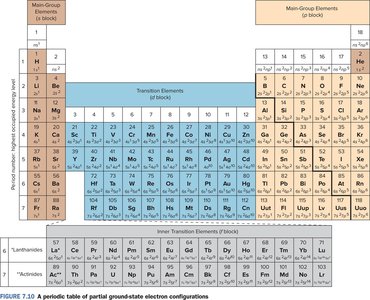
Example: Ground-state electron configuration for Sb: [Kr] 4d10 5s2 5p3; for Au: [Xe] 4f14 5d10 6s1.
Additional info: The Aufbau principle works well for s- and p-block elements, but less reliably for d- and f-block elements due to electron correlation and relativistic effects.
Electron Configurations of Ions
Formation of Cations and Anions
Metals tend to lose valence electrons to form cations, while nonmetals gain electrons to form anions. For transition metals, ns electrons are removed before (n–1)d electrons.
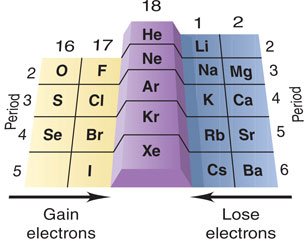
Example: Ca → Ca2+ (loses two electrons from 4s)
Fe → Fe2+ or Fe3+ (loses 4s before 3d electrons)
S → S2– (gains two electrons in 3p)
Magnetic Properties Related to Electron Configurations
Paramagnetism and Diamagnetism
Substances are classified based on their magnetic behavior:
Paramagnetic: Contains unpaired electrons; attracted to magnetic fields.
Diamagnetic: All electrons are paired; repelled by magnetic fields.
Example: CrO2 contains Cr4+ and O2– ions. The electron configuration of Cr4+ is [Ar] 3d2, which is paramagnetic due to unpaired electrons.
Trends in Ionic Radii
Cations vs. Anions
Cations are smaller than their parent atoms because they lose electrons, reducing electron-electron repulsion and allowing the nucleus to pull remaining electrons closer. Anions are larger than their parent atoms due to increased electron-electron repulsion.
Example: Li+ is smaller than Li; F– is larger than F.
Ranking: K+ < Cl– < S2– (increasing size)
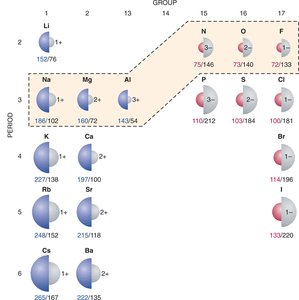
Additional info: Ionic radii depend on both the charge and the electron configuration; higher positive charge leads to smaller cations, while higher negative charge leads to larger anions.
