 뒤로
Matter, Atoms, and Their Properties: Foundations of General Chemistry
스터디 가이드 - 스마트 노트
 자료에 맞춘 맞춤형 노트, 핵심 정의, 예시, 맥락을 확장해 제공합니다.
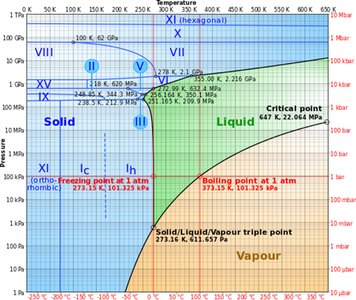
Matter and Its Phases
Empirical Observations of Matter
Matter exists in different phases, each with distinct physical characteristics. Understanding these phases is fundamental to classifying and studying chemical substances.
Solids: Definite shape and volume.
Liquids: Definite volume, but take the shape of their container.
Gases: No definite shape or volume; expand to fill their container.
Phase Changes: Matter can transition between phases (e.g., melting, boiling) due to changes in energy.
Mixtures and Solutions: Some substances mix uniformly (e.g., salt in water), while others separate into layers (e.g., oil and water).
Categorizing Matter
Physical and Chemical Properties
Matter is classified based on its observable and measurable properties, which are divided into physical and chemical categories.
Physical Properties: Characteristics that can be observed without changing the substance's identity (e.g., color, density, melting point).
Chemical Properties: Characteristics that describe a substance's ability to undergo chemical changes (e.g., flammability, reactivity).
Physical Changes: Changes that do not alter the chemical identity (e.g., melting, boiling).
Chemical Changes: Changes that result in the formation of new substances (e.g., combustion, rusting).
Intensive vs. Extensive Properties
Properties of matter are further classified based on their dependence on the amount of substance present.
Intensive Properties: Do not depend on the amount of matter (e.g., density, color, boiling point).
Extensive Properties: Depend on the amount of matter (e.g., mass, volume, energy released upon combustion).
Property | Intensive/Extensive | Physical/Chemical |
|---|---|---|
Mass | Extensive | Physical |
Energy released upon combustion | Extensive | Chemical |
Density | Intensive | Physical |
Temperature | Intensive | Physical |
Volume | Extensive | Physical |
Color | Intensive | Physical |
Reactivity | Intensive | Chemical |
Classification of Matter
Types of Substances
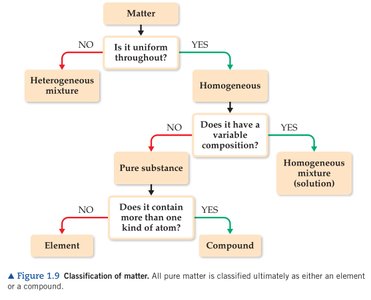
Matter can be classified based on its composition and uniformity.
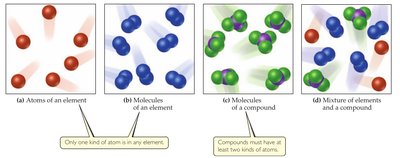
Pure Substance: Composed of only one type of particle (element or compound).
Element: Substance that cannot be broken down into simpler substances by chemical means.
Compound: Substance formed from two or more elements chemically combined in fixed proportions.
Mixture: Combination of two or more pure substances in which each retains its own identity.
Homogeneous Mixture (Solution): Uniform composition throughout.
Heterogeneous Mixture: Non-uniform composition.
Energy in Chemistry
Kinetic and Potential Energy
Chemical changes are driven by energy, which exists in two main forms:
Kinetic Energy: Energy due to motion. For a particle of mass m and velocity v:
Potential Energy: Energy due to position or arrangement. Electrostatic potential energy between two charges q1 and q2 separated by distance r:
Heat: Transfer of energy due to temperature difference.
Work: Transfer of energy due to a force acting over a distance:
Temperature vs. Heat: Temperature measures average kinetic energy; heat is energy transfer due to temperature difference.
The Atomic Perspective
Structure of Atoms
Atoms are the fundamental building blocks of matter, composed of subatomic particles:
Protons: Positively charged, mass ≈ 1 amu.
Neutrons: Neutral, mass ≈ 1 amu.
Electrons: Negatively charged, mass ≈ amu (much lighter than protons/neutrons).
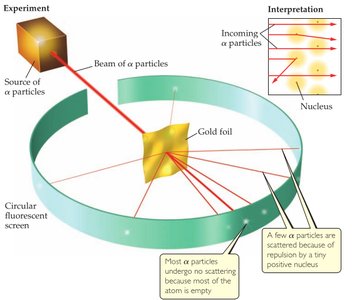
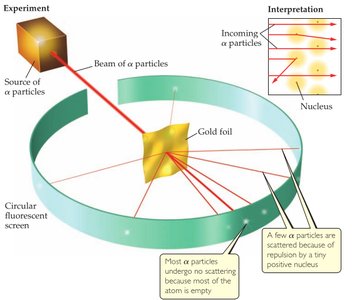
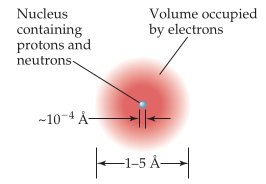
Rutherford's gold foil experiment demonstrated that atoms have a small, dense nucleus containing protons and neutrons, with electrons occupying the surrounding space.
Modern View of the Atom
The atom consists of a compact nucleus surrounded by a cloud of electrons. Chemical properties are largely determined by the arrangement and behavior of electrons, while the identity of the element is defined by the number of protons in the nucleus.
Atomic Number (Z): Number of protons in the nucleus; defines the element.
Mass Number (A): Total number of protons and neutrons.
Isotopes: Atoms of the same element with different numbers of neutrons.
Atomic symbol notation:
Example: (Nitrogen with 7 protons and 7 neutrons)
Atomic Weights and Isotopes
Calculating Atomic Weight
The atomic weight of an element is the weighted average of the masses of its naturally occurring isotopes, based on their relative abundances.
Example (Uranium):
Natural uranium: 99.274% U, 0.726% U
Atomic weight calculation:
amu
The Periodic Table
Organization and Significance
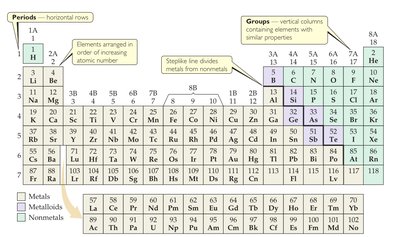
The periodic table arranges elements by increasing atomic number and recurring chemical properties. It is a foundational tool for understanding chemical behavior.
Groups (columns): Elements with similar chemical properties.
Periods (rows): Elements with increasing atomic number.
Classification: Metals, nonmetals, and metalloids are distinguished by their properties and position on the table.
Example: Strontium poisoning occurs when strontium replaces calcium in bone, illustrating the chemical similarity of elements in the same group.
Additional info: The periodic table is essential for predicting element properties, chemical reactivity, and trends such as electronegativity and atomic radius, which will be explored in later chapters.
