 뒤로
Matter: Its Properties and Measurement (Chapter 1) - General Chemistry Study Notes
스터디 가이드 - 스마트 노트
 자료에 맞춘 맞춤형 노트, 핵심 정의, 예시, 맥락을 확장해 제공합니다.
Matter: Its Properties and Measurement
Classification of Matter
Matter is anything that has mass and occupies space. Understanding the classification of matter is fundamental in chemistry, as it helps distinguish between different types of substances and mixtures.
Atom: The basic building block for all matter. Atoms are the smallest units of elements that retain the properties of the element.
Molecule: Two or more atoms joined together by chemical bonds. Molecules can consist of atoms from the same element or different elements.
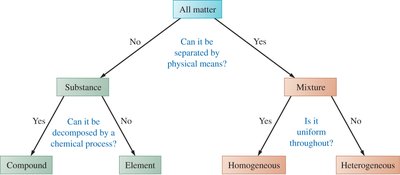
Element: A pure substance consisting of identical atoms. Elements cannot be broken down into simpler substances by chemical means.
Compound: A pure substance composed of two or more different elements chemically combined in fixed proportions.
Molecules of an element: Two or more atoms of the same element joined together (e.g., O2, N2).
Molecules of a compound: Two or more atoms of different elements joined together (e.g., H2O, CO2).
Pure substance: Consists of only one type of molecule or atom.
Mixture: Consists of two or more different molecules or substances physically combined. Mixtures can be separated by physical means.
Separation and purification techniques are required to isolate pure substances from mixtures.
Example: Mercury (Hg) is an element, fluorine (F2) is a molecule of an element, hydrogen fluoride (HF) and hydrogen sulfide (H2S) are molecules of compounds.
Properties of Matter
Properties of matter are categorized as physical or chemical, depending on whether the identity of the substance changes during observation.
Physical Properties: Can be observed without changing the substance into another substance. Examples include color, melting point, boiling point, density, and solubility.
Chemical Properties: Can only be observed when a substance undergoes a chemical change, resulting in a new substance. Examples include flammability, corrosiveness, and reactivity with acids.
Example: The boiling point of water is a physical property, while its ability to react with sodium is a chemical property.
Changes of Matter
Changes in matter are classified as physical or chemical, based on whether the composition of the substance changes.
Physical Changes: Changes that do not alter the composition of the substance. Examples include melting, freezing, and dissolving.
Chemical Changes: Changes that result in the formation of new substances. Examples include combustion, rusting, and digestion.
Example: Melting ice is a physical change; burning wood is a chemical change.
Measurement of Matter
Measurement is essential in chemistry for quantifying properties such as length, mass, time, temperature, and amount of substance. The International System of Units (SI) is used for standardization.
Length: Measured in meters (m).
Mass: Measured in kilograms (kg).
Time: Measured in seconds (s).
Temperature: Measured in Kelvin (K), Celsius (°C), or Fahrenheit (°F).
Amount: Measured in moles (mol).
Prefixes are used to denote multiples and submultiples of units (e.g., kilo-, milli-, micro-).
Mass vs. Weight: Mass is the amount of matter in an object, while weight is the force exerted by gravity on that mass.
Temperature Conversion Equations:
Example: Converting 25°C to Fahrenheit:
Density and Percent Composition
Density and percent composition are important for characterizing substances and mixtures.
Density: The mass per unit volume of a substance.
Percent Composition: The percentage by mass of each component in a mixture or compound.
Example 1: Seawater is 3.5% NaCl by mass. To extract salt from 1.0 kg of seawater: NaCl.
Example 2: Sterilizing alcohol is 70% isopropanol by mass. If 15.0 g of isopropanol is isolated from a 25.0 mL sample, density can be calculated:
Comparison Table:
Property | Physical Change | Chemical Change |
|---|---|---|
Composition | Unchanged | Changed |
Example | Melting ice | Burning wood |
Uncertainties in Measurements
Measurement in chemistry is subject to errors and uncertainties, which affect the reliability of results.
Systematic Errors: Consistent, repeatable errors due to faulty equipment or bias.
Random Errors: Errors that occur unpredictably and vary from measurement to measurement.
Precision: The closeness of repeated measurements to each other.
Accuracy: The closeness of a measurement to the true value.
Accuracy can be checked by measuring the same value using different methods.
Significant Figures
Significant figures indicate the precision of a measurement. The more significant figures, the greater the accuracy.
Exact numbers: Have infinite significant figures (e.g., 35 students, π).
Rules:
All nonzero digits are significant.
Zeroes between significant digits are significant.
Zeroes preceding a number or decimal point are not significant.
Zeroes following a number are significant only if a decimal point is present.
Zeroes following the decimal point are significant if they are terminal.
In exponential notation, the coefficient determines the number of significant figures.
Examples:
7.0010 has 5 significant figures.
0.0005 has 1 significant figure.
0.000500 has 3 significant figures.
1.000500 has 7 significant figures.
7000 has 1 significant figure (unless specified otherwise).
7000. has 4 significant figures.
Calculations with Significant Figures:
Multiplication/Division: The result should have as many significant figures as the number with the least significant figures used in the calculation.
Addition/Subtraction: The result should have the same number of digits after the decimal point as the number with the fewest decimal places.
Example: Volume calculation: If length = 3.12 cm, height = 7.62 cm, width = 3.1 cm, the volume is (rounded to 2 significant figures, as width has 2).
Rounding Off: Increase the final digit by one if the digit you are rounding is greater than 5; leave unchanged if the digit is 0, 1, 2, 3, or 4.
