뒤로
Molecules and Compounds: Structure, Bonding, and Nomenclature
스터디 가이드 - 스마트 노트
 자료에 맞춘 맞춤형 노트, 핵심 정의, 예시, 맥락을 확장해 제공합니다.
Chapter 3: Molecules and Compounds
Objectives and Overview
This chapter introduces the foundational concepts of molecules and compounds, including the types of chemical bonds, chemical formulas, atomic-level structure, and systematic naming (nomenclature) of compounds. It also covers the calculation of formula mass, the mole concept, and an introduction to organic compounds.
Chemical Bonds
Ionic and Covalent Bonds
Chemical bonds are the forces that hold atoms together in compounds. There are two primary types:
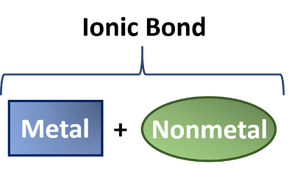
Ionic Bonds: Involve the transfer of electrons from a metal to a nonmetal, resulting in the formation of oppositely charged ions (cations and anions) held together by electrostatic attraction.
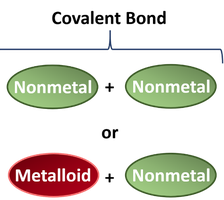
Covalent Bonds: Involve the sharing of electrons between two or more nonmetal atoms, resulting in the formation of molecules.
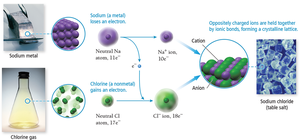
Example: Sodium (Na) transfers an electron to chlorine (Cl), forming Na+ and Cl- ions, which combine to form NaCl.
Chemical Formulas
Types of Chemical Formulas
Chemical formulas indicate the elements present in a compound and the relative number of atoms or ions of each. There are three main types:
Empirical Formula: Shows the simplest whole-number ratio of atoms in a compound.
Molecular Formula: Shows the actual number of atoms of each element in a molecule.
Structural Formula: Shows how atoms are bonded to each other within the molecule.
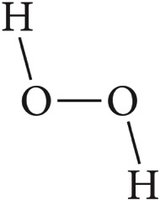
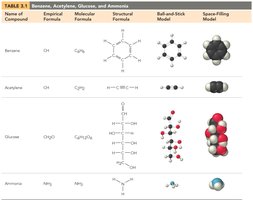
Example: Hydrogen peroxide has the empirical formula HO, molecular formula H2O2, and a structural formula showing the connectivity of atoms.
Comparison of Compounds
Name of Compound | Empirical Formula | Molecular Formula | Structural Formula | Ball-and-Stick Model | Space-Filling Model |
|---|---|---|---|---|---|
Benzene | CH | C6H6 | Ring structure | Ball-and-stick | Space-filling |
Acetylene | CH | C2H2 | Linear | Ball-and-stick | Space-filling |
Glucose | CH2O | C6H12O6 | Chain/ring | Ball-and-stick | Space-filling |
Ammonia | NH3 | NH3 | Pyramidal | Ball-and-stick | Space-filling |
Elements and Compounds at the Atomic Level
Classification of Pure Substances
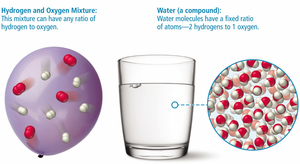
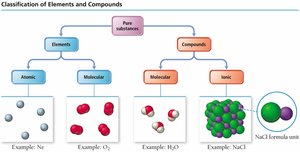
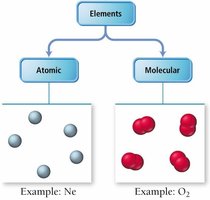
Pure substances can be classified as elements or compounds. Elements can exist as atomic (single atoms) or molecular (diatomic or polyatomic molecules). Compounds can be molecular (covalently bonded) or ionic (composed of ions).
Atomic and Molecular Elements
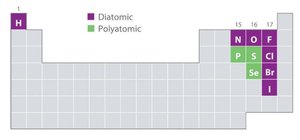
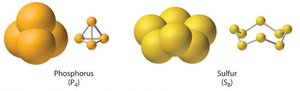
Some elements exist as single atoms (atomic elements), while others exist as molecules (molecular elements). Diatomic molecules consist of two atoms (e.g., O2, N2), and polyatomic molecules contain more than two atoms (e.g., P4, S8).

Types of Compounds
Ionic vs. Molecular Compounds
Compounds are classified based on the types of elements involved and the nature of their bonding:
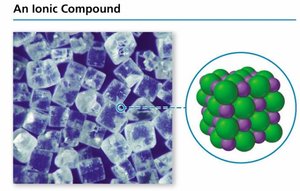
Ionic Compounds: Composed of metal cations and nonmetal anions, held together by ionic bonds. Example: NaCl.
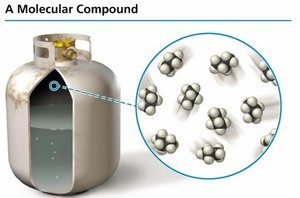
Molecular Compounds: Composed of nonmetals bonded covalently. Example: H2O.
Naming Compounds (Nomenclature)
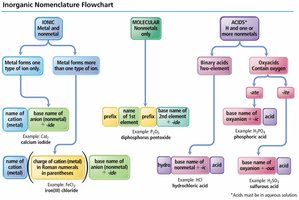
Inorganic Nomenclature Flowchart
Naming inorganic compounds follows systematic rules based on the type of compound (ionic, molecular, or acid) and the elements involved.
Ionic Compounds
Composed of cations (usually metals) and anions (usually nonmetals).
The smallest electrically neutral collection of ions is called a formula unit.
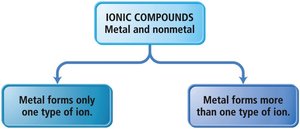
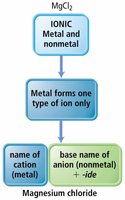
Metals may form only one type of ion (invariant charge) or more than one (variable charge).
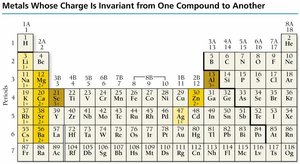
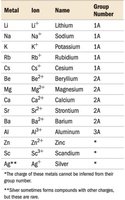
Writing Formulas for Ionic Compounds
Write the symbol and charge for the metal cation and nonmetal anion.
Cross the charges (without sign) to become subscripts for the opposite ion.
Reduce subscripts to the smallest whole-number ratio.
Check that the total positive and negative charges balance.
Polyatomic Ions
Polyatomic ions are groups of covalently bonded atoms with an overall charge. Common examples include ammonium (NH4+), nitrate (NO3-), and sulfate (SO42-).
Oxyanions
Oxyanions are polyatomic ions containing oxygen and another element. Naming depends on the number of oxygen atoms:
More oxygen: -ate (e.g., NO3-: nitrate)
Fewer oxygen: -ite (e.g., NO2-: nitrite)
Prefixes: per- (more than -ate), hypo- (less than -ite)
Hydrates
Hydrates are ionic compounds with a fixed number of water molecules associated with each formula unit. Example: CaCl2 · 6H2O is calcium chloride hexahydrate.
Naming Binary Molecular Compounds
Binary molecular compounds (two nonmetals) use prefixes to indicate the number of atoms. The prefix mono- is never used for the first element.
Acids
Acids are molecular compounds that release H+ ions when dissolved in water. They are named based on their composition:
Binary acids: Hydro- + base name of nonmetal + -ic acid (e.g., HCl: hydrochloric acid)
Oxyacids: Based on the polyatomic ion (e.g., H2SO4: sulfuric acid, HNO2: nitrous acid)
Formula Mass and the Mole Concept
Formula Mass
The formula mass (or molecular mass) is the sum of the atomic masses of all atoms in a molecule or formula unit, expressed in atomic mass units (amu).
Formula:
Mole Concept
The mole is a counting unit in chemistry, relating the mass of a substance to the number of particles (Avogadro's number: particles/mol).
Formula:
Composition of a Compound
Mass Percent Composition
The mass percent of an element in a compound is calculated as:
Empirical and Molecular Formulas from Composition
Convert mass percentages to grams (assume 100 g sample if not given).
Convert grams to moles for each element.
Divide by the smallest number of moles to get the simplest ratio.
If necessary, multiply to obtain whole numbers for subscripts.
To determine the molecular formula, divide the molar mass by the empirical formula mass and multiply the empirical subscripts by this factor.
Introduction to Organic Compounds
Carbon Bonding
Carbon forms four covalent bonds and can create chains, branches, and rings, leading to a vast diversity of organic compounds.
Classification of Organic Compounds
Hydrocarbons: Contain only carbon and hydrogen. Types include alkanes (single bonds), alkenes (double bonds), alkynes (triple bonds), and aromatics (benzene rings).
Functionalized Hydrocarbons: Contain additional functional groups (e.g., alcohols, amines) that determine chemical reactivity.
Naming Hydrocarbons
The base name is determined by the number of carbons (meth-, eth-, prop-, etc.), and the suffix indicates the type of bond (-ane, -ene, -yne).
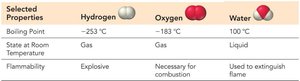
Summary Table: Properties of Hydrogen, Oxygen, and Water
Property | Hydrogen | Oxygen | Water |
|---|---|---|---|
Boiling Point | -253°C | -183°C | 100°C |
State at Room Temperature | Gas | Gas | Liquid |
Flammability | Explosive | Necessary for combustion | Used to extinguish flame |
Key Visuals