 뒤로
Molecules, Compounds, Chemical Formulas, and Bonding
스터디 가이드 - 스마트 노트
 자료에 맞춘 맞춤형 노트, 핵심 정의, 예시, 맥락을 확장해 제공합니다.
Molecules, Compounds, and Chemical Formulas
Introduction to Compounds and Chemical Formulas
Most substances encountered in daily life are compounds, not elemental substances. Chemical formulas provide information about the types and numbers of atoms in a compound, and help us understand why elements form compounds: bonding lowers the potential energy between charged particles in atoms.
Empirical Formula: Shows the simplest whole-number ratio of atoms in a compound.
Molecular Formula: Shows the actual number of atoms of each element in a molecule.
Structural Formula: Shows how atoms are connected in a molecule.
Ball-and-Stick Model: Visualizes the spatial arrangement of atoms and bonds.
Space-Filling Model: Represents the relative sizes and spatial relationships of atoms.
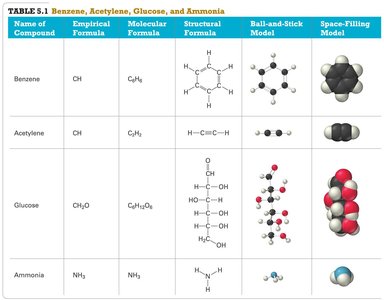
Example: Benzene has an empirical formula of CH, a molecular formula of C6H6, and a structural formula showing a ring of carbon atoms with alternating double bonds.
Name of Compound | Empirical Formula | Molecular Formula | Structural Formula | Ball-and-Stick Model | Space-Filling Model |
|---|---|---|---|---|---|
Benzene | CH | C6H6 | Ring structure | See image | See image |
Acetylene | CH | C2H2 | H–C≡C–H | See image | See image |
Glucose | CH2O | C6H12O6 | Ring structure | See image | See image |
Ammonia | NH3 | NH3 | Trigonal pyramidal | See image | See image |
Counting Atoms, Molecules, and Moles
The Mole Concept and Avogadro's Number
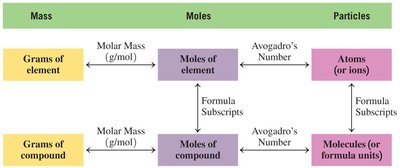
The mole is a fundamental unit in chemistry for counting atoms, molecules, or formula units. One mole contains entities (Avogadro's Number). Molar mass (g/mol) links the mass of a substance to the number of moles.
Mole: The amount of substance containing as many entities as there are atoms in 12 g of carbon-12.
Avogadro's Number (): entities per mole.
Molar Mass: The mass of one mole of a substance, found on the periodic table.
Example: 1 mole of carbon = 12.01 g; 1 mole of sodium = 22.99 g.
Calculations with Moles and Mass
Converting Between Mass, Moles, and Particles
To convert between grams, moles, and number of particles, use the following relationships:
Grams to moles: Divide by molar mass.
Moles to particles: Multiply by Avogadro's Number.
Moles to grams: Multiply by molar mass.
Particles to moles: Divide by Avogadro's Number.
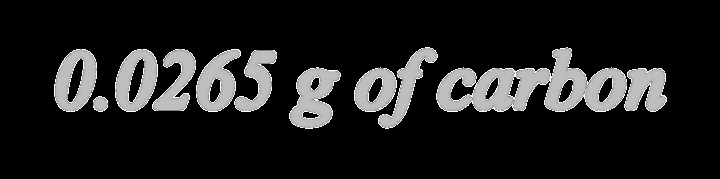
Example: Calculate the moles of carbon in 0.0265 g of carbon:
Given: 0.0265 g C
Molar mass of C: 12.01 g/mol
Calculation:
Example: How many copper atoms are in a penny weighing 3.10 g? (Assume penny is pure Cu)
Given: 3.10 g Cu
Molar mass of Cu: 63.55 g/mol
Calculation:
Atoms:

Example: Find the number of CO2 molecules in 10.8 g of dry ice (dry ice is pure CO2):
Given: 10.8 g CO2
Molar mass of CO2: 44.01 g/mol
Calculation:
Molecules:

Mass Percent Composition
Calculating Mass Percent of Elements in Compounds
Mass percent composition expresses the percentage by mass of each element in a compound. It can be determined from the formula or from experimental analysis.
Formula:
Percentages may not always total 100% due to rounding.

Example: Determine the mass percent composition of CaCl2:
Molar mass of CaCl2: g/mol
Mass percent Ca:
Mass percent Cl:









Empirical and Molecular Formulas
Determining Empirical and Molecular Formulas
The empirical formula is the simplest whole-number ratio of atoms in a compound. The molecular formula is a multiple of the empirical formula, determined by the molar mass.
To find empirical formula: Convert mass percent to grams, then to moles, write pseudo-formula, divide by smallest number of moles, and multiply to get whole numbers.
To find molecular formula: , where
Example: Benzopyrene has a molar mass of 252 g and an empirical formula of C5H3. Empirical formula mass = g. . Molecular formula = C20H12.


Types of Chemical Bonds
Ionic, Covalent, and Metallic Bonds
Atoms form bonds to lower their potential energy. There are three main types of chemical bonds:
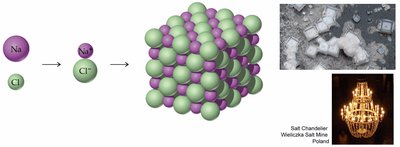
Ionic Bonds: Result from the transfer of electrons from a metal to a nonmetal, forming cations and anions.
Covalent Bonds: Result from the sharing of electrons between nonmetals.
Metallic Bonds: Result from the pooling of valence electrons among metal atoms.
Properties of Ionic Compounds
Structure and Physical Properties
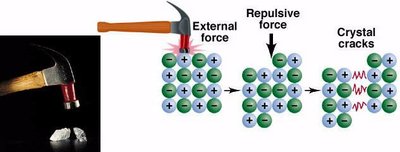
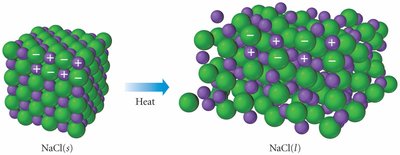
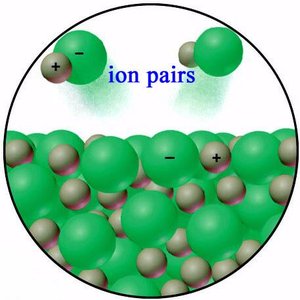
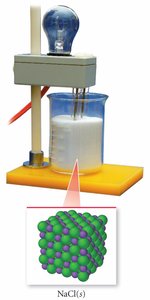
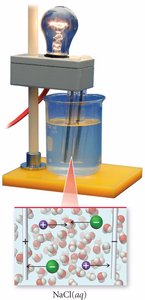
Ionic compounds form crystalline solids with high melting and boiling points. They are hard, rigid, and brittle due to strong electrostatic forces between ions. Ionic solids do not conduct electricity, but when melted or dissolved, the ions are free to move and conduct electricity.
Crystal lattice: Three-dimensional array of cations and anions.
High melting/boiling points: Due to strong ionic bonds.
Electrical conductivity: Only when ions are mobile (liquid or aqueous).

Properties of Molecular and Metallic Compounds
Molecular Compounds
Molecular compounds are held together by covalent bonds, which are directional and strong within molecules but weak between molecules. They are often gases, liquids, or low-melting solids.
Metallic Compounds
Metallic bonding involves a sea of delocalized electrons, making metals conductive, malleable, and ductile.
Naming Compounds
Rules for Naming Ionic and Covalent Compounds
Type I Ionic Compounds: Metal forms only one cation. Name cation first, anion second (add -ide).
Type II Ionic Compounds: Metal can form multiple cations. Specify charge with Roman numeral.
Type III Covalent Compounds: Formed between two nonmetals. Use prefixes to indicate number of atoms.
Polyatomic Ions: Name cation first, then polyatomic anion.
Acids: Name based on anion; -ate becomes -ic, -ite becomes -ous, add "acid".
Example: NaCl is sodium chloride; FeS is iron(II) sulfide; CO2 is carbon dioxide; Mg(NO3)2 is magnesium nitrate.
Chemical Equations
Writing and Interpreting Chemical Equations
Chemical equations represent reactions using formulas. Reactants are written on the left, products on the right. Coefficients indicate the number of molecules or moles involved.
Example:
Coefficients multiply all atoms in the compound.
