뒤로
Nomenclature of Inorganic Compounds: Study Guide
스터디 가이드 - 스마트 노트
 자료에 맞춘 맞춤형 노트, 핵심 정의, 예시, 맥락을 확장해 제공합니다.
Nomenclature of Inorganic Compounds
Common and Systematic Names
Nomenclature in chemistry refers to the system of naming chemical substances. Compounds often have both common names (arbitrary, based on properties or history) and systematic names (precisely describing chemical composition).
Common Name: Informal, may relate to physical or chemical properties (e.g., "table salt" for NaCl).
Systematic Name: Follows IUPAC rules, describes the exact chemical formula (e.g., "sodium chloride" for NaCl).
Example: CaCO3 is commonly called "limestone" and systematically named "calcium carbonate."
Elements and Molecules
Diatomic and Polyatomic Molecules
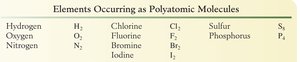
Some elements do not exist as single atoms in nature; instead, they form molecules with two or more atoms.
Diatomic molecules: Consist of two atoms bonded together (e.g., H2, O2, N2).
Polyatomic molecules: Contain more than two atoms (e.g., P4, S8).
Formation and Naming of Ions
Forming Cations
Metals tend to lose electrons to achieve stability, forming positively charged ions called cations.
Cation: An ion with a positive charge due to loss of electrons.
Example: (potassium atom forms potassium ion).
Naming Cations
Cations are named after their parent atoms.

Forming Anions
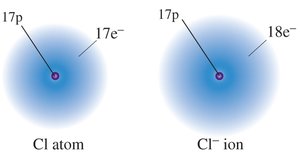
Nonmetals gain electrons to become stable, forming negatively charged ions called anions.
Anion: An ion with a negative charge due to gain of electrons.
Example: (chlorine atom forms chloride ion).
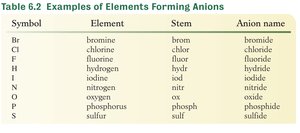
Naming Anions
Monatomic anions use the stem of the element’s name with the ending changed to -ide.
Ion Charges and the Periodic Table
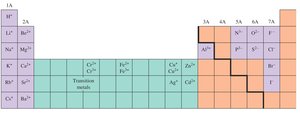
The charge of ions depends on their position in the periodic table. Metals on the left form only one ion, while many transition metals form multiple ions. The charge of a nonmetal is calculated as group number minus 8.
Ionic Compounds
Properties and Structure
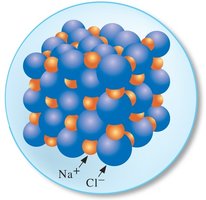
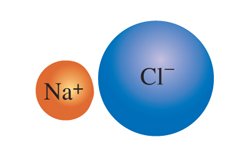
Ionic compounds are formed by the electrostatic attraction between cations and anions. Their formulas represent the simplest whole-number ratio of each element.
Solid at room temperature
Conduct electricity when molten
Example: NaCl (sodium chloride)
Writing Formulas for Ionic Compounds
To write the formula for an ionic compound:
Write the formula for the metal ion followed by the nonmetal ion.
Combine the smallest numbers of each ion needed to give a charge sum equal to zero.
Write the formula as the symbol for the metal and nonmetal, each followed by a subscript if needed.
Example:
Example:
Example:
Naming Binary Ionic Compounds
Compounds with Metals Forming One Type of Cation
Binary ionic compounds contain only two elements: a metal and a nonmetal. For metals that form only one type of cation:
Write the name of the cation.
Write the name of the anion with the -ide ending.
Example: is "aluminum fluoride"
Example: is "potassium chloride"
Compounds with Metals Forming Multiple Types of Cations
For metals that can form more than one type of cation (often transition metals), the Stock System is used:
Name the cation with a Roman numeral indicating its charge.
Name the anion with the -ide ending.
Example: is "iron(III) chloride"
Example: is "copper(II) oxide"
Classic System
Some metals use Latin names with -ous and -ic suffixes to indicate lower and higher charges, respectively.
Example: is "ferrous"; is "ferric"
Example: is "stannous fluoride"
Naming Binary Molecular Compounds
Rules and Prefixes
Binary molecular compounds contain two nonmetals or a nonmetal and a metalloid. Prefixes indicate the number of atoms:
Number | Prefix |
|---|---|
1 | mono- |
2 | di- |
3 | tri- |
4 | tetra- |
5 | penta- |
6 | hexa- |
7 | hepta- |
8 | octa- |
9 | nona- |
10 | deca- |
Example: is "carbon monoxide"; is "carbon dioxide"
Example: is "sulfur hexafluoride"
Acids Derived from Binary Compounds
Naming Binary Acids
Acid formulas begin with hydrogen. For binary acids in aqueous solution:
Write the prefix hydro- followed by the stem of the second element.
Add the suffix -ic and the word "acid."
Example: (aq) is "hydrochloric acid"
Example: (aq) is "hydrofluoric acid"
Polyatomic Ions
Definition and Examples
A polyatomic ion contains two or more elements bonded together, carrying a net charge.
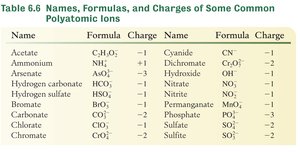
Many polyatomic ions containing oxygen are called oxy-anions and have names ending in -ate or -ite.
-ate: More oxygen atoms (e.g., sulfate SO42-)
-ite: One less oxygen atom (e.g., sulfite SO32-)
Prefixes per- and hypo- indicate more or fewer oxygens, respectively.
Some polyatomic ions end in -ide (e.g., hydroxide OH-, cyanide CN-).
Only one common positive polyatomic ion: ammonium NH4+.
Writing Formulas with Polyatomic Ions
Parentheses are used around polyatomic ions when a subscript is needed to balance the charge.
Example:
Example:
Naming Compounds Containing Polyatomic Ions
To name these compounds:
Write the name of the cation.
Write the name of the anion.
Example: is "ammonium nitrate"
Example: is "lead(II) acetate"
Oxy-Acids
Naming Oxy-Acids
Oxy-acids are neutral compounds beginning with H and ending with an oxygen-containing polyatomic ion.
If the polyatomic ion ends in -ate, the acid name ends in -ic acid.
If the polyatomic ion ends in -ite, the acid name ends in -ous acid.
Example: (sulfuric acid) from sulfate
Example: (sulfurous acid) from sulfite
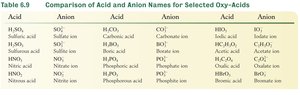
Comparison of Acid and Anion Names
Acids and their corresponding anions are systematically related in nomenclature.
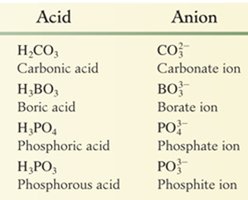
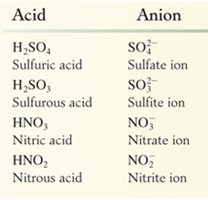
Summary of Naming Binary and Polyatomic Compounds
Flow Diagrams for Naming Compounds
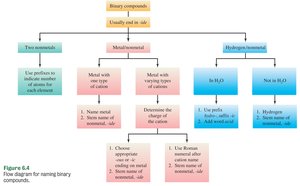
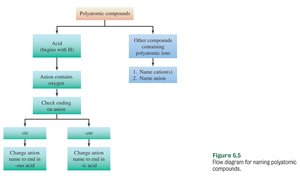
Flow diagrams help organize the rules for naming binary and polyatomic compounds.