 뒤로
Periodic Properties of the Elements: Structure, Trends, and Electron Configuration
스터디 가이드 - 스마트 노트
 자료에 맞춘 맞춤형 노트, 핵심 정의, 예시, 맥락을 확장해 제공합니다.
Periodic Properties of the Elements
Elemental Patterns and the Periodic Law
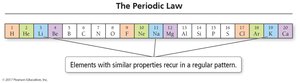
The periodic law describes the recurring patterns in the physical and chemical properties of elements, which are observed when elements are arranged in order of increasing atomic number. These patterns allow scientists to predict the properties of undiscovered elements and understand elemental behavior.
Periodic property: A property that exhibits a repeating pattern across periods or groups in the periodic table.
Example: Density increases as you move down a column in the periodic table due to an increase in atomic mass and volume.
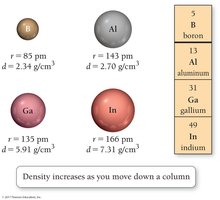
The Development of the Periodic Table
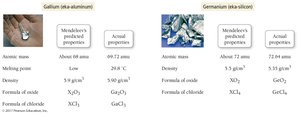
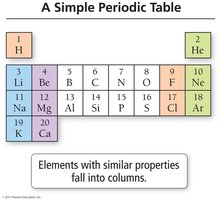
In the nineteenth century, scientists noticed that certain groups of elements had similar properties. Dmitri Mendeleev organized these elements into a table, arranging them by increasing atomic mass so that elements with similar properties fell into the same columns. He left gaps for undiscovered elements and predicted their properties with remarkable accuracy.
Mendeleev's periodic law: When elements are arranged in order of increasing mass, certain sets of properties recur periodically.
Modern periodic table: Elements are now arranged by increasing atomic number, not mass.
Structure and Classification of the Modern Periodic Table
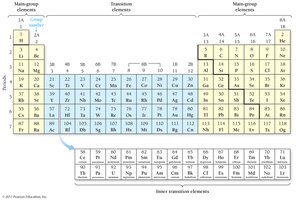
The periodic table is organized into rows (periods) and columns (groups or families). Elements in the same group have similar chemical properties. The table is divided into metals, nonmetals, and metalloids, as well as main-group elements, transition metals, and inner transition metals.
Main-group elements: Groups 1A–8A; properties are predictable based on position.
Transition elements: d-block; properties are less predictable.
Inner transition elements: f-block; properties are less predictable.
Electron Configuration and Quantum Theory
Electron Configuration: Arrangement of Electrons in Atoms
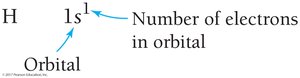
Quantum-mechanical theory describes electrons as existing in orbitals. The electron configuration of an atom specifies the orbitals occupied by electrons, following the principles of energy minimization and quantum numbers.
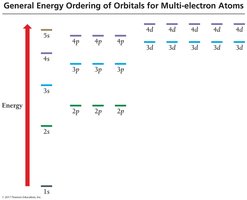
Aufbau principle: Electrons fill orbitals from lowest to highest energy.
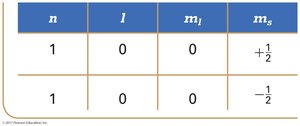
Pauli exclusion principle: No two electrons in an atom can have the same set of four quantum numbers; each orbital holds a maximum of two electrons with opposite spins.
Hund's rule: Electrons occupy degenerate orbitals singly before pairing.
Quantum Numbers and Electron Spin
Each electron in an atom is described by four quantum numbers: principal (n), angular momentum (l), magnetic (ml), and spin (ms). The spin quantum number (ms) can be +1/2 or -1/2, representing the two possible orientations of electron spin.
Spin pairing: Two electrons in the same orbital must have opposite spins, resulting in diamagnetism (no net magnetic field).
Energy Ordering of Atomic Orbitals
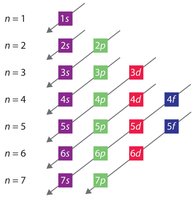
In multi-electron atoms, sublevels (s, p, d, f) within a principal energy level are split in energy due to electron-electron interactions, shielding, and penetration. The general order of filling is:
s < p < d < f (increasing energy)
Shielding, Penetration, and Effective Nuclear Charge (Zeff)
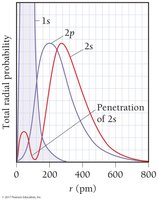
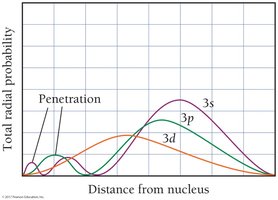
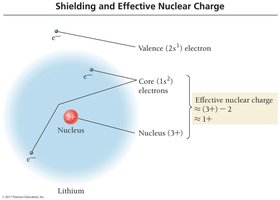
Electrons in multi-electron atoms experience both attraction to the nucleus and repulsion from other electrons. Shielding reduces the effective nuclear charge (Zeff) felt by outer electrons. Penetration refers to how close an electron can get to the nucleus, affecting energy and shielding.
Effective nuclear charge: (Z = nuclear charge, S = shielding constant)
Penetration order: s > p > d > f
Writing Electron Configurations and Orbital Diagrams
Electron configurations are written by listing the occupied orbitals and the number of electrons in each. Orbital diagrams use boxes or lines to represent orbitals and arrows for electrons, indicating spin.
Example: Sulfur (S): 1s2 2s2 2p6 3s2 3p4

Valence and Core Electrons
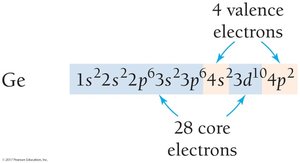
Valence electrons are those in the outermost principal energy level and are responsible for chemical reactivity. Core electrons are in inner, filled shells and do not participate in bonding.
Example: Germanium (Ge): 4 valence electrons (n=4), 28 core electrons
Orbital Blocks in the Periodic Table
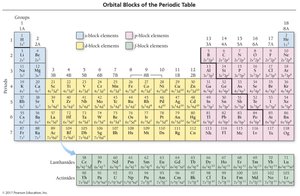
The periodic table is divided into s, p, d, and f blocks, corresponding to the type of orbital being filled. The group number of a main-group element equals its number of valence electrons, and the period number equals its highest principal quantum number.
Transition Metals and Electron Configuration Anomalies
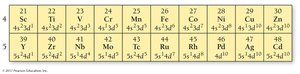
Transition metals (d-block) and inner transition metals (f-block) often have irregular electron configurations due to small energy differences between s and d (or f) orbitals. Some elements (e.g., Cr, Cu, Mo, Ag) have experimentally determined configurations that differ from the expected order.
Periodic Trends in Elemental Properties
Effective Nuclear Charge and Periodic Trends
The effective nuclear charge (Zeff) increases across a period (left to right) and decreases down a group (top to bottom). This trend influences atomic size, ionization energy, and other properties.
Atomic Radii
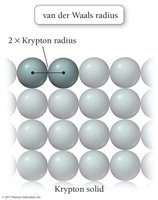
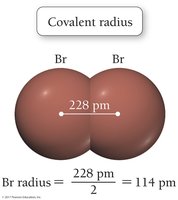
Atomic radius is the average distance from the nucleus to the outermost electrons. It can be measured as van der Waals radius (nonbonding) or covalent radius (bonding).
Trend: Atomic radius decreases across a period (due to increasing Zeff) and increases down a group (due to increasing n).
Ionization Energy
Ionization energy (IE) is the energy required to remove an electron from a gaseous atom or ion. The first ionization energy (IE1) refers to removing the first electron.
Trend: IE decreases down a group and increases across a period.
Exceptions: Occur due to subshell structure and electron pairing (e.g., between groups 2A/3A and 5A/6A).
Electron Affinity
Electron affinity (EA) is the energy change when an electron is added to a gaseous atom. A more negative EA means the atom more readily accepts an electron.
Trend: EA generally becomes more negative across a period; halogens have the highest (most negative) EA.
Metallic Character
Metallic character refers to how closely an element's properties match those of a typical metal (malleability, conductivity, low ionization energy).
Trend: Metallic character increases down a group and decreases across a period.
Summary Table: Periodic Trends
Property | Across a Period (→) | Down a Group (↓) |
|---|---|---|
Atomic Radius | Decreases | Increases |
Ionization Energy | Increases | Decreases |
Electron Affinity | More negative | Less negative |
Metallic Character | Decreases | Increases |
Practice Problems and Applications
Predict the larger atom: N or F? (N is larger; atomic radius decreases across a period.)
Which has higher first ionization energy: Al or S? (S; IE increases across a period.)
Which is more metallic: Sn or Te? (Sn; metallic character decreases across a period.)
Additional info: This summary covers the core concepts of periodic properties, electron configuration, and periodic trends, as outlined in a typical General Chemistry curriculum.
