 뒤로
Periodic Properties of the Elements: Structure, Trends, and Electron Configurations
스터디 가이드 - 스마트 노트
 자료에 맞춘 맞춤형 노트, 핵심 정의, 예시, 맥락을 확장해 제공합니다.
Periodic Properties of the Elements
Introduction to Periodic Properties
The periodic properties of elements are predictable based on their position within the periodic table. These properties include atomic radius, density, ionization energy, electron affinity, and metallic character. Understanding these trends is essential for predicting the behavior of elements in chemical reactions.
Periodic Law and the Periodic Table
Historical Development of the Periodic Table
The periodic table was developed through the recognition of recurring patterns in element properties:
Döbereiner's Triads: Groups of three elements with similar properties.
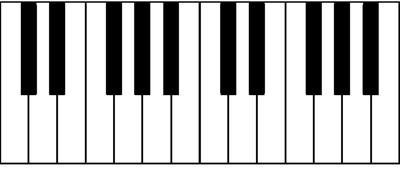
Newlands' Law of Octaves: Every eighth element had similar properties, analogous to musical octaves.
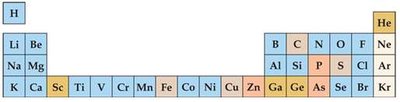
Mendeleev's Periodic Law: When elements are arranged by increasing atomic mass, certain properties recur periodically.
Moseley's Contribution: Arranged elements by atomic number, resolving inconsistencies.
Prediction and Discovery of Elements
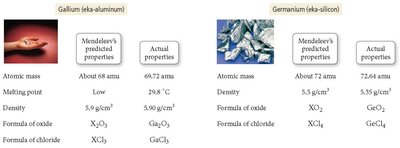
Mendeleev predicted the properties of undiscovered elements (e.g., gallium and germanium) based on periodic trends. Actual properties closely matched his predictions, validating the periodic law.
Structure of the Periodic Table
Classification of Elements
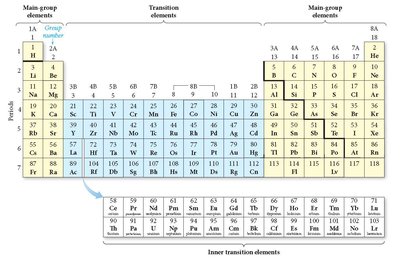
The periodic table is divided into main group elements, transition elements, and inner transition elements (lanthanides and actinides). Groups (columns) and periods (rows) organize elements by similar properties and increasing atomic number.
Electron Configurations and Orbitals
Notation and Principles
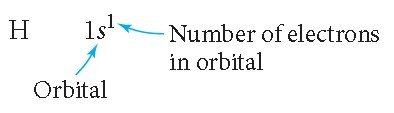
Electron configuration describes the arrangement of electrons in an atom's orbitals. The notation (e.g., 1s1) indicates the orbital and the number of electrons in it.
Aufbau Principle: Electrons fill the lowest energy orbitals first.
Pauli Exclusion Principle: No two electrons in an atom can have the same set of four quantum numbers; each orbital holds a maximum of two electrons with opposite spins.
Hund's Rule: Electrons occupy degenerate orbitals singly before pairing.
Sublevel Capacities
The s sublevel has 1 orbital (2 electrons).
The p sublevel has 3 orbitals (6 electrons).
The d sublevel has 5 orbitals (10 electrons).
The f sublevel has 7 orbitals (14 electrons).

Penetration and Shielding
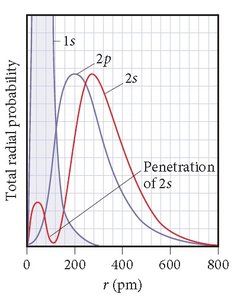
Electrons in different orbitals experience varying degrees of penetration and shielding, affecting their energy levels. Penetration refers to how close an electron can get to the nucleus, while shielding is the reduction of nuclear attraction due to other electrons.
Condensed Electron Configurations
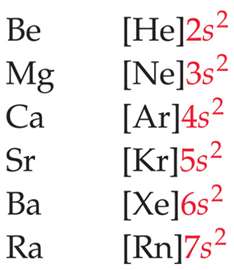
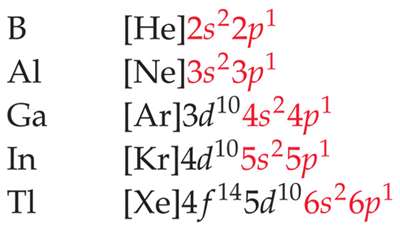
Condensed notation uses noble gas symbols to represent core electrons, focusing on valence electrons which determine chemical properties.
Periodic Trends in Atomic Properties
Atomic Radius
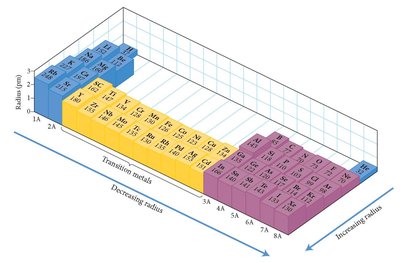
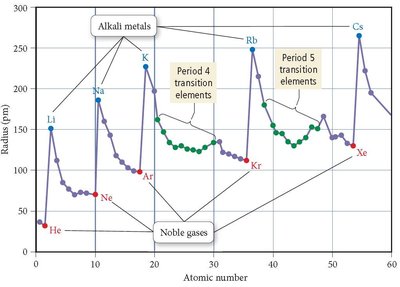
Atomic radius is the average distance from the nucleus to the outermost electron. It can be measured as bonding (covalent) or nonbonding (van der Waals) radius. Atomic radius increases down a group and decreases across a period.
Ionic Radius
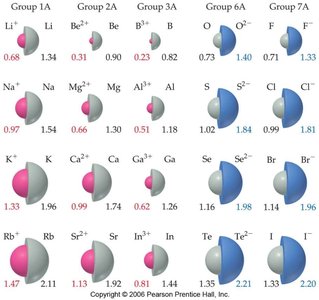
Ionic radius depends on nuclear charge, number of electrons, and electron configuration. Cations are smaller than their parent atoms, while anions are larger. Isoelectronic series show decreasing radius with increasing nuclear charge.
Ionization Energy
Definition and Trends
Ionization energy is the energy required to remove an electron from a gaseous atom or ion. First ionization energy increases across a period and decreases down a group. Successive ionization energies increase as more electrons are removed.

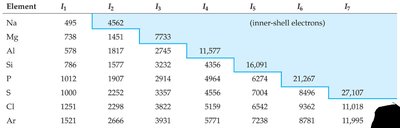
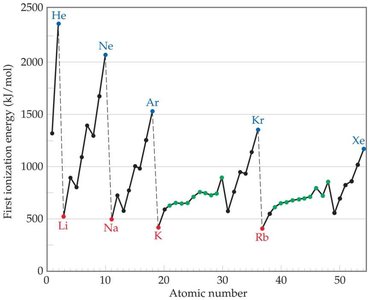
Element | I1 | I2 | I3 | I4 | I5 | I6 | I7 |
|---|---|---|---|---|---|---|---|
Na | 495 | 4562 | 7733 | ||||
Mg | 738 | 1451 | 7733 | ||||
Al | 578 | 1817 | 2745 | 11577 | |||
Si | 786 | 1577 | 3232 | 4356 | 16091 | ||
P | 1012 | 1907 | 2914 | 4964 | 6274 | 21267 | |
S | 1000 | 2252 | 3825 | 7004 | 8496 | 27107 | |
Cl | 1251 | 2298 | 3822 | 5159 | 6542 | 9362 | 11018 |
Ar | 1521 | 2666 | 3931 | 5771 | 7238 | 8781 | 11995 |
Electron Affinity
Definition and Trends
Electron affinity is the energy change when an electron is added to a gaseous atom. It is generally negative for elements that readily gain electrons (e.g., halogens) and positive or near zero for noble gases and some metals.

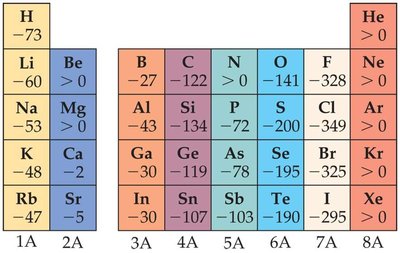
Metallic Character
Trends in Metallic Character
Metallic character refers to the tendency of an element to lose electrons and form positive ions. It increases down a group and decreases across a period. Metals are found on the left and center of the periodic table, nonmetals on the right, and metalloids between them.
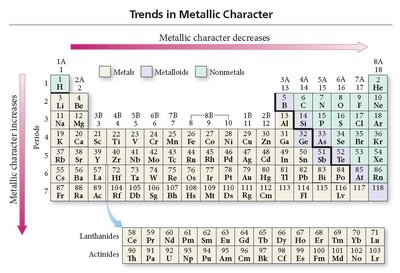
Summary Table: Key Periodic Properties
Property | Trend Down a Group | Trend Across a Period |
|---|---|---|
Atomic Radius | Increases | Decreases |
Ionic Radius | Increases | Decreases |
Ionization Energy | Decreases | Increases |
Electron Affinity | Varies | Generally increases (more negative) |
Metallic Character | Increases | Decreases |
Additional info:
Periodic properties are fundamental for understanding reactivity, bonding, and the classification of elements.
Electron configuration is the basis for predicting chemical behavior and periodic trends.
