뒤로
Periodicity and the Electronic Structure of Atoms: Quantum Mechanics, Atomic Orbitals, and Periodic Properties
스터디 가이드 - 스마트 노트
 자료에 맞춘 맞춤형 노트, 핵심 정의, 예시, 맥락을 확장해 제공합니다.
Periodicity and the Electronic Structure of Atoms
The Quantum World
The quantum world describes the behavior of matter and energy at atomic and subatomic scales. In this realm, physical properties such as energy and position are quantized, meaning they can only take on certain discrete values. A quantum is the smallest possible unit of any physical quantity, and quantization is the principle that these properties are not continuous but occur in steps.
Photon: A single quantum of light, representing electromagnetic radiation.
Quantized Energy: The energy of electrons in atoms is quantized, leading to the stability of atoms and matter.
Analogy: Just as a spectator’s seat in a stadium is quantized (Section, Row, Seat), an electron’s location in an atom is quantized (energy level, orbital type).


Electromagnetic Radiation and the Electromagnetic Spectrum
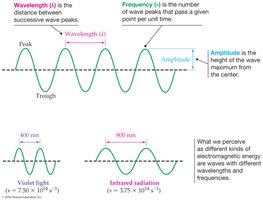
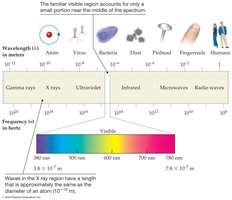
Electromagnetic radiation is energy that travels through space as waves. It is characterized by its speed, wavelength, and frequency. The speed of light (c) in a vacuum is a constant value: m/s.
Wavelength (\(\lambda\)): The distance between successive wave peaks.
Frequency (\(\nu\)): The number of wave peaks passing a point per unit time.
Relationship:
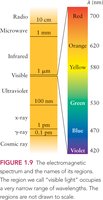
Energy: The energy of electromagnetic radiation varies with wavelength and frequency.
Atomic Emission Spectra
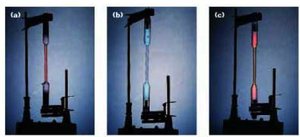
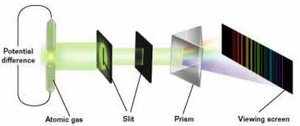
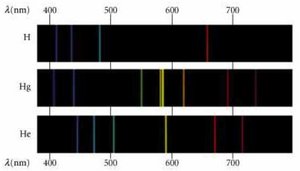
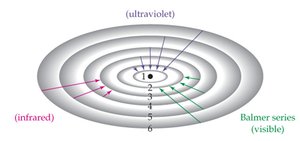
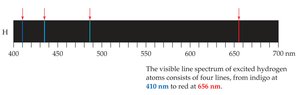
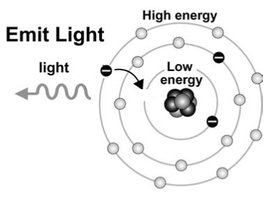
When atoms are energized (by heat or electricity), they emit light. The color of light emitted depends on the atom’s structure. Passing this light through a prism or diffraction grating produces an emission spectrum, a series of colored lines unique to each element.
Emission Spectrum: The pattern of lines is a fingerprint for each element.
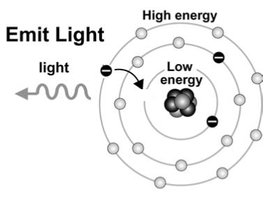
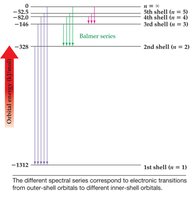
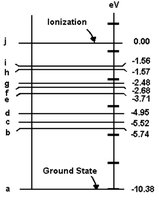
Bohr Model Explanation: Electrons absorb energy and move to higher energy levels (excited state). When they return to lower levels (ground state), they emit photons with energy equal to the difference between the levels.
Energy-Wavelength Relationship: , where is Planck’s constant ( J·s).

Energy of Electron Transitions
The energy absorbed or emitted by an atom during electron transitions is directly related to the wavelength of the photon involved. Each transition corresponds to a specific spectral line.
Energy Difference:
Example: Violet light (380 nm) corresponds to a higher energy transition than red light (780 nm).
Ionization Energy: The energy required to remove an electron from an atom.

Particlelike Properties of Radiant Energy: The Photoelectric Effect
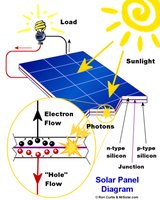
The photoelectric effect demonstrates that light behaves as both a wave and a particle. When light of sufficient frequency strikes a metal, electrons are ejected. The energy of the ejected electrons depends on the frequency of the incident light, not its intensity.
Planck’s Postulate:
Threshold Frequency: No electrons are ejected unless the light exceeds a certain frequency.
Wave-Particle Duality: Light exhibits both wave and particle properties.
The Wave-Particle Duality of Matter
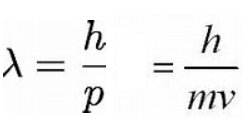
Not only does light exhibit wave-particle duality, but matter (such as electrons) also shows wavelike behavior. The de Broglie relation connects the wavelength of a particle to its mass and velocity.
de Broglie Relation:
Example: A car with mass 1150 kg and velocity 24.6 m/s has an extremely small wavelength.

The Quantum Mechanical Model of the Atom
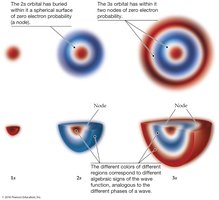
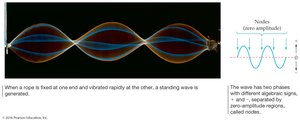
The quantum mechanical model, developed by Schrödinger and Heisenberg, describes electrons as occupying orbitals defined by wave functions. The probability of finding an electron in a region is given by the square of the wave function ().
Heisenberg Uncertainty Principle: It is impossible to know both the position and momentum of an electron precisely.
Orbitals: Regions of space where electrons are likely to be found, described by quantum numbers.



Quantum Numbers and Atomic Orbitals
Atomic orbitals are described by four quantum numbers:
Principal Quantum Number (n): Indicates the energy level and size of the orbital (n = 1, 2, 3, ...).
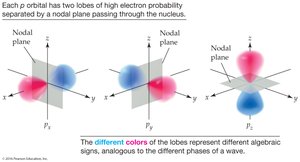
Angular Momentum Quantum Number (l): Defines the shape of the orbital (l = 0: s, l = 1: p, l = 2: d, l = 3: f).
Magnetic Quantum Number (ml): Specifies the orientation of the orbital in space (ml = -l to +l).
Spin Quantum Number (ms): Indicates the spin direction of the electron (+1/2 or -1/2).
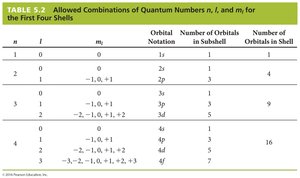
n | l | ml | Orbital Notation | Number of Orbitals in Subshell | Number of Orbitals in Shell |
|---|---|---|---|---|---|
1 | 0 | 0 | 1s | 1 | 1 |
2 | 0,1 | 0; -1,0,+1 | 2s, 2p | 1, 3 | 4 |
3 | 0,1,2 | 0; -1,0,+1; -2,-1,0,+1,+2 | 3s, 3p, 3d | 1, 3, 5 | 9 |
4 | 0,1,2,3 | 0; -1,0,+1; -2,-1,0,+1,+2; -3,-2,-1,0,+1,+2,+3 | 4s, 4p, 4d, 4f | 1, 3, 5, 7 | 16 |
Electron Spin and the Pauli Exclusion Principle
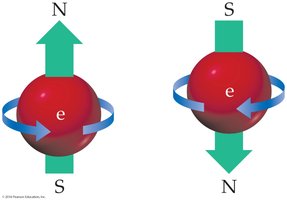
Electrons possess spin, which creates a tiny magnetic field. The Pauli Exclusion Principle states that no two electrons in an atom can have the same set of four quantum numbers.
Orbital Energy Levels in Multielectron Atoms
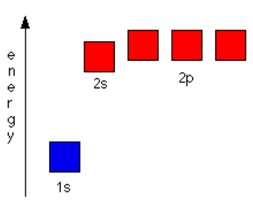
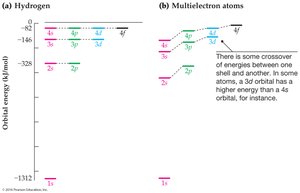
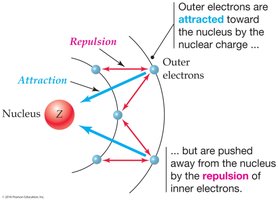
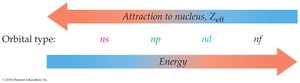
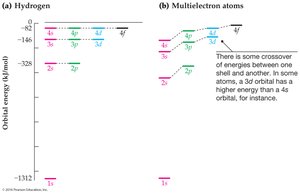
In atoms with more than one electron, the energy of an orbital depends on both its quantum numbers and the effective nuclear charge (Zeff), which is the net positive charge felt by an electron after accounting for electron shielding.
Effective Nuclear Charge: (electron shielding)
Electron Shielding: Inner electrons reduce the attraction between the nucleus and outer electrons.
Electron Configurations of Multielectron Atoms
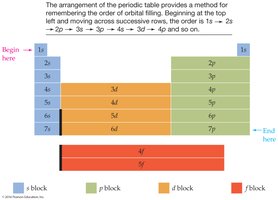
Electron configuration describes the arrangement of electrons in an atom’s orbitals. The Aufbau Principle guides the order in which orbitals are filled:
Lower-energy orbitals fill before higher-energy orbitals.
Each orbital can hold two electrons with opposite spins (Pauli Exclusion Principle).
Hund’s Rule: Electrons fill degenerate orbitals singly before pairing.
Electron Configurations and the Periodic Table
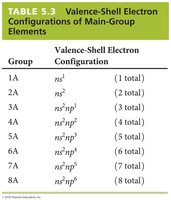
The periodic table reflects the electron configurations of elements. The arrangement of blocks (s, p, d, f) corresponds to the filling of orbitals. Shorthand notation uses noble gas configurations to simplify electron configuration writing.
Valence Shell: The outermost shell, important for chemical properties.
Shorthand Configuration: Uses noble gas core, e.g., [Ne] 3s1 for Na.
Electron Configurations and Periodic Properties: Atomic Radii
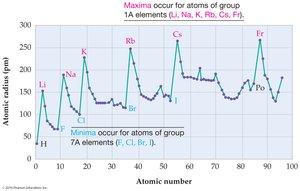
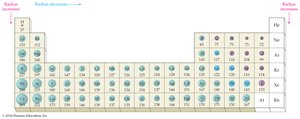
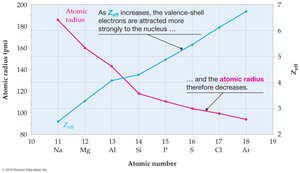
Atomic radius is a periodic property that varies across the periodic table. As effective nuclear charge increases across a period, atomic radius decreases. Maxima occur for group 1A elements, and minima for group 7A elements.
Trend: Atomic radius decreases across a period and increases down a group.
Reason: Increased nuclear charge pulls electrons closer, reducing radius.