 뒤로
Polar Covalent Bonds, Naming Binary Covalent Compounds, Lewis Structures, and Formal Charge
스터디 가이드 - 스마트 노트
 자료에 맞춘 맞춤형 노트, 핵심 정의, 예시, 맥락을 확장해 제공합니다.
Chemical Bonding I: The Lewis Model
Polar Covalent Bonds
Polar covalent bonds occur when two atoms with different electronegativities share electrons unequally, resulting in partial charges on each atom. The atom with higher electronegativity attracts the shared electrons more strongly, acquiring a partial negative charge (δ-), while the less electronegative atom acquires a partial positive charge (δ+).
Electronegativity (EN): A measure of an atom's ability to attract electrons in a bond.
Polar Covalent Example: In water (H2O), oxygen (EN = 3.5) is more electronegative than hydrogen (EN = 2.2), so electrons are pulled closer to oxygen.
Partial Charges: The more electronegative atom (O) has δ-, and the less electronegative atom (H) has δ+.
Electronegativity Difference: indicates a polar covalent bond.

Dipole Notation and Vectors
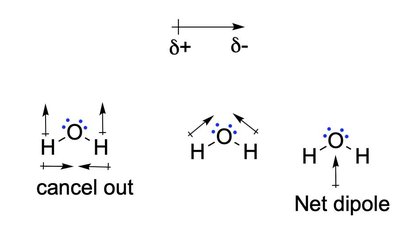
Dipole notation is used to represent the direction of electron density in polar bonds. The dipole arrow points from the positive to the negative end. In molecules, the vector sum of individual bond dipoles determines the net molecular dipole.
Dipole Arrow: Points from δ+ to δ-.
Net Dipole: If bond dipoles do not cancel, the molecule has a net dipole moment.
Example: Water has a net dipole because its bond dipoles add up.
Trends in Electronegativity
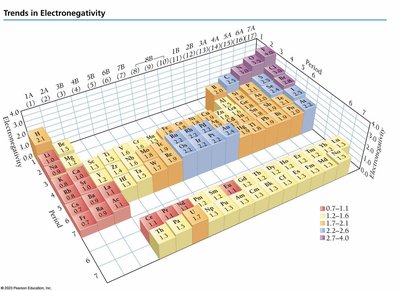
Electronegativity increases across a period and decreases down a group in the periodic table. This trend helps predict bond polarity and the distribution of electron density in molecules.
Highest EN: Fluorine (F) is the most electronegative element.
Periodic Trend: EN increases left to right, decreases top to bottom.
Application: Used to determine bond polarity and formal charge distribution.
Naming Binary Covalent Compounds
Rules for Naming
Binary covalent compounds consist of two nonmetal elements. The naming follows specific rules to indicate the number and identity of each element.
First Element: Use the element name; add a prefix (di-, tri-, tetra-, penta-) if more than one atom.
Second Element: Always use a numerical prefix and end the name with "-ide".
Hydrogen Exception: If H is present, it is usually listed first and does not get a prefix.
Group and Period Rule: If both elements are in the same group, the one with the higher period number is named first.
Examples:
CO: carbon monoxide
CO2: carbon dioxide
N2O3: dinitrogen trioxide
H2S: hydrogen sulfide
BrCl: bromine monochloride
Drawing Lewis Structures of Covalent Compounds
Steps for Drawing Lewis Structures
Lewis structures represent the arrangement of valence electrons in molecules. They help visualize bonding and lone pairs, and are essential for predicting molecular shape and reactivity.
Count all valence electrons for each atom in the molecule.
Place the least electronegative atom in the center (except hydrogen).
Connect perimeter atoms to the central atom with single bonds.
Assign lone pairs to perimeter atoms to complete their octet.
Place leftover electrons on the central atom.
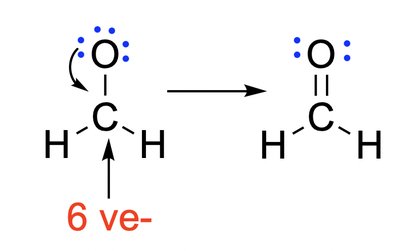
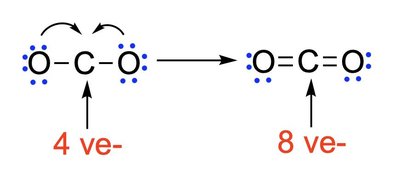
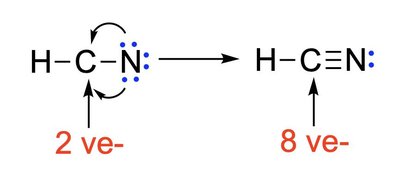
If the central atom has less than an octet, convert a lone pair from a perimeter atom into a multiple bond (double or triple bond).
Examples of Lewis Structures
Lewis structures for common molecules illustrate the application of the above steps.
Formaldehyde (CH2O): Total valence electrons = 12.
Carbon Dioxide (CO2): Total valence electrons = 16.
Hydrogen Cyanide (HCN): Total valence electrons = 10.
Lewis Structures and Formal Charge
Calculating Formal Charge
Formal charge is a bookkeeping tool used to determine the distribution of electrons in a molecule. It helps identify the most stable Lewis structure and predict reactivity.
Formula:
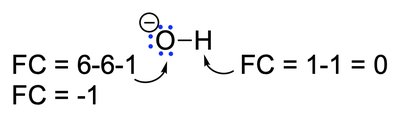
Associated Electrons: Lone pairs (2 electrons each), bonds (1 electron per bond).
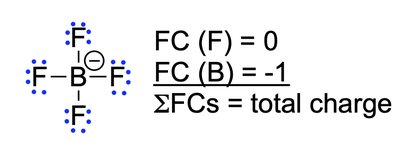
Sum of Formal Charges: The sum of all formal charges in a molecule equals the total charge of the molecule or ion.
Examples:
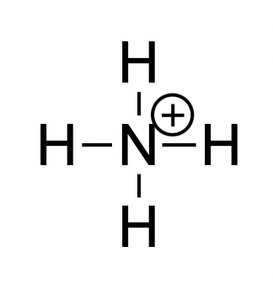
NH4+: Total valence electrons = 8; formal charge on N = +1.
OH-: Total valence electrons = 8; formal charge on O = -1.
BF4-: Total valence electrons = 32; formal charge on B = -1, F = 0.

Formal Charge vs Real Charge Distribution
Formal charge is used for electron counting, but the real charge distribution depends on electronegativity differences and molecular structure. The actual partial charges (δ+, δ-) are determined by the polarity of bonds and the arrangement of atoms.
Formal Charge: Useful for identifying the most stable resonance structure.
Real Charge Distribution: Determined by electronegativity and molecular geometry.
Example: In BF4-, formal charges add up to the total charge, but real charge distribution is calculated based on EN and structure.

Additional info: These notes cover key concepts from General Chemistry Chapter 10 (Chemical Bonding I: The Lewis Model), including polar covalent bonds, naming binary covalent compounds, drawing Lewis structures, and calculating formal charge. The examples and images reinforce the academic explanations and provide visual clarity for each topic.
