 뒤로
Properties and Classification of Solids in General Chemistry
스터디 가이드 - 스마트 노트
 자료에 맞춘 맞춤형 노트, 핵심 정의, 예시, 맥락을 확장해 제공합니다.
Properties of Solids
Macroscopic Properties and Intermolecular Forces
Solids exhibit a range of macroscopic properties—such as melting point, boiling point, hardness, and conductivity—that are determined by the types and strengths of interactions between their constituent particles. These interactions include ionic bonds, covalent bonds, metallic bonds, and intermolecular forces. The relationship between the microscopic structure and macroscopic properties is fundamental to understanding the behavior of solids.
Intermolecular forces are responsible for the physical properties of solids and liquids.
Vapor pressure and boiling point are directly related to the strength of these interactions.
Melting points correlate with interaction strength, but the relationship can be more subtle due to rearrangement rather than breaking of interactions.
Classification of Solids
Solids are classified based on the nature of the particles occupying the lattice points and the type of bonding present. The four basic types are: ionic solids, covalent network solids, molecular solids, and metallic solids.
Ionic Solids
Covalent Network Solids
Molecular Solids
Metallic Solids
A lattice is a three-dimensional arrangement of points representing the positions of the centers of the components of a solid (atoms, ions, or molecules).
Ionic Solids
Structure and Properties
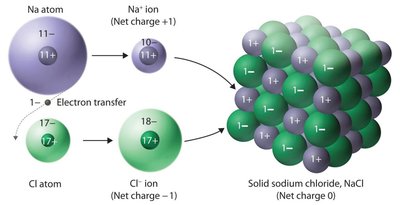
Ionic solids are composed of ions arranged in a lattice structure. The strong electrostatic attraction between oppositely charged ions results in distinctive properties.
Low vapor pressure, high melting and boiling points due to strong ionic interactions.
Brittle nature caused by repulsion of like charges when layers slide.
Conduct electricity only when ions are mobile (molten or dissolved).
Generally formed between metal cations and nonmetal anions.
Strength of attraction described by Coulomb’s Law: smaller ions and higher charges yield stronger attractions and higher lattice energy.
Coulomb’s Law:
Where E is the energy, Q1 and Q2 are the charges, r is the distance between ions, and \varepsilon_0 is the permittivity of free space.
Covalent Network Solids
Structure and Properties
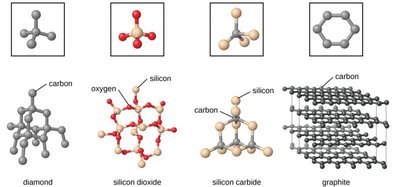
Covalent network solids consist of atoms bonded together in a continuous network via strong covalent bonds. These solids are typically formed from nonmetals and exhibit unique physical properties.
High melting points and hardness due to strong covalent bonds.
Rigid and brittle structure; bond angles are fixed.
Examples include diamond (3D network), graphite (2D layers), silicon dioxide (SiO2), and silicon carbide (SiC).
Graphite is soft and conducts electricity within layers due to weak London Dispersion forces between layers.
Glass is an amorphous solid produced by heating SiO2.
Molecular Solids
Structure and Properties
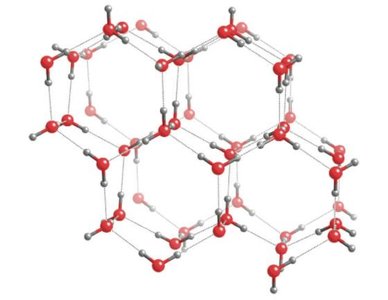
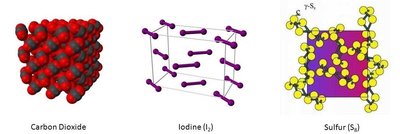
Molecular solids are composed of discrete molecules held together by relatively weak intermolecular forces, such as hydrogen bonding, dipole-dipole interactions, and London dispersion forces.
Low melting points due to weak intermolecular forces.
Do not conduct electricity; valence electrons are tightly held.
Can be composed of large molecules or polymers.
Examples: ice (H2O, hydrogen bonding), dry ice (CO2, LDF), iodine (I2), sulfur (S8), phosphorous (P4), hydrocarbons, polymers.
Metallic Solids
Structure and Properties
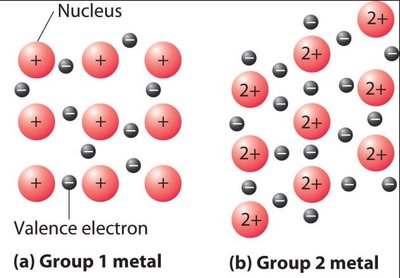
Metallic solids consist of metal atoms arranged in a lattice, with valence electrons delocalized in a "sea" that allows for conductivity and malleability.
Good conductors of electricity and heat due to mobile electrons.
Malleable and ductile; metal cores can rearrange easily.
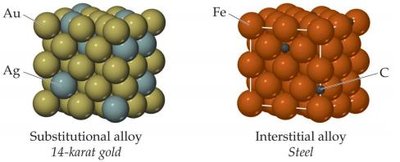
Alloys retain mobile electrons and remain conductive.
Interstitial alloys (small atoms fill spaces) decrease malleability and ductility.
Substitutional alloys (similar-sized atoms substitute) maintain malleability.
Biomolecules and Polymers
Noncovalent Interactions and Structure
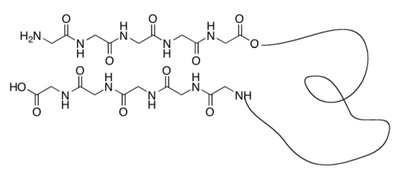
Large biomolecules and polymers exhibit noncovalent interactions between different molecules or regions of the same molecule. The shape and functionality of these molecules depend strongly on these interactions, such as hydrogen bonding, which can lead to folded structures and secondary shapes.
Summary Tables
Types of Solids and Their Properties
The following tables summarize the main types of solids, their interactions, properties, and examples:
Type of Solid | Interaction | Properties | Examples |
|---|---|---|---|
Ionic | Ionic | High melting point, brittle, hard | NaCl, MgO |
Molecular | Hydrogen Bonding, Dipole-Dipole, London Dispersion | Low melting point, nonconducting | H2O, CO2 |
Metallic | Metallic Bonding | Variable hardness and melting point, conducting | Fe, Mg |
Network | Covalent Bonding | High melting point, hard, nonconducting | C (diamond), SiO2 (quartz) |

Ionic Solids | Molecular Solids | Covalent Solids | Metallic Solids |
|---|---|---|---|
Poor conductors of heat and electricity | Poor conductors of heat and electricity | Poor conductors of heat and electricity* | Good conductors of heat and electricity |
Relatively high melting point | Low melting point | High melting point | Melting points depend on electron configuration |
Hard but brittle; shatter under stress | Soft | Very hard and brittle | Easily deformed under stress; ductile and malleable |
Relatively dense | Low density | Low density | Usually high density |
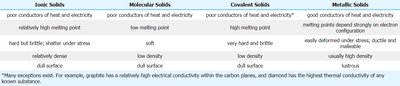
Additional info: Graphite is an exception, as it has high electrical conductivity within carbon planes, and diamond has the highest thermal conductivity of any known substance.
Example: Melting Points of Solids
CO2 vs. SiO2
CO2 melts at -78°C (molecular solid) and SiO2 melts at 1,650°C (covalent network solid). The difference is due to the type of forces broken upon melting: CO2 only requires breaking weak intermolecular forces, while SiO2 requires breaking strong covalent bonds.
Practice and Application
Classification and Properties
Classify substances (e.g., Cl2, Ni, BN, FeS) as ionic, molecular, covalent network, or metallic solids and arrange them by melting point.
Match descriptions to solid types and identify forces broken upon melting.
Explain why solids with strong attractive forces have high melting points.
Justify differences in melting points between covalent network and molecular solids.
Identify the type of solid formed by various substances (e.g., CH4, I2, graphite, KCl, C6H12O6, CaBr2, SiC, Au).
Compare melting points of HBr (molecular solid, -87°C) and NaBr (ionic solid, 747°C) based on the forces broken during melting.
