 뒤로
Quantum-Mechanical Model of the Atom: Study Notes
스터디 가이드 - 스마트 노트
 자료에 맞춘 맞춤형 노트, 핵심 정의, 예시, 맥락을 확장해 제공합니다.
Quantum-Mechanical Model of the Atom
The Beginnings of Quantum Mechanics
Quantum mechanics is the fundamental theory that explains the behavior of matter at the atomic and subatomic levels. It forms the basis for understanding the periodic table, chemical bonding, and many technological applications such as lasers and computers.
Quantum mechanics explains why elements exhibit specific chemical properties.
It provides insight into why some elements are metals, others are nonmetals, and why elements show periodic patterns in their properties.
The Behavior of the Very Small
Electrons are extremely small particles whose behavior determines the properties of atoms. Direct observation of electrons is impossible because any attempt to observe them alters their behavior.
Electron behavior is central to atomic structure and chemical reactivity.
Observing electrons changes their state due to their small size and sensitivity to external influences.
The Quantum-Mechanical Model
The quantum-mechanical model describes how electrons exist and behave in atoms. It helps predict atomic properties based on electron behavior.
Explains why elements form ions with specific charges.
Accounts for the reactivity and inertness of elements.
The Nature of Light
Wave Nature of Light
Light is a form of electromagnetic radiation, consisting of oscillating electric and magnetic fields that move perpendicular to each other and to the direction of travel.
Electric field: Region where charged particles experience a force.
Magnetic field: Region where magnetized particles experience a force.
All electromagnetic waves travel at the speed of light, c.

Characterizing Waves
Waves are described by their amplitude, wavelength, and frequency.
Amplitude: Height of the wave, related to light intensity.
Wavelength (\lambda): Distance between successive crests or troughs.
Frequency (\nu): Number of wave cycles passing a point per unit time, measured in hertz (Hz).

Relationship Between Wavelength and Frequency
For electromagnetic waves, wavelength and frequency are inversely proportional because the speed of light is constant.
Shorter wavelength means higher frequency.
Longer wavelength means lower frequency.
Equation:
Where is the speed of light, is wavelength, and is frequency.
Color and Light
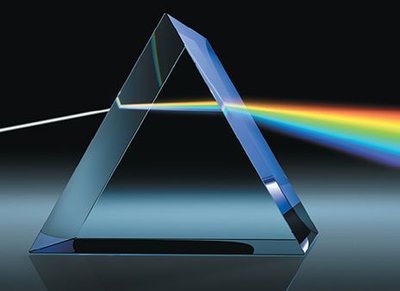
The color of visible light is determined by its wavelength or frequency. White light is a mixture of all visible wavelengths. Objects appear colored when they absorb some wavelengths and reflect others.
Visible spectrum: Red, Orange, Yellow, Green, Blue, Indigo, Violet.
Observed color is due to reflected wavelengths.
The Electromagnetic Spectrum
Overview of the Electromagnetic Spectrum
Visible light is only a small part of the electromagnetic spectrum, which includes radio waves, microwaves, infrared, ultraviolet, X-rays, and gamma rays.
Shorter wavelength (higher frequency) light has higher energy.
Radio waves: lowest energy; Gamma rays: highest energy.
High-energy radiation can damage biological molecules (ionizing radiation).

Energy of Photons
Einstein proposed that light energy comes in discrete packets called photons. The energy of a photon is directly proportional to its frequency and inversely proportional to its wavelength.
Planck's constant (h): Fundamental constant in quantum mechanics.
Energy equation:

Atomic Spectroscopy and the Bohr Model
Emission Spectra
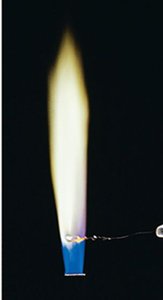
When atoms absorb energy, they often emit light. Passing this light through a prism reveals an emission spectrum unique to each element, which can be used for identification (e.g., flame tests).
Emission spectra are noncontinuous and element-specific.
Applications: Fireworks, neon lights, flame tests.

Bohr Model of the Atom
Bohr's model introduced the concept of quantized energy levels for electrons in atoms. Electrons travel in fixed orbits (stationary states) at specific distances from the nucleus.
Energy of the atom is quantized; only certain energy levels are allowed.
Electrons emit photons when they transition from higher to lower energy orbits.
The energy of the emitted photon corresponds to the difference between the energy levels.

Identifying Elements with Flame Tests
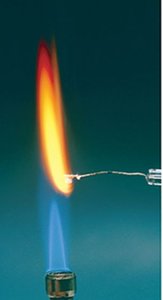
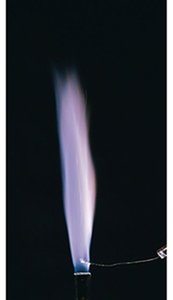
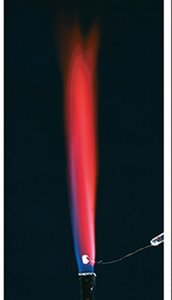
Flame tests are used to identify elements based on the characteristic color of light they emit when excited.
Sodium (Na): Yellow flame
Potassium (K): Violet flame
Lithium (Li): Red flame
Barium (Ba): Green flame
Summary Table: Electromagnetic Spectrum
Type | Wavelength (m) | Frequency (Hz) | Energy |
|---|---|---|---|
Radio | 10-1 to 103 | 106 to 109 | Low |
Microwave | 10-3 to 10-1 | 109 to 1012 | Low |
Infrared | 10-6 to 10-3 | 1012 to 1014 | Medium |
Visible | 400–750 nm | 1014 to 1015 | Medium |
Ultraviolet | 10-8 to 10-7 | 1015 to 1016 | High |
X-ray | 10-10 to 10-8 | 1016 to 1018 | High |
Gamma ray | 10-12 to 10-10 | 1018 to 1020 | Highest |
Additional info: Table values inferred from standard electromagnetic spectrum ranges.
