 뒤로
Quantum Mechanics and Electronic Structure: Study Notes for General Chemistry
스터디 가이드 - 스마트 노트
 자료에 맞춘 맞춤형 노트, 핵심 정의, 예시, 맥락을 확장해 제공합니다.
Quantum Mechanics and Electronic Structure
Light, Energy, and the Bohr Model
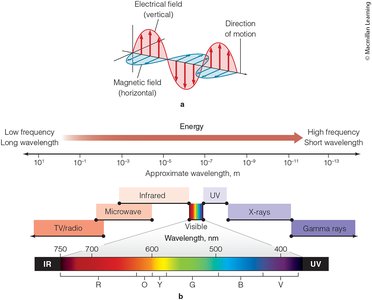
The study of quantum mechanics begins with understanding the nature of light and its interaction with matter. Light, or electromagnetic radiation, is a form of energy that travels in waves characterized by oscillating electric and magnetic fields.
Electromagnetic Spectrum: The electromagnetic spectrum encompasses all types of electromagnetic radiation, from radio waves to gamma rays. Each type is defined by its wavelength and frequency.
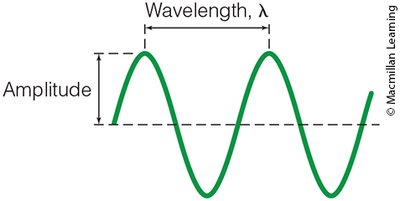
Wave Parameters: Waves are described by four main parameters: wavelength (\(\lambda\)), frequency (\(\nu\)), amplitude, and velocity (speed of light, \(c\)).
Relationship: Wavelength and frequency are inversely related. The product of wavelength and frequency equals the speed of light:
Energy of Photons: Light exhibits both wave-like and particle-like properties. Photons are packets of energy, and their energy is given by: where \(h\) is Planck's constant (\(6.626 \times 10^{-34}\) J·s).
Particle-Wave Duality of Light
Light behaves as both a wave and a particle. The energy delivered by a photon depends on its frequency. This duality is fundamental to quantum mechanics and explains phenomena such as the photoelectric effect.
Calculating Wavelength: For a light frequency of \(7.50 \times 10^{14}\) Hz, use .
Photon Energy: For a frequency of \(5.46 \times 10^{14}\) Hz, J.
Photon Count: To find the number of photons in a pulse, divide total energy by energy per photon.
Flame Tests and the Bohr Model of the Atom
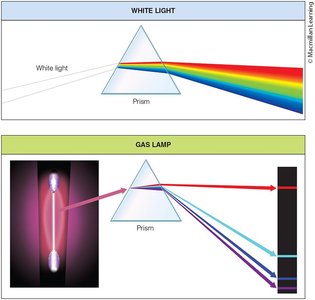
Flame tests are used to identify elements based on the color of light emitted when their electrons transition between energy levels. The Bohr model explains these colors as quantum jumps between discrete energy levels.
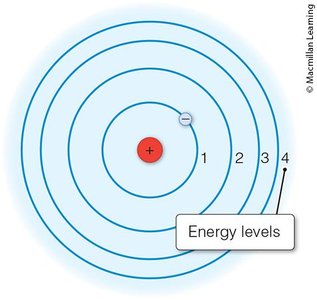
Bohr Model: Electrons orbit the nucleus in quantized energy levels. When electrons absorb energy, they move to higher levels; when they release energy, they emit light and return to lower levels.
Line Spectra: Each element produces a unique line spectrum due to these quantum jumps.

The Wave Nature of Matter
The Bohr model treated electrons as particles, but quantum mechanics describes them as having both wave-like and particle-like properties. The De Broglie wavelength applies to all matter, especially at the atomic scale.
De Broglie Wavelength: Any object with mass has a wavelength, \(\lambda = \frac{h}{mv}\), where \(m\) is mass and \(v\) is velocity.
Probability: At the atomic level, we can only predict the probability of finding an electron in a certain region.
Heisenberg Uncertainty Principle: It is impossible to know both the position and momentum of an electron exactly.
Schrödinger Equation: Describes electrons using wavefunctions (\(\psi\)). The square of the wavefunction (\(\psi^2\)) gives the probability density.
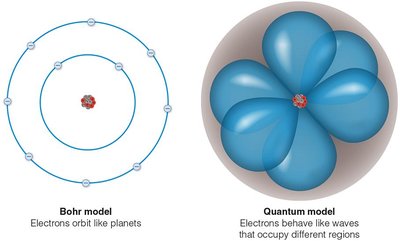
Electronic Structure: The Quantum Model
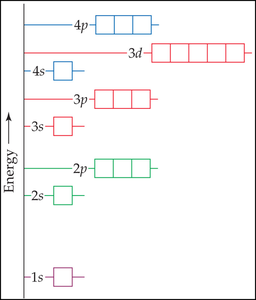
The quantum model predicts and explains the arrangement of electrons within atoms. Electrons occupy energy levels (shells), sublevels (subshells), and orbitals.
Energy Levels: Principal quantum number (\(n\)) defines the shell.
Sublevels: Subshells (s, p, d, f) are defined by the angular momentum quantum number (\(l\)).
Orbitals: Each sublevel contains a specific number of orbitals, each with a unique orientation.
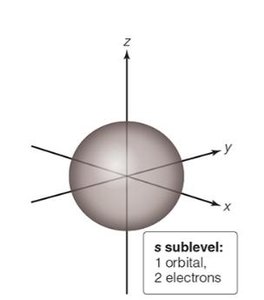
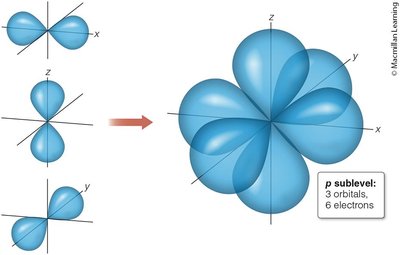
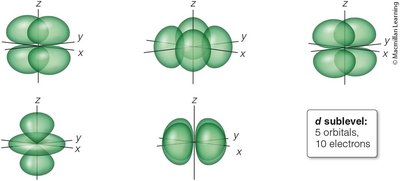
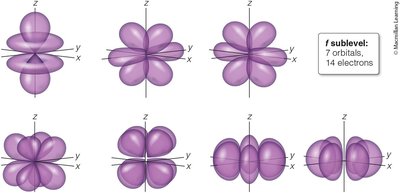
Quantum Numbers and Electron Distinguishability
Each electron in an atom is described by four quantum numbers, which uniquely identify its energy, shape, orientation, and spin.
Principal Quantum Number (n): Energy level (size), n = 1, 2, 3, ...
Angular Momentum Quantum Number (l): Sublevel (shape), l = 0, 1, ..., n-1
Magnetic Quantum Number (ml): Orbital orientation, ml = -l to +l
Spin Quantum Number (ms): Electron spin, ms = +1/2 or -1/2
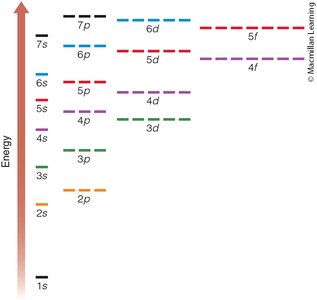
Describing Electron Configuration
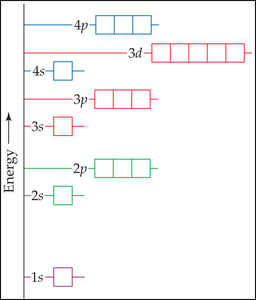
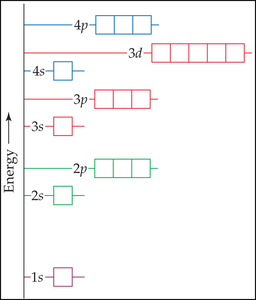
Electron configuration describes the arrangement of electrons in an atom. The ground state is the lowest energy configuration, determined by three rules:
Aufbau Principle: Electrons fill the lowest energy orbitals first.
Pauli Exclusion Principle: No two electrons in an atom can have the same set of four quantum numbers.
Hund's Rule: Electrons occupy orbitals singly before pairing.
Valence Electrons and Stability
Electrons are classified as inner, outer, or valence. Valence electrons determine chemical behavior. Atoms are most stable with a full octet (eight electrons in the highest energy level).
Octet Rule: Atoms tend to gain, lose, or share electrons to achieve a full octet.
Examples: Noble gases have full octets and are chemically inert.
Element | Electron Configuration | Valence Electrons |
|---|---|---|
He | 1s2 | 2 |
Ne | 1s22s22p6 | 8 |
Ar | 1s22s22p63s23p6 | 8 |
Kr | 1s22s23s23p64s23d104p6 | 8 |
Noble Gas Notation and Electron Configurations for Larger Atoms
Noble gas notation condenses electron configurations by representing core electrons with the symbol of the nearest noble gas. This highlights the valence electrons responsible for chemical reactions.
Example: Sodium (Na): Full: 1s22s22p63s1 Noble gas: [Ne]3s1
Example: Phosphorus (P): Full: 1s22s22p63s23p3 Noble gas: [Ne]3s23p3
Electron Configurations for Ions
Atoms gain or lose electrons to form ions, achieving stability by satisfying the octet rule. Metals lose electrons to form cations, while nonmetals gain electrons to form anions.
Species | Symbol | Full Configuration | Noble Gas Configuration |
|---|---|---|---|
Sodium atom | Na | 1s22s22p63s1 | [Ne]3s1 |
Sodium ion | Na+ | 1s22s22p6 | [Ne] |
Oxygen atom | O | 1s22s22p4 | [He]2s22p4 |
Oxide ion | O2- | 1s22s22p6 | [Ne] |
Electron Configurations for Transition Metals
Transition and post-transition metals lose s and p electrons before d electrons when forming ions. This results in unique electron configurations for their ions.
Species | Symbol | Noble Gas Configuration |
|---|---|---|
Co atom | Co | [Ar]4s23d7 |
Co2+ ion | Co2+ | [Ar]3d7 |
Co3+ ion | Co3+ | [Ar]3d6 |
Sn atom | Sn | [Kr]5s24d105p2 |
Sn2+ ion | Sn2+ | [Kr]5s24d10 |
Sn4+ ion | Sn4+ | [Kr]4d10 |
Isoelectronic Species
Atoms and ions with the same electron configuration are called isoelectronic. This often occurs when ions achieve noble gas configurations.
Species | Symbol | Full Configuration | Noble Gas Configuration |
|---|---|---|---|
Sulfide ion | S2- | 1s22s22p63s23p6 | [Ar] |
Chloride ion | Cl- | 1s22s22p63s23p6 | [Ar] |
Calcium ion | Ca2+ | 1s22s22p63s23p6 | [Ar] |
Electron Configuration and the Periodic Table
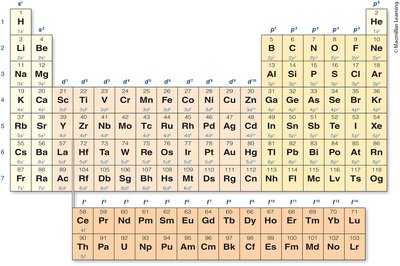
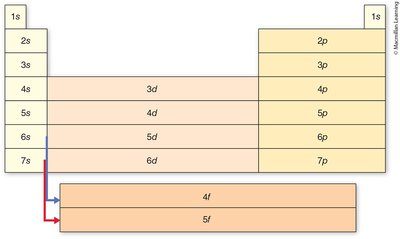
Electron configurations are closely related to the structure of the periodic table. Elements in the same group have similar valence electron configurations, which explains their similar chemical properties.
Exceptions in Electron Configuration
Some elements, especially transition metals, have unexpected electron configurations. These exceptions are due to the stability provided by filled or half-filled sublevels.
Element | Expected | Actual |
|---|---|---|
Cr | [Ar]4s23d4 | [Ar]4s13d5 |
Mo | [Kr]5s24d4 | [Kr]5s14d5 |
Cu | [Ar]4s23d9 | [Ar]4s13d10 |
Ag | [Kr]5s24d9 | [Kr]5s14d10 |
Au | [Xe]6s25d9 | [Xe]6s15d10 |
Additional info: These notes expand on brief points from the original materials, providing full academic context, definitions, and examples for clarity and completeness.
