 뒤로
Quantum Mechanics and Periodic Properties: Electrons, Orbitals, and the Periodic Table
스터디 가이드 - 스마트 노트
 자료에 맞춘 맞춤형 노트, 핵심 정의, 예시, 맥락을 확장해 제공합니다.
Electromagnetic Radiation and the Electromagnetic Spectrum
Nature of Electromagnetic Radiation
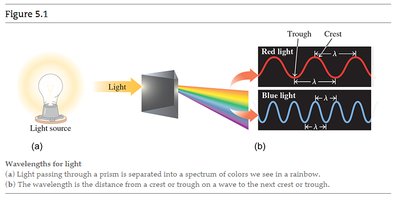
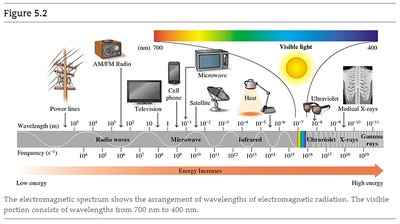
Electromagnetic radiation is a form of energy that travels through space as waves. It includes radio waves, microwaves, infrared, visible light, ultraviolet (UV), x-rays, and gamma rays. All electromagnetic radiation moves at the speed of light, which is m/s.
Wavelength (λ): The distance between two consecutive crests or troughs of a wave.
Frequency (ν): The number of wave crests passing a point per second.
Relationship: The speed of light is the product of wavelength and frequency:
Visible Light: Occupies wavelengths from 700 nm (red) to 400 nm (violet).
Energy: As frequency increases, wavelength decreases, and energy increases.
Atomic Spectra and Energy Levels
Photons and Atomic Spectra
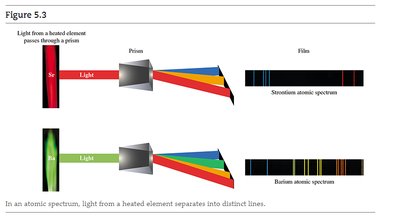
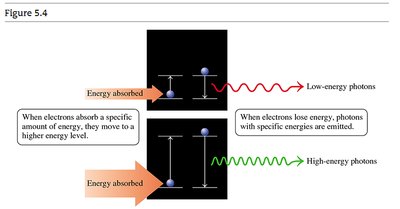
Light is emitted as photons, which are particles of electromagnetic radiation. When elements are excited, they emit light at specific wavelengths, producing atomic spectra unique to each element. These spectral lines correspond to changes in electron energy levels.
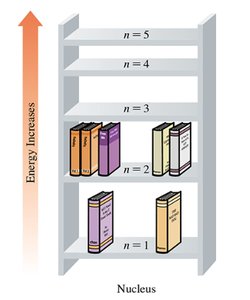
Energy Levels: Electrons occupy specific energy levels, denoted by the principal quantum number n (1–7).
Excited State: When an electron absorbs energy equal to the difference between energy levels, it moves to a higher energy level.
Relaxation: When the electron returns to a lower energy level, it emits a photon.
Sublevels and Orbitals
Structure of Energy Levels
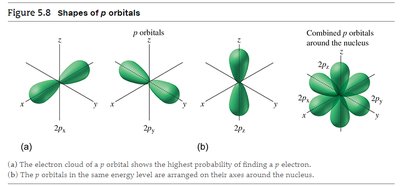
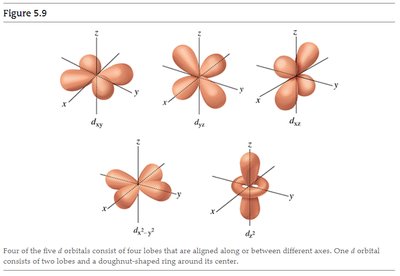
Each energy level contains sublevels designated as s, p, d, and f. These sublevels contain orbitals, which are regions where electrons are likely to be found. The maximum number of electrons in each energy level is determined by the formula .
Sublevels: s (1 orbital), p (3 orbitals), d (5 orbitals), f (7 orbitals).
Orbital Shapes: s is spherical, p is dumbbell-shaped, d and f have more complex shapes.
Electron Capacity: Each orbital holds 2 electrons with opposite spins.
Energy Level (n) | 2n2 | Maximum Number of Electrons |
|---|---|---|
1 | 2(1)2 | 2 |
2 | 2(2)2 | 8 |
3 | 2(3)2 | 18 |
4 | 2(4)2 | 32 |

Orbital Diagrams and Electron Configurations
Representing Electron Arrangements
Electron arrangements can be shown using orbital diagrams (boxes and arrows) or electron configurations (notation). Lower energy orbitals fill first, and electrons occupy separate orbitals of the same energy before pairing (Hund’s Rule).
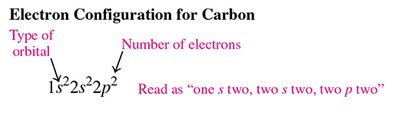
Electron Configuration: Indicates the distribution of electrons among orbitals, e.g., for carbon:
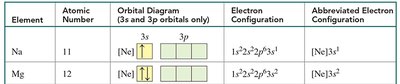
Abbreviated Configuration: Uses noble gas notation for elements beyond neon, e.g., for sodium.
Element | Atomic Number | Orbital Diagram (3s and 3p only) | Electron Configuration | Abbreviated Electron Configuration |
|---|---|---|---|---|
Na | 11 | [Ne] 3s1 | 1s22s22p63s1 | [Ne] 3s1 |
Mg | 12 | [Ne] 3s2 | 1s22s22p63s2 | [Ne] 3s2 |
Electron Configurations and the Periodic Table
Periodic Table Blocks and Filling Order
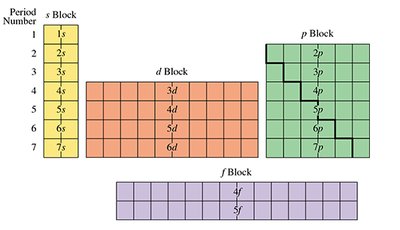
The periodic table is divided into s, p, d, and f blocks, which correspond to the filling of orbitals. The filling order is determined by orbital energies, with exceptions for certain elements (e.g., Cr, Cu, Mo, Ag).
Filling Order: 4s fills before 3d due to lower energy.
Exceptions: Some elements promote electrons to half-fill or fill d orbitals.
Trends in Periodic Properties
Valence Electrons, Atomic Size, Ionization Energy, and Metallic Character
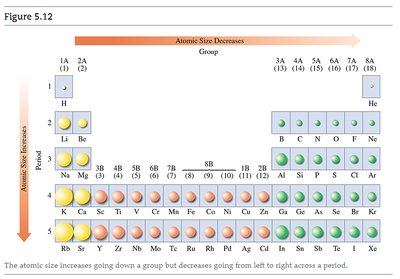
Periodic properties are determined by electron arrangements and energy levels. The group number indicates the number of valence electrons. Atomic size, ionization energy, and metallic character show predictable trends across periods and groups.
Atomic Size: Increases down a group (more shells), decreases across a period (greater nuclear charge).
Ionization Energy: Energy required to remove an electron; decreases down a group, increases across a period.
Metallic Character: Tendency to lose electrons; increases down a group, decreases across a period.
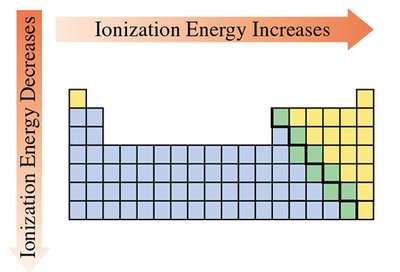
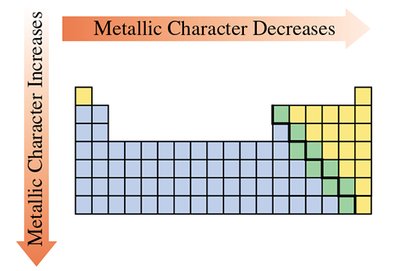
Summary Table: Periodic Trends
Property | Trend Down a Group | Trend Across a Period |
|---|---|---|
Atomic Size | Increases | Decreases |
Ionization Energy | Decreases | Increases |
Metallic Character | Increases | Decreases |
Additional info: The notes cover quantum mechanics, atomic structure, electron configurations, and periodic properties, which are central to General Chemistry topics.
